Guide Photos
Awesome sights on a daily basis!
Each day our guides see something new, it never gets old for these guys. Check out some of their photos from guiding bear and whale watching excursions.
Marine Mammals Airborne 2 of 3

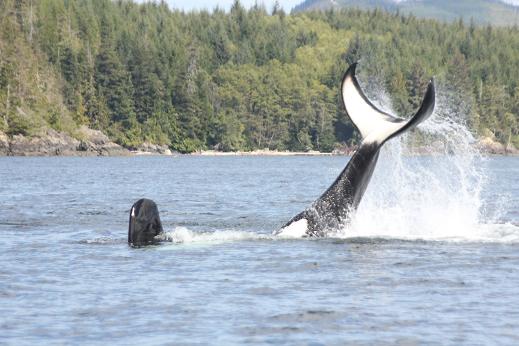
Many reasons have been suggested for breaching humpback whales.
They often breach when they are in groups, suggesting social reasons, such as an assertion of dominance, courting or warning of danger Other widely accepted reasons is to dislodge parasites from the skin or that the behaviour may simply be a form of play. Some believe that a breach allows the whale to breathe in air that is not close to the surface, which may aid breathing in rough seas. From my experience it is often the young whales that do repeated breaches which agree with the play theory and when we have rough water on a whale watching day we also seem to have more breaches. To be honest the reason is not that important the action is just spectacular.
Marine Mammals Airborne 1 of 3
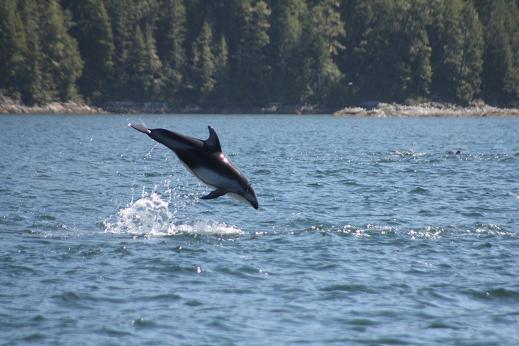
This is a Pacific White Sided Dolphin or “Lag” for short as it is a much easier name to use over a marine radio. These dolphins travel in groups between 20 to 100 but, on occasion, reach numbers of up to approximately 3,000. If you only see a couple, you might want to keep a look out, there are usually more not too far off. Lags travel quickly reaching speeds up to 25 knots (almost 30 mph or 47 kph). They are very acrobatic and their frequent airborne flips and leaps can reach extreme heights.
A Grizzly story in Six parts 6 of 6
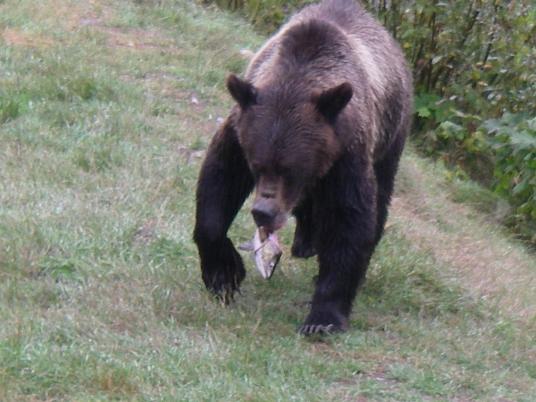
Soon the mother comes across the river and the young male retreats up the bank with its salmon. This is definitely a good move for our viewing as the bear in now about seven meters (yards) from our camera lens on the viewing platform. Moral of the story: “never mess with a mother grizzly with cubs” or “good photos are more often a result of luck than skill”.
A Grizzly story in Six parts 5 of 6
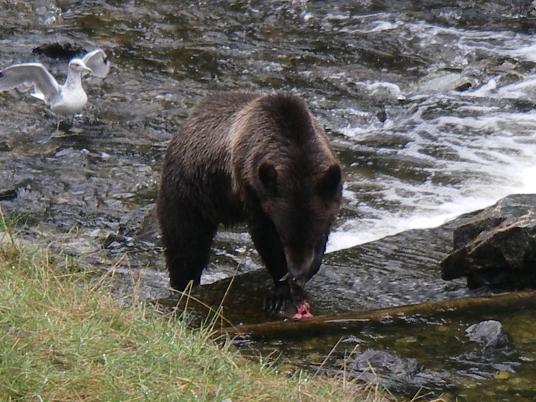
With this confidence the grizzly takes the salmon to one side of the river and starts to eat. This works for a few minutes…
A Grizzly story in Six parts 4 of 6

The second non-family member grizzly finally catches its first salmon and immediately looks toward the mother. This bear is a four or five year old male and seems pretty confident…
A Grizzly story in Six parts 3 of 6
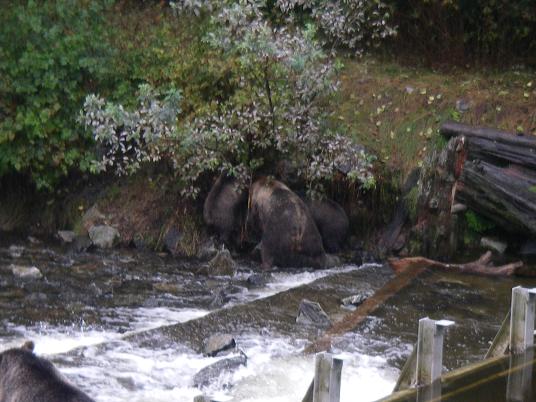
The larger bear did not put up a fight. The mother took the salmon and the cubs back to the nook or their dinner table. The story continues…
A Grizzly story in Six parts 2 of 6
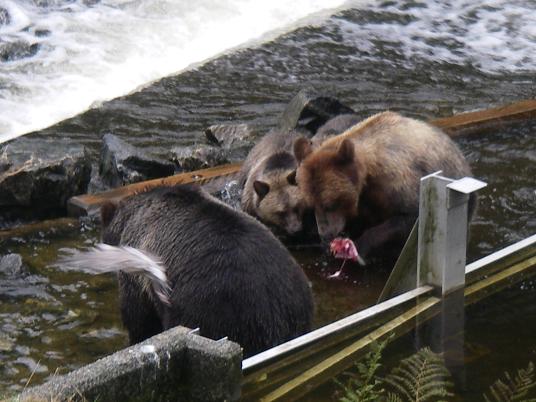
The mother prior to this picture had caught and shared two salmon with her cubs. The large female in this photo had caught her first fish when the mother came over and took it away…
A Grizzly story in Six parts 1 of 6
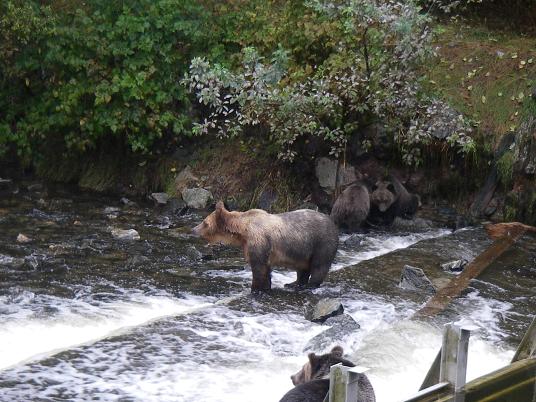
Our lodge, after August 24th, uses viewing platforms on Knight Inlet’s Glendale River. On this day in mid-September a mother with two cubs were “sharing” a prime fishing area with two other grizzly bears. The mother was an aggressive bear but the cubs tended to stay back in a nook in the bank unless a salmon had been caught…
Black Bear mother and cub
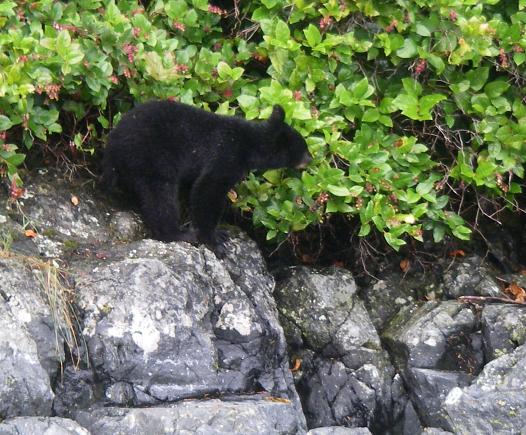
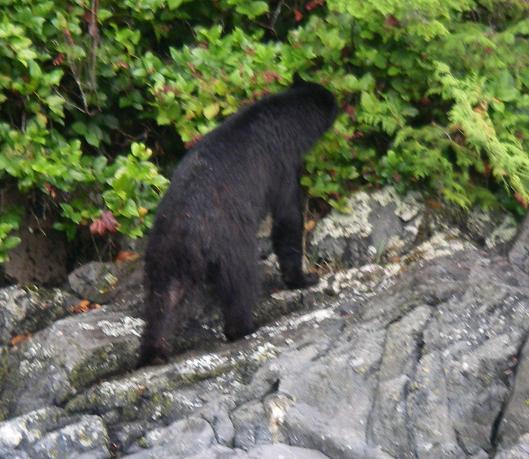
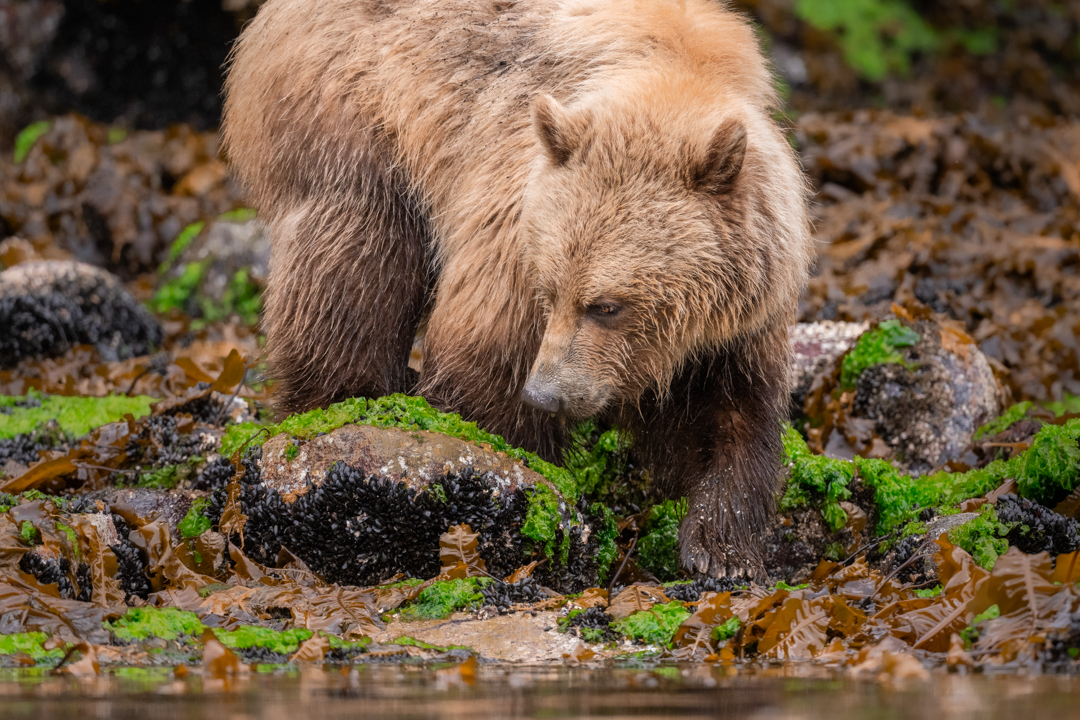
Although all species of bears, including black and grizzly bears, are technically of the order Carnivora, they are essentially omnivores that eat plants, insects, fish, and animals. On this day we watched this mother and cub for more than thirty minutes as they moved along the beach turning over rocks in search of food that is high in protein and is made up of crab, clams, barnacles, amphipods and other tiny invertebrates. These two also ate some seaweed and finished off their search in a patch of salal berries. It was a learning time for the cub as it followed mother and copied her every action.