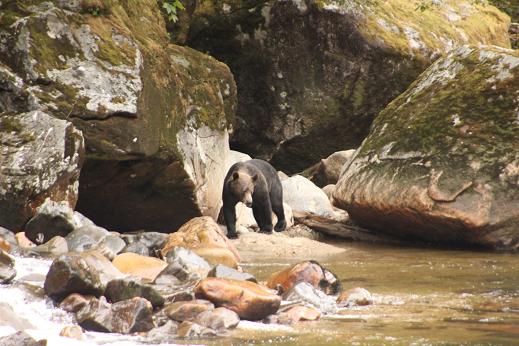
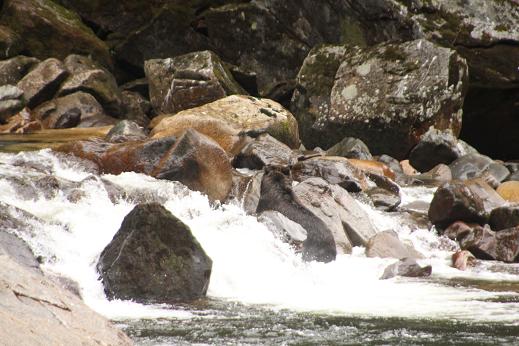
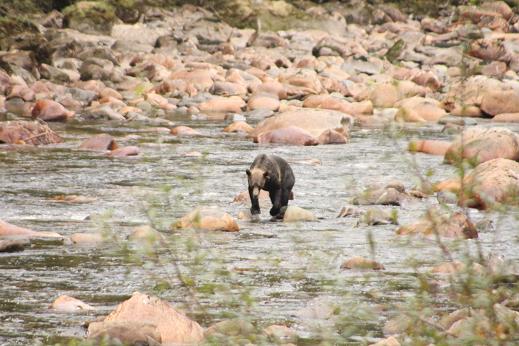
Yesterday’s, today’s and tomorrow’s post photos are taken with a Pentax Optio Wpi 6MP and 3X Optical Zoom which does not have a “good zoom” lens for wildlife photo’s so with most cameras you would have much better photos. It is the feeling you get when watching grizzlies that are across the river from where you are sitting that is the adrenaline rush. You are not in a boat or a viewing stand but sitting on a rock bank across a river from the grizzlies. Trapper Rick knows these bears and they respond to his voice but he is still carries a gun to ensure your safety. The grizzly bear in the water is fishing for salmon and does manage to catch one…
Tag Archives: Bears
Trapper Rick’s Grizzlies 1 of 3
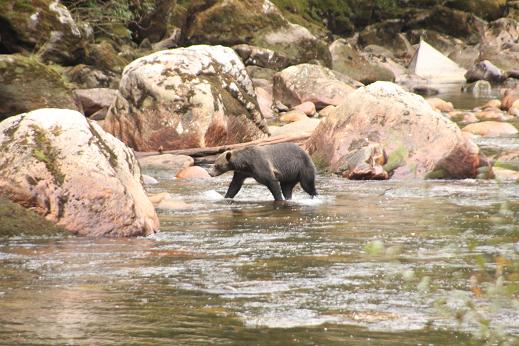
On the extra day in camp we take a forty-five minute boat ride cross Knight Inlet through Thompson Sound to the Kakweikan River and spend a day with Trapper Rick. This river is located on the BC mainland and once there we travel by road to Rick’s cabin. Below the cabin on the river is a waterfall and a fish ladder that help the salmon by-pass the falls. (For more photos of Trapper’s cabin and surrounding area go to “Categories” on the left and select “River Day”.) This grizzly bear is working its way up river to the falls and the salmon….
Grizzly bears drink in a tidal river
 On Grizzly Bear Lodge’s wildlife tours during the hot days of July and August we frequently see grizzly bears in the water. The water in Knight Inlet’s Glendale estuary is a mixture of salt and fresh water which the grizzly bears often drink when the tide is going out. On a rising tide the surface water contains more salt so less drinking. It is better to have the grizzlies wading and swimming and cooling off in the water than moving into the shade away from our viewing.
Grizzly bear claws

The grizzly bear claws are incredibly long, thick and powerful. The nails themselves can be 5 to 6 inches long. They use them to do more digging than any other bear species, digging dens, uprooting shrubs, shredding logs and stumps in search of insects and tubers, and turning over rocks on the beach. Also used to catch and hold salmon while they eat. This over head view is of a grizzly as it walks beneath the viewing stands on Knight Inlet’s Glendale River where we spend our viewing time after August 24th.
Spring Grizzly Bears Grazing
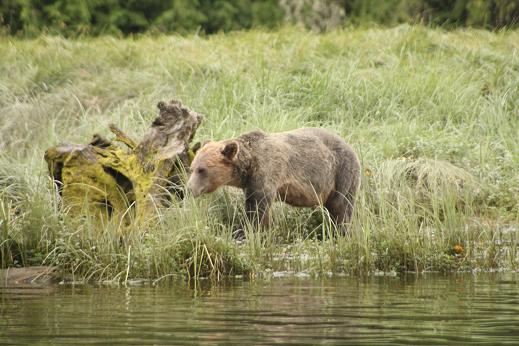
In the spring the grizzly bears we view on the lodges wilderness tours are primarily grazing or turning over rocks. They come down to the shores of Knight Inlet to eat the sedge grass, which is very high in protein. This sedge sustains them until the salmon enter the rivers of British Columbia’s coast in mid-August. The morning grizzly bear tour uses 18 to 20 foot boats to travel up Knight Inlet to the Glendale River where we transfer to smaller a boat that allow us to drift along the shore to watch and hear the bears eating. This flat bottom skiff also permits us to follow the grizzly bears up river as the tide rises.
Grizzly approaching with caution 3 of 3

Necessary because the grizzlies already fishing for salmon are a mother with two cubs (look closely at the top right corner of the photo) and another large female. This bear is a four or five year old male and they are always cautious around other grizzlies especially a mother with cubs.
Grizzly approaching with caution 2 of 3
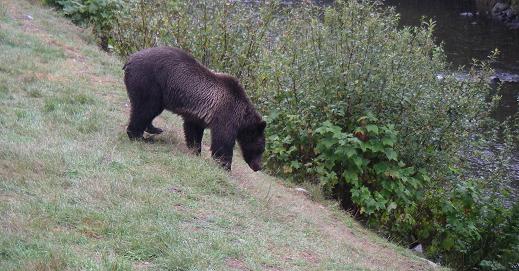
The grizzly slowly starts down the bank to the holding pool, keeping its eyes lowered so it does not appear aggressive. The approach is necessary….
Grizzly approaching with caution 1 of 3
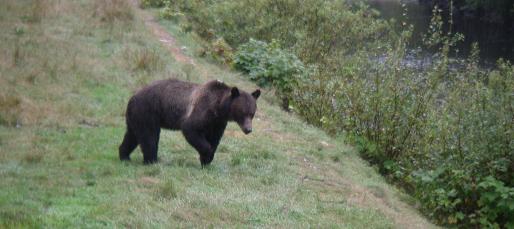
We are in the first viewing stand looking down the finger of land that links us to the second stand. This grizzly bear came up from the natural river and is crossing the track of road on its way to the pool holding the salmon waiting to enter the man made spawning channel. Its first glance is toward our position which is approximately 25 meters (yards) from the bear…
Grizzly Bear View
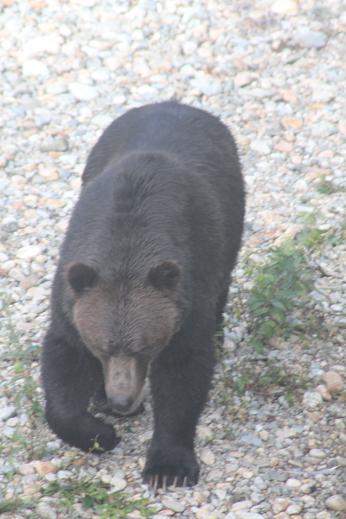
Watching grizzly bears from the viewing stands on the Glendale River is a little different that from a boat in the river estuary. This is especially true when the bear walks directly below the stand. This downward perspective truly shows the size and bulk of this grizzly. This is a “well fed” bear that is a long way to fatting for hibernation. The photo was taken on September 2nd and means the bear still has two months to add additional layers of fat.
Trapper Rick’s Boat Pool 3 of 3

Part of the reason for crossing the river was to join it’s sister on the far side. In the previous posting the sister was looking across the river at this scene and a freshly caught salmon is always an invitation. This process of grizzly bears moving up and crossing the river took about an hour but the guests did not feel that it was time wasted.