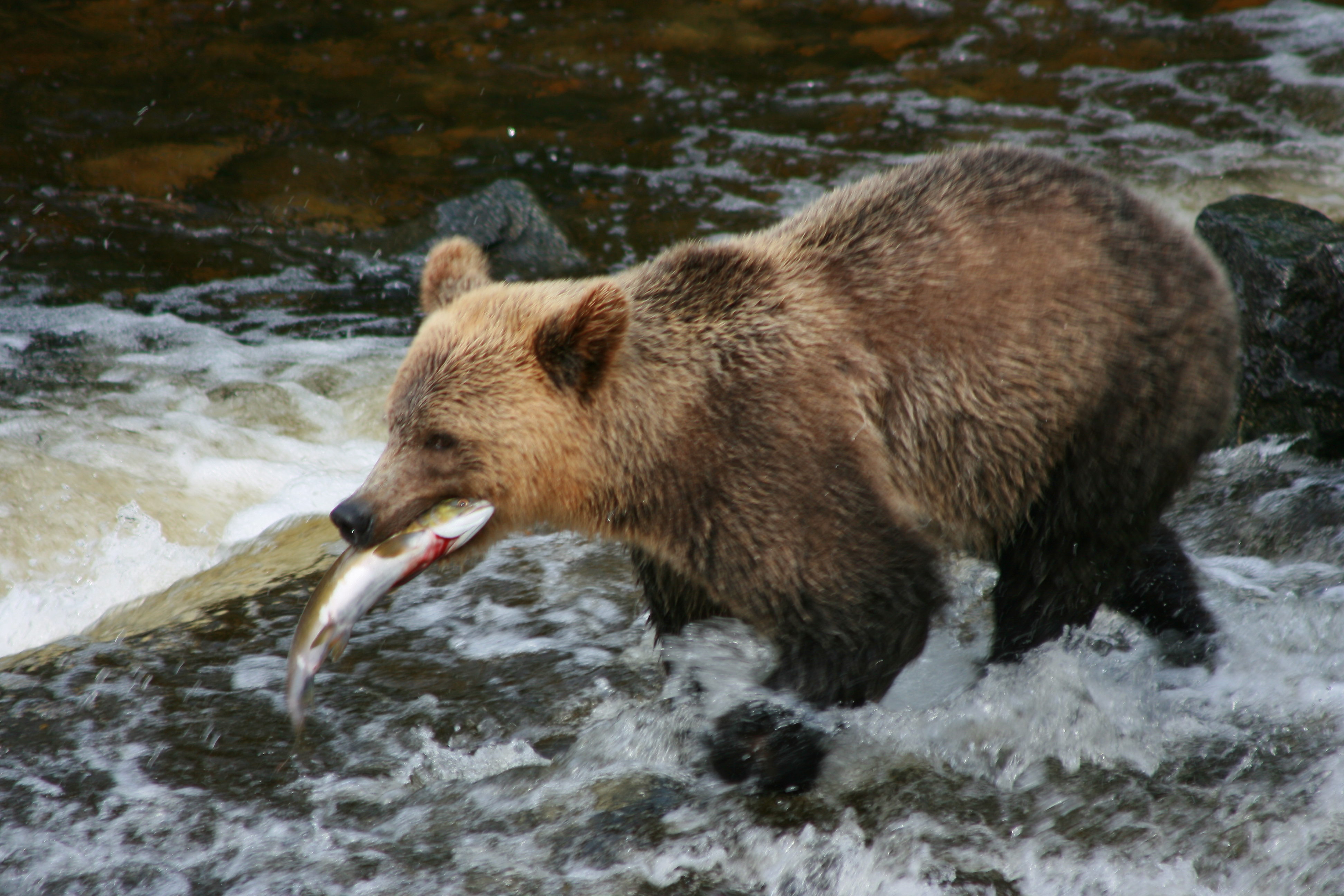
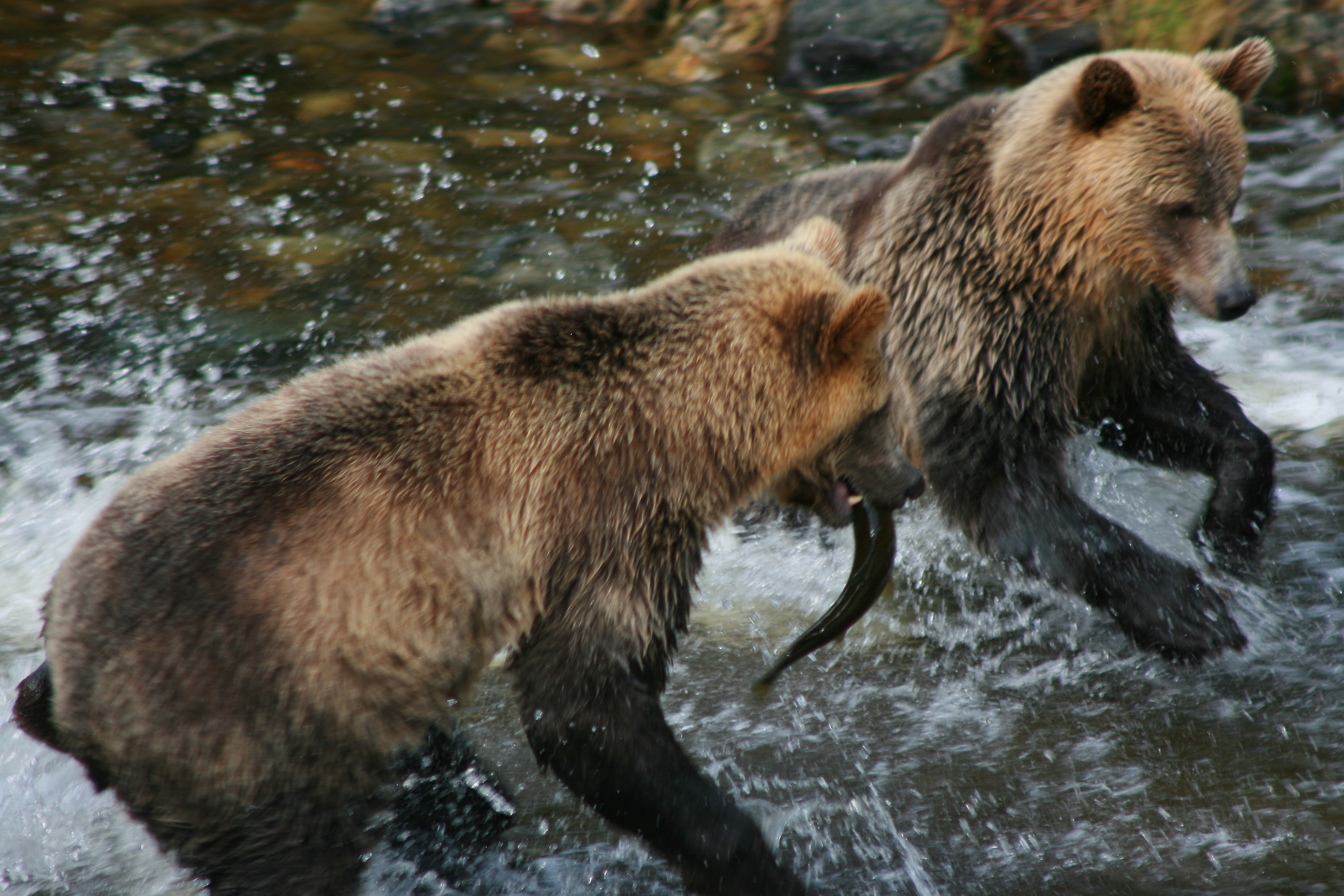
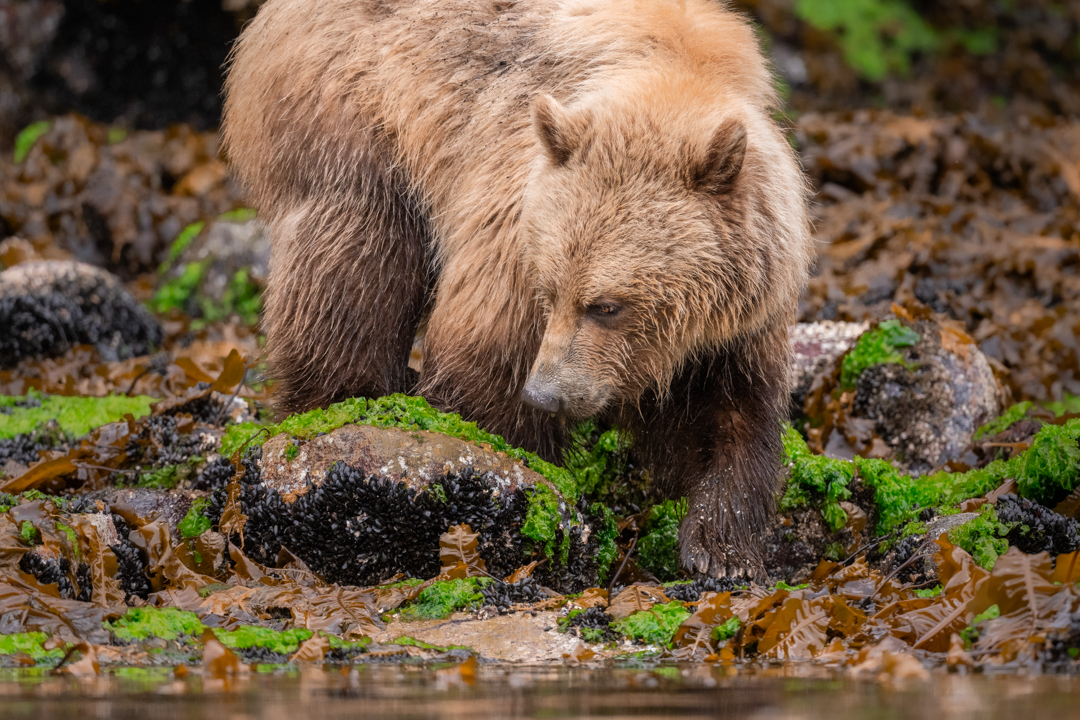
A day of grizzly bear viewing from our lodge requires a run up BC’s Knight Inlet to a salmon spawning river that attracks bears from the surrounding area. This grizzly seems to have its eye on us as it leaves the river and comes toward the viewing stand. Wildlife viewing, as you know is not a zoo but most of time the results are outstanding.
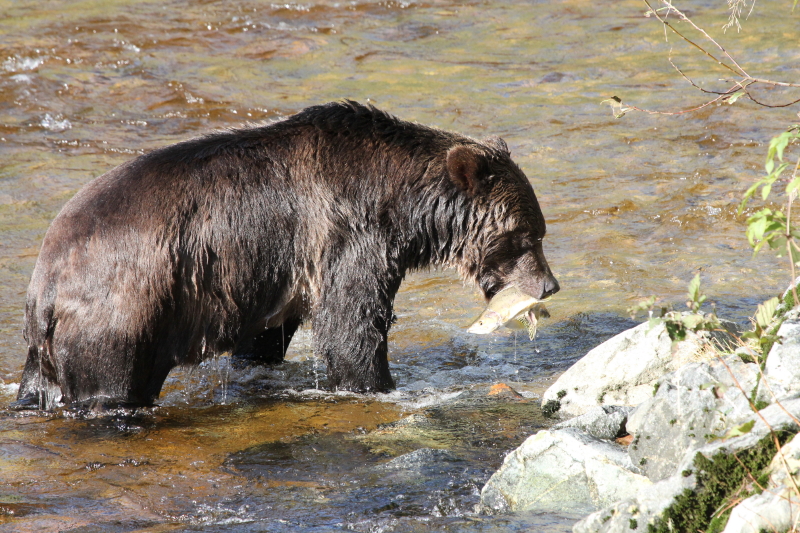
This could be a two for one photo provided by Janis (from UK). A great shot of a grizzly bear with a salmon and also in the background, if you look closely a salmon coming over the small falls. If you click on the picture it will enlarge to give you a better view. On the wildlife safari trips it is easier to get a picture of a grizzly bear feeding than a salmon over the falls.
On the lodges grizzly bear tours we often view bears quite close. The viewing stands are located on a narrow road next to Knight Inlet’s Glendale River and after the grizzlies have eaten enough salmon they often pass beneath or very close to the viewing stand. This is the reason we are in an enclosed cage and the bears are free to roam.
Not all grizzly bears look “majestic” when you first see them. After diving for salmon their first appearance they look rather sad. Some of the bear’s fish in shallow water while other take to looking around sunken logs to trap fish. Wildlife viewing is never predictable and every tour is unique.
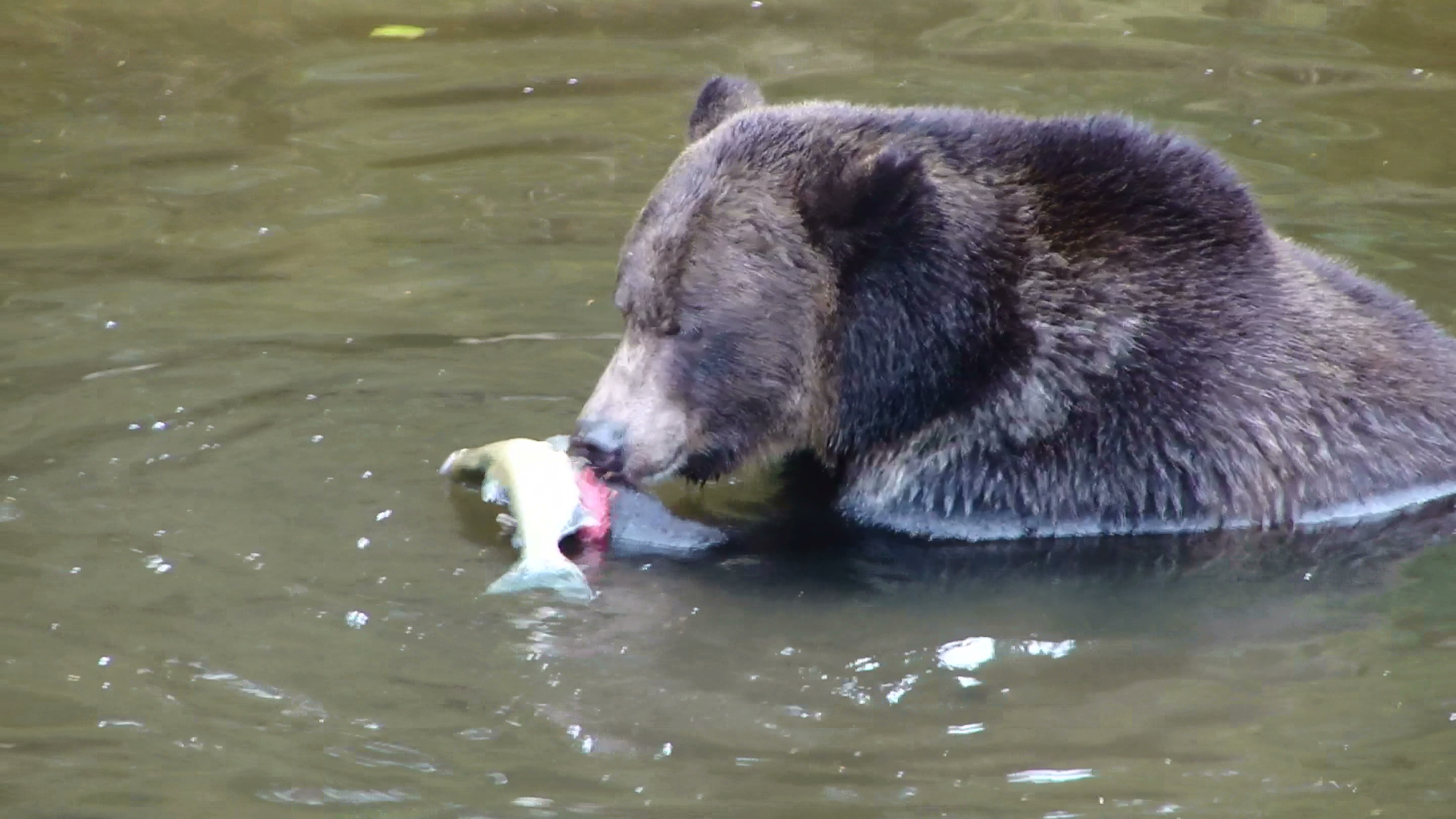
Luwen & Liwen from Singapore got a great picture of a grizzly bear on the Glendale River in Knight Inlet eating one of the favourite parts of a salmon it just caught: the eggs or roe. During the peak of the salmon run the bears have access to an abundance of salmon at that time they will eat only the parts highest in calories – the eggs, skin and brains. Salmon roe and skin are also high in fat; grizzlies will often discard the body of the fish, which is left for the eagles. Early is the salmon run the grizzly devour the whole fish to “bulk up” for the coming winter this is also true later in the season for those bears that have not achieved sufficient weight or fat to survive the winter.
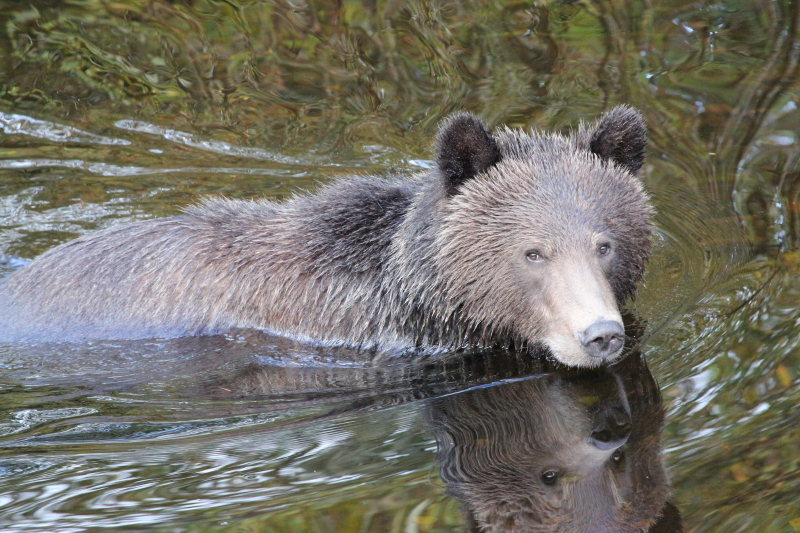
Just when you think the grizzly bears you are viewing do not really know that you are there you get one that looks you right in the eye when caught taking a photo. To put a human touch it would be “A little privacy if you don’t mind.” The bears on the lodge’s tour up Knight Inlet tend to ignore our intrusion into their life. In the spring and summer, while they are feeding on the beach they only acknowledge our presence if we get to close. In the fall in the viewing stands on the Glendale River sudden movement, load noises or a cameras flash left on will get their attention. For the most part the grizzly is aware but chooses to ignore. Guest James O’Donoghue from the UK provided this photo.
The area Grizzly Bear Lodge uses for viewing bears in the fall is on Knight Inlet’s Glendale River. The viewing stands are a fifteen minute van ride up the river and are located right on the river a few meters (yards) from the waters edge. Some parts of the viewing area are in shallow water where the bears are seen chasing the salmon and catching them on the surface. This takes quite a bit of energy and time as the fish are fast. Other bears prefer to conserve their energy and fish in the deep water, which requires bears to dive to pick up dead or wounded salmon that have drift down from up stream. When deep water fishing it is often easier to walk to shore to eat than constantly diving to retrieve the dropped meat. James O’Donoghue of the UK provided this photo.
No this is not a cub but rather an adult grizzly bear sitting in sedge grass. The grass in the estuary of Knight Inlet’s Glendale River is better than a meter (3 feet) high. In the spring bears come to this area to feed on the sedge grass is it up to 25% protein and as the berries in the coastal forests are not yet available this is the reason why grizzly bears are in the estuary. At lower tides when more of the beach is exposed the bears will spent more time turning over rocks in the inter-tidal zone looking for food high in protein such as crab, clams, barnacles, amphipods and other tiny invertebrates. Much a grizzly’s time in the spring is spent in search of food this changes in the fall once the salmon arrive and food is more abundant. Photo by guest Debbie Zygmunt.
As stated in yesterdays post; although the grizzly bear siblings may spend their first three or four years together it does not mean they will share their salmon catch. Sleeping and denning together is one thing but food is survival and that becomes an individual matter. It is common to see the sibling sub-adults traveling together in the spring in Knight Inlet’ Glendale River estuary and even on the river later in the fall when the pink salmon arrive in the river. They may have shared their mother’s food but not the food they catch.
Alone and vulnerable sibling grizzly bears of the Knight Inlet area often stay together until they are three or four years old often fishing, eating and sleeping side-by-side, and even denning together. The average breeding age for female grizzlies is 4.5 years. Males reach sexual maturity at roughly the same age as the females. Sub-adult females tend to establish home ranges within or overlapping their mother’s home range. Sub-adult males are usually discouraged from staying in the same area by the larger males and must travel large distances to establish a home range. And even though these sub-adult males are capable of breeding at three or four years of age, they rarely have the opportunity to do so because of these older, bigger males.
Just like that another season has come to an end. We are grateful for all the wonderful staff and the guests this season. It was an excellent season and we are already looking forward to next May.
One of the highlights of the season was all of the new cubs out. It was awesome to see so many new cubs of the year and that is great news for our bear populations moving forward. We had great spring viewing and this continued through summer. On our river trips we started to see salmon arriving in August and enjoyed some great shoulder season viewing. The fish at the viewing platforms were a little late showing up this year, but viewing during late September at the platforms was great and the estuary viewing remained strong throughout the season.
Out in the whale watching world it was another year that saw large numbers of resident Orca who remained in the area right into October. The Humpback viewing was also great with large numbers feeding in Blackfish Sound. It is so amazing to have these magnificent animals back in our waters in such numbers.
Over the winter and spring we will be doing some repairs and maintenance. We rebuilt the front deck last spring, utilising cedar cut on site. We will continue with some siding, rooms improvements and hopefully a floating sauna ready for the start of our season.
2026 is already looking like a very busy season for us. We only have limited high season availability so please book early to ensure we have space for your group.