All posts by Lodge Guide

Grizzly Bear Salad Break

Grizzly Bear Grazing


This photo was taken on the first day (August 25) in the viewing stands this summer (2014). This grizzly had been doing well catching salmon and feeding her cubs, that is “cubs” as she has triplets (see tomorrows post). But as many bears in the area she is taking a break and eating some grass along the riverbank. Not sure why a grizzly would give up the abundance of salmon for grass but would assume that a change is as good as a rest and the possibility that it might aid in digestion. This shows the fact that grizzlies will eat almost anything. They are omnivorous and will eat plants and other animals if available. What they eat depends on what kind of foods is available where they live and the particular season.


Male Resident Killer Whale

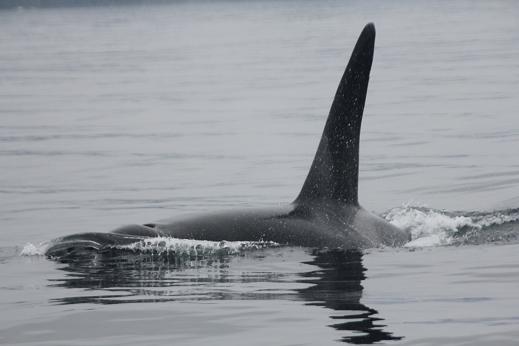
Male killer whale

Male because of the large dorsal fin as the species shows considerable size difference between males and females. Adult males develop larger pectoral flippers, dorsal fins, tail flukes, and girths than females. Resident because the dorsal fin is rounded at the tip and curved and tapering while the transient is shorter and sharper. The other key reason that this is a resident is that it is coming close to the boat while transients are less curious and will not approach a boat.


Sunrise Just Missed

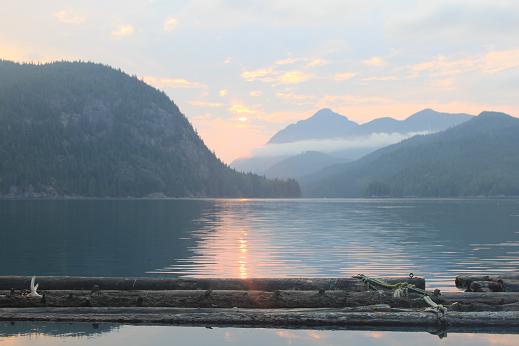
Lodge sunrise

The morning view across the bay in front of the Lodge. Guest are called between 6:30 and 7:00 for an 8:00 or 8:30 departure depending on the time of the season. A good breakfast is on the table and most important fresh coffee or tea. This photo shows the tail end of a beautiful sunrise over calm waters.


Too Many Salmon

Grizzly with salmon

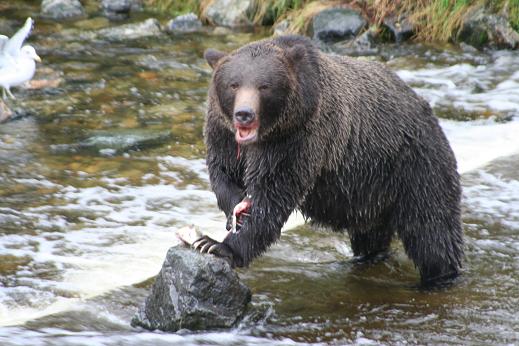
When a grizzly bear is more concerned about a small piece of salmon on its leg than the one slipping into the water it means it is not worried about catching another. The white shapes in the water around the bear are salmon. The past summer was very hot, the water level in the river low which caused low oxygen content in the water and a die off of several thousand salmon. For this reason the grizzlies knew they could easily catch salmon to eat. This lasted for several weeks until the rains came and fresh salmon moved up river.


River Grizzly Bear

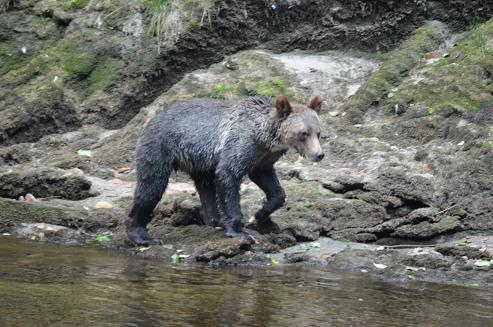
Shore walker grizzly

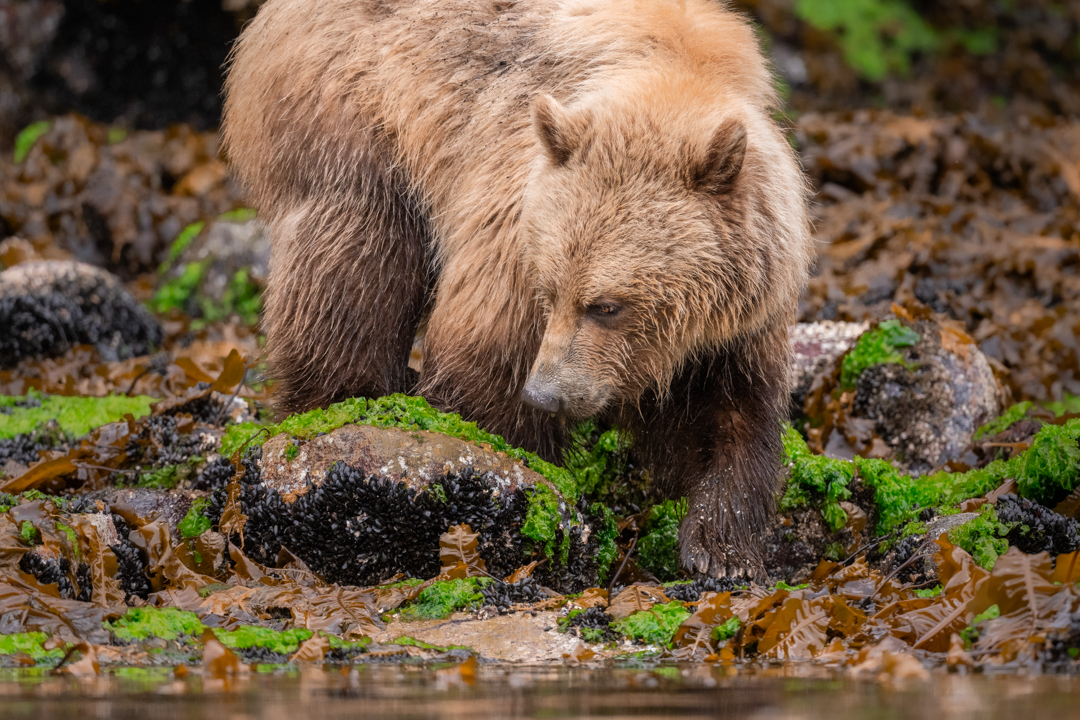
The first half of the grizzly bear watching season occurs along the shores of Knight Inlet, the Glendale River estuary and up the river. There are eight to ten bears that are in this area all the time then some come for a time then move on to another area. This bear we encountered while on the river was one of those around for a short time. It was very cautious and constantly glancing our way unlike the “resident” bears, which tend to ignore the boats and people. Normally the only thing that will really make a bear leave suddenly is another larger bear.


Steller Sea Lions 2 of 2

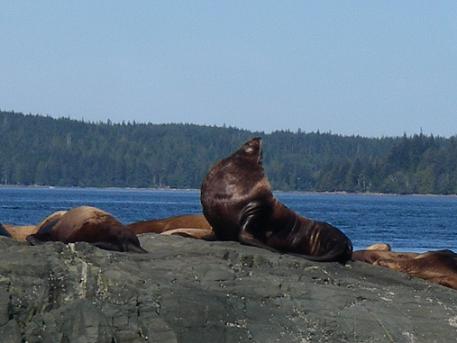
sealions

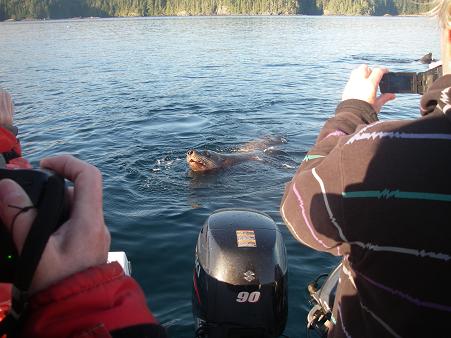
Steller sea lions are social and gather at various times throughout the year when mating and breeding are not taking place. They use traditional haul out sites (an area used for resting) and rookeries (an area used for breeding and rearing young) on remote and exposed islands. These sites can be rock shelves, ledges, boulders, and gravel or sand beaches. Even in crowds, the big bulls are unmistakable—they are three times larger than females.

Weight:   males: up to 2,500 pounds (1,120 kg)   females: up to 770 pounds (350 kg)   pups: about 35-50 pounds (16-22.5 kg)

Length:   males: about 10-11 feet (3-3.4 m)    females: about 7.5-9.5 feet (2.5-3.0 m)    pups: about 3.3 feet (1 m)


Stellar Sea Lions 1 of 2

Sea lions close

Steller sea lions range throughout the Pacific Rim (from northern California to Northern Honshu in Japan, and to the Bering Strait). About 70 percent of the Steller sea lion population reside in Alaska. They do not migrate like some pinnipeds, but they do move seasonally to different feeding and resting areas. Late May and early June as well as September and October seem to be the time of the year when there are more sea lions in our area. However over the past several years more have remained in the area all year.  In the water they do not seem that large but they are curious and often visit us as we watch them on shore (see tomorrows posting).


Pacific white-sided dolphins

Pacific whitesided dolphins

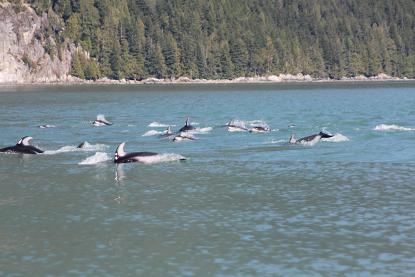
Pacific white-sided dolphins are frequently viewed on all our wildlife tours.  There are estimated to be 900,000 pacific white-sided dolphins in the North Pacific. Dolphins travel in groups throughout their lives. In B.C., Pacific white-sided dolphins are usually encountered in groups of 10 – 100 animals, although some groups have been seen with 2,000 or more individuals. Dolphin remains are present in First Nation’s middens (waste heap) dating back 2,000 years, but were rare in B.C. during the 19th and 20th centuries. They were first spotted by fishermen in 1956 north of Vancouver Island, and sightings became more common in the 1980’s as Pacific white-sided dolphins started to spend more time in inshore waters and inlets along the B.C. coast. It’s possible that their long absence was related to a change in ocean temperatures and a shift in their prey distribution.


One for the Road

Grizzly cubs with salmon

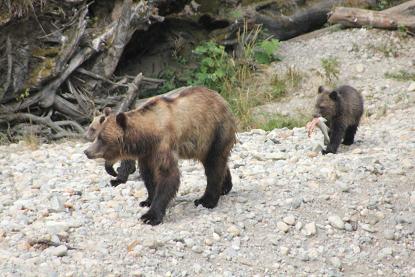
We had been watching this mother catch, eat and share salmon with her cubs for about forty-five minutes. As this mother decided it was time to move on the one cub did not want to but a few growls and it grabbed the salmon it did not want to leave and started to follow. As first year cubs they do not stray to far from their mother even for food.