Grizzly Watching

Grizzly Bears are magnificent and the biggest reason visitors choose our lodge!

Grizzly bears thrive here and the viewing opportunities are spectacular. We have operated our Grizzly Bear Lodge for decades and know the prime spots for bear watching. The ultimate grizzly bear photo opportunities.

Slow Grizzly Bear Cubs 1 of 2

grizzly bear cubs follow mother

These two first year grizzly cubs were taking their time as they walked the gravel bar next to the viewing stands we use on a Knight Inlet river. They had just crossed a small stream to get to the gravel bar and were not looking forward to what their mother had planned next…

Four Grizzly Bears?

grizzly bears share fishing

This is the case when grizzly bears respect each others comfort zone. The head in the lower right corner belongs to a very large female which is not a threat to the mother and cubs but they still have their own fishing areas. The single grizzly dominated the better fishing area near the entrance to the spawning channel while the mother and cubs caught all the salmon they needed a little lower on the river. The abundance of salmon in this area means there is little need to fight and therefore less chance of an injury that could reduce the ability to catch salmon. It is all about fattening for hibernation and fighting is counter productive.

Grizzly Bear Coat Colour

grizzly bear coat colour

“The coat of an individual bear may change colour during the year, with the new coat in summer a dark rich brown, while the worn coat becomes tawny or reddish brown. The winter fur is thicker and coarser than the summer fur and appears shaggy. During summer the old inner fur and guard hairs are shed; by autumn there is a fully developed coat, with guard hairs about 10 cm long, underfur about 8 cm long.” This explains the coat on this bear which appears to be in transition form a summer to winter coat. In our grizzly viewing area we have notice that the coats will darken after the grizzlies have been feeding on the oil rich salmon.

Bald Eagles Feeding

wildlife tour watching bald eagles

The herring ball mentioned in the May 14th is an ideal place for bald eagles to feed. The summer of 2015 on the BC coast was a summer with an abundance to eagles. This photo was one chosen from a group that had over thirty eagles feeding in one area. Two of the eagles without the white heads (means they were born this summer) are learning to pick herring out of the water. They follow one of their parents on a diving run and copy their technique hoping for success.

Grizzly Mother and Cubs Foraging in the River

grizzly bear and cubs fishing

It is after August 24th and we are watching grizzly bears from the viewing stands on Knight Inlet’s Glendale River. This mother with larger cubs than yesterday’s post is waiting for salmon to move into the shallow water. About 20 meters (yards) to this bear’s left is a school of several thousand salmon in a holding pool. The pool is two meters deep which makes it hard to catch the salmon so the grizzlies wait for them to move up the channel over the weir to the spawning area. The approach to the weir is shallow and a good place to fish.


Grizzly Mother and Cubs Foraging on the Beach

watching grizzly bears rolling rocks

This photo could be from this time of the year because Grizzly Bear Lodge starts their wildlife tours in mid-May however the cubs are a little large so I would make it mid-June. In the early spring the bears are on the beach to turnover rocks. This inter-tidal zone “food” is high in protein and is made up of crab, clams, barnacles, amphipods and other tiny invertebrates. The “beach food” is important because berries are relatively scarce during spring and bears will continue to loose weight until well into June.

Grizzly Bear Eating Seaweed?

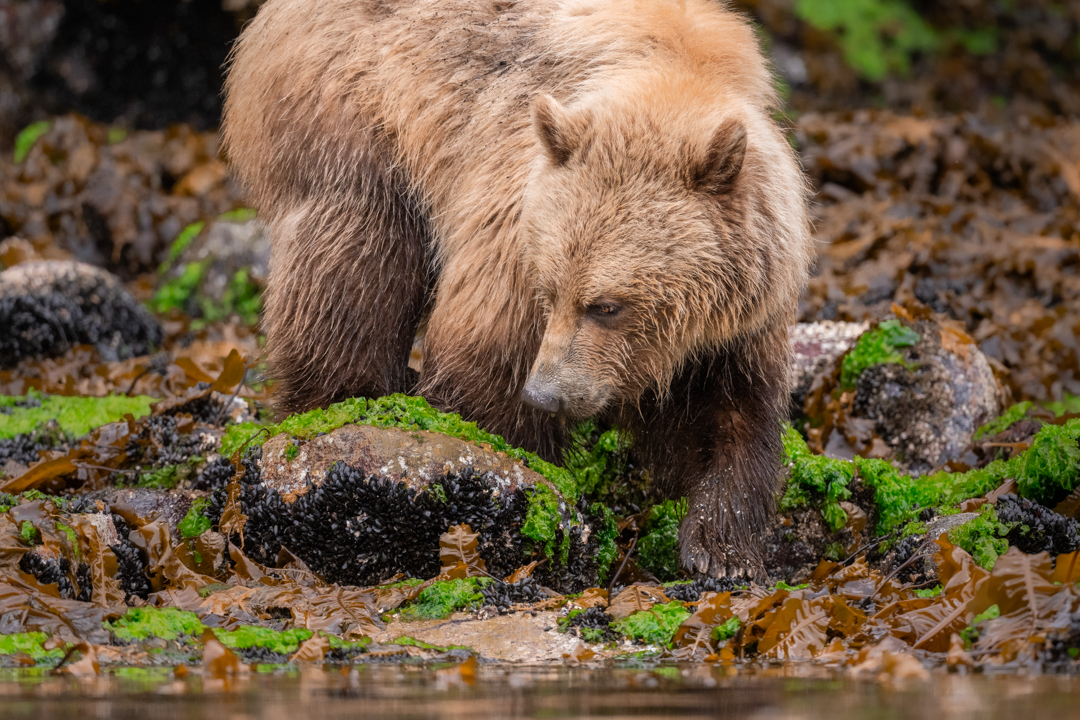
watching bears eating seaweed

This is more common than one would think. It is not a result of the lack of other food it is more because seaweed is full of vitamins and minerals –vitamins: A, C, E, K and B and minerals: iodine, selenium, calcium and iron. Not sure how many grizzly bears have a degree in advanced nutrition but over the centuries they seem to have learned what is good for their system.

Grizzly Bear Grazing

viewing grass eating grizzlies

In the spring grizzly bears come to the Glendale River estuary to feed on the sedge grass as it is up to 25% protein and the berries in the coastal forests are not yet available. At lower tides when more of the beach is exposed the bears will spent more time turning over rocks in the inter-tidal zone looking for food high in protein such as crab, clams, barnacles, amphipods and other tiny invertebrates. Much of a grizzly’s time in the spring is spent in search of food. This changes in the fall once the salmon arrive and food is more abundant. Spring grizzly bear watching is along the shore from the water while the fall viewing is from a stationary platform.

Fall Tour Grizzly Bear

Grizzly eating a salmon


The fall grizzly bear watching trips are from two viewing platforms located on a man made spawning channel adjacent to the Glendale River. If you go to to “Categories” and select “Wildlife Tour Itinerary” and follow the instructions you will have an excellent aerial view of the platforms. The platforms are about 3 meters (10 feet) off the ground, covered with room form eight to ten people but we limit tours to a maxim of five. The bears are fishing for salmon although they do stop to eat grass and berries.


Spring Tour Grizzly Bear


Grizzly Bear eating barnacles

Spring grizzly bear tours are from mid-May to August 24th. This is the date we are permitted to use the viewing platform on the Glendale River. The spring tours are along the shore of Knight Inlet, Glendale Cove and in the Glendale River. Along the Inlet the grizzlies scrap the barnacles and muscles from the rocks as shown in the photo. In the Cove they turn over rocks. This inter-tidal zone “food” is high in protein and is made up of crab, clams, barnacles, amphipods and other tiny invertebrates. The “beach food” is important because plant food is relatively scarce during spring and bears will continue to loose weight until well into June. In the river they graze on sedge grass, dig root, and enjoy the berry patches. There is allot of activity along the shore and the grizzlies are close and at eye level for good photos.