Whale Watching

We’re not all about the bears, whales are abundant here too!

Killer whales and humpback whales are often seen during our wildlife tours. There are resident whales and transient whales that can be seen feeding and playing in our waters.

Humpback Whales Feeding

Humpbacks Lunging

The humpback whales that migrate between Hawaii and Alaska have started to find that there is an abundance of food (herring) in the waters at the mouth of Knight Inlet. Our lodge in located on Knight Inlet 32 Kilometer (20 miles) from this area and it has become the center for humpback viewing. Five or six years ago a good day with humpbacks was four or five while now an average day is a dozen. With more whales comes more competition for the food so now it is common to have several whales lunge feeding on the same school of herring and this makes your guide happy because you are happy.


Good Timing Photo

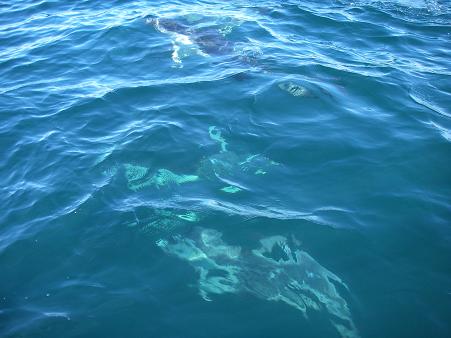
Dolphins Playing

Pacific whitesided dolphin love to play in the wake of the boat or to ride the bow wave. The most reliable way to obtain photos when you are traveling with a pod of several hundred is to point and click as many times as possible. Once you return to the lodge you can delete all the pictures of sky and water and you may have one or two keepers. The best way to enjoy the dolphins is to put down your camera and buy one of the photos that Glen, one of the guides, has for sale. This running with the dolphins can happen on any of the day trips whether to view grizzly bears, whales or a visit to the wild river on the extra day in camp.


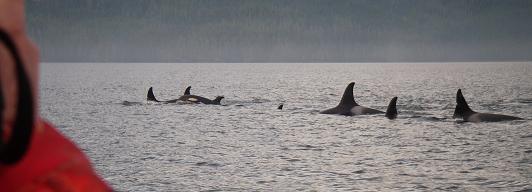
Killer Whales pod A30

Killer Whale Pod

If you have time to refer to the posting of June 16th this is again the resident killer whale pod A30 with A72 the last orca with a notch in her dorsal fin.  The guest in the corner of the photo provides a little perspective for the closeness of the orca. On the lodges whale watching safaris we are on the water 7 to 8 hours which allows us time to position ourselves for a number of good pictures of the wildlife we view. The whale watching tours view marine wildlife such as killer whales, humpback whales, dolphins, porpoise, harbour seals, Steller sealions, occasionally minke whales, a wide variety of waterfowl, bald eagles, and frequently black bear as we travel to and from the lodge.


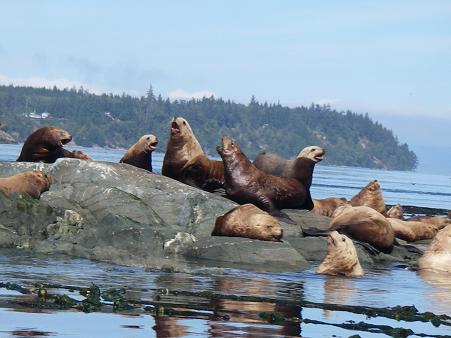
Sealions at rest?

Sealions at haulout

It seems that Steller sealions get little rest. They may be at one of their haul-out areas but seldom is all quite. As they come and go from the water they climb over each other and just as they get settled again another one moves to start the roaring all over. On occasion we may eat lunch in the area of the sealions but only if we are up wind. The noise is bad enough but the smell is worse.


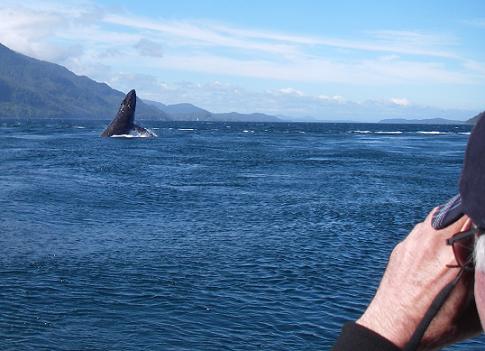
Amazing Humpback Whale

Humpback Whales Breaching


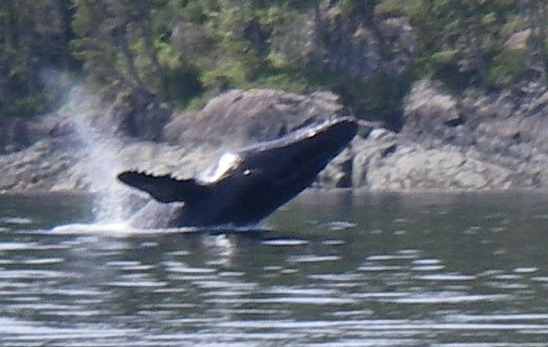
The amazing aspect of this breaching was the location and number of  breaches. We were on a whale watching safari at Cracroft point with a pod of resident killer whales that were feeding on the salmon feeding on the herring in the fast water of the tide ripe. The humpback was in the same area feeding on the herring when it started to do this lunging and coming down with a load slap. This occurred in an arc on the outside of the killer whales. The arc was over 200 meters (yards) long and the lunging was repeated eleven times in a row. It did not seem to bother the orca so it happened a second time but only eight lunges. The orca kept feeding and the humpback returned to it’s herring and the guest got a great show and pictures.


Pacific Whitesided Dolphns

Whitesides Dolphins


The June 8th posting showed our boats with a pod of pacific whitesided dolphins playing in the bow wake and the prop-wash. If you stop the boat the dolphins often stop with you and come along side the boat and that is what this picture shows. Two dolphins less than one meter (yard) from the boat.


Northern resident A72

Orca A72

If you Google “orca A72” and go into  “A30 matriline – Wikipedia, the free encyclopedia” you will learn about all about Bend (born 1999). Bend is a young female and has a distinctive cut at the middle of her dorsal fin, the cause of which is not known. Above photo.

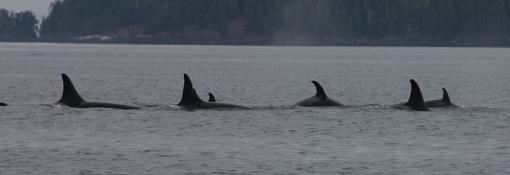
The orca pod often viewed on our tours is the A30.  A30 matrilineal is the name given to the most commonly seen orca matriline in British Columbia. The matriline was present in over 60% of all of the encounters in the Johnstone Strait region, making it one of best known matrilines. The group’s size has increased, from 6 in the mid-1970s to 10 as of 2013, including 4 calves. It is most frequently seen in Johnstone Strait from late spring to early fall, often traveling with other pods of the Northern Resident Community. The second photo shows this pod minus the three adult males which were in the area but not traveling with the family. Note A72 is the fifth one in the photo.
Orca Pod


Humpback Whales Breaching

Humpback breaching

Many reasons have been suggested for breaching. Whales are more likely to breach when they are in groups, suggesting social reasons, such as an assertion of dominance, courting or warning of danger. It is also possible that the loud “smack” upon re-entering is useful for stunning or scaring prey. Others suggest that a breach allow the whale to breathe in air that is not close to the surface, which may aid breathing in rough seas. Another widely accepted possible reason is to dislodge parasites from the skin. But to tell truth I do not think the guests I have in the boat care about the reason they are just happy to see breaching whales.


Almost three heads whale watching

Humpback lunge feeding

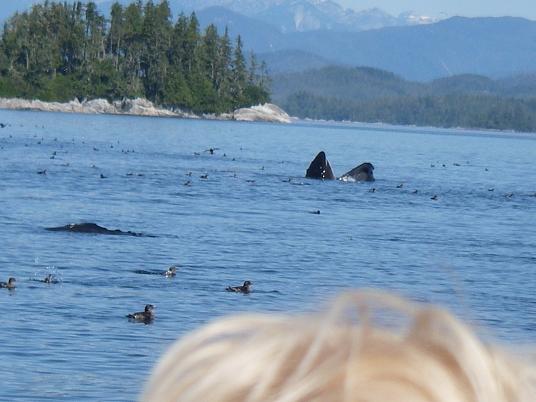
Whale watching over the past five years has become more interesting as the number of humpback whales in our viewing area has increased from four or five to twelve on a normal day. On this day the first head of blonde hair is to give you perspective for the closeness of the humpback whales lunge feeding through a balls of herring. One whale has not completed its lunge out of the water and the other to the left side of the picture is just starting to poke its head out of the water. If I had waited about ten seconds it would have been a great photo but that is the reason we normally spend several hours with the humpbacks so you can get the “good” photo. My excuse is it is hard to run the boat and take good pictures.


Killer Whale Breathing

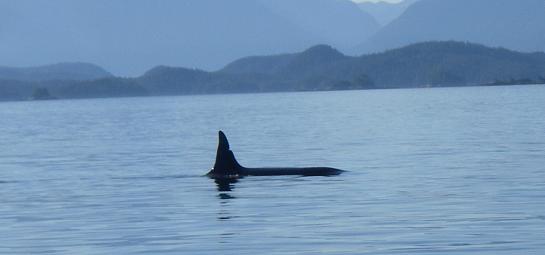
Killer Whale Surfacing


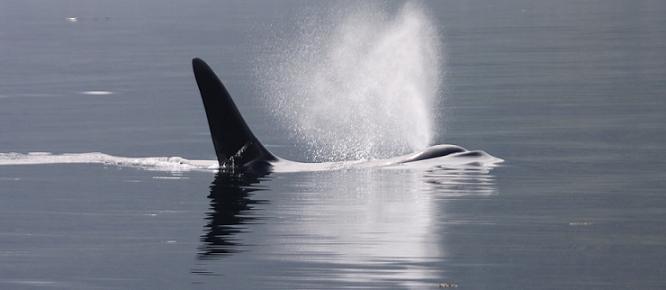
An interesting sequence of photos taken on a whale watching day in the Johnstone Strait. This area is a fifty-minute boat ride from Grizzly Bear Lodge, a time spent looking for black bear, bald eagles, dolphins and enjoying the morning scenery. The photo above shows an orca just breaking water and starting to exhale as shown by the bubbling water marking the start of the blow. The photo below the final exhale and then breathing in before it disappears.

Killer whale breathing