Whale Watching

We’re not all about the bears, whales are abundant here too!

Killer whales and humpback whales are often seen during our wildlife tours. There are resident whales and transient whales that can be seen feeding and playing in our waters.

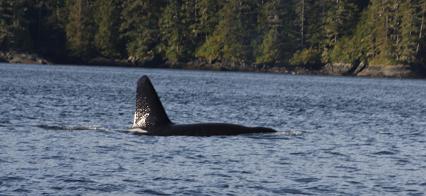
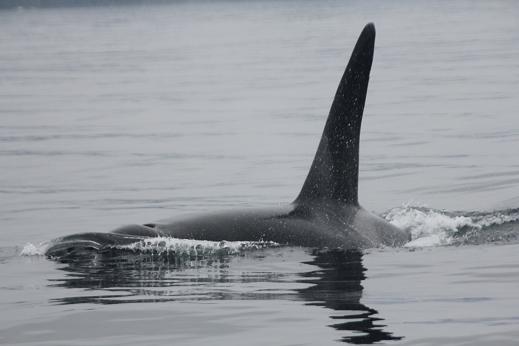
Male Resident Killer Whale

Male killer whale

Male because of the large dorsal fin as the species shows considerable size difference between males and females. Adult males develop larger pectoral flippers, dorsal fins, tail flukes, and girths than females. Resident because the dorsal fin is rounded at the tip and curved and tapering while the transient is shorter and sharper. The other key reason that this is a resident is that it is coming close to the boat while transients are less curious and will not approach a boat.


Steller Sea Lions 2 of 2

sealions

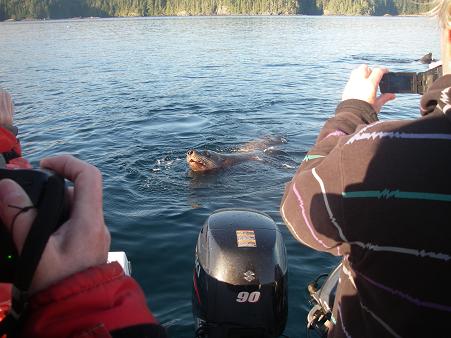
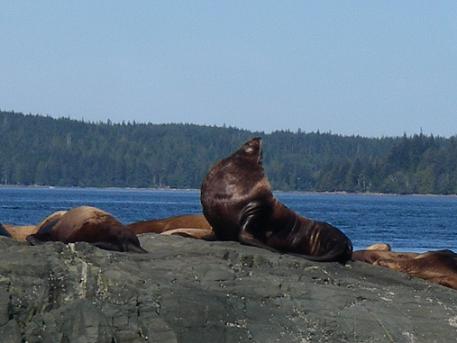
Steller sea lions are social and gather at various times throughout the year when mating and breeding are not taking place. They use traditional haul out sites (an area used for resting) and rookeries (an area used for breeding and rearing young) on remote and exposed islands. These sites can be rock shelves, ledges, boulders, and gravel or sand beaches. Even in crowds, the big bulls are unmistakable—they are three times larger than females.

Weight:   males: up to 2,500 pounds (1,120 kg)   females: up to 770 pounds (350 kg)   pups: about 35-50 pounds (16-22.5 kg)

Length:   males: about 10-11 feet (3-3.4 m)    females: about 7.5-9.5 feet (2.5-3.0 m)    pups: about 3.3 feet (1 m)


Stellar Sea Lions 1 of 2

Sea lions close

Steller sea lions range throughout the Pacific Rim (from northern California to Northern Honshu in Japan, and to the Bering Strait). About 70 percent of the Steller sea lion population reside in Alaska. They do not migrate like some pinnipeds, but they do move seasonally to different feeding and resting areas. Late May and early June as well as September and October seem to be the time of the year when there are more sea lions in our area. However over the past several years more have remained in the area all year.  In the water they do not seem that large but they are curious and often visit us as we watch them on shore (see tomorrows posting).


Pacific white-sided dolphins

Pacific whitesided dolphins

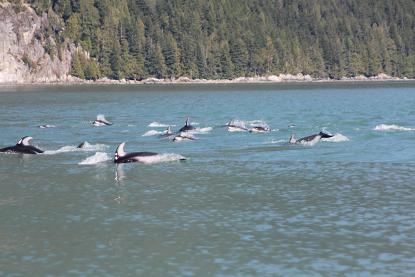
Pacific white-sided dolphins are frequently viewed on all our wildlife tours.  There are estimated to be 900,000 pacific white-sided dolphins in the North Pacific. Dolphins travel in groups throughout their lives. In B.C., Pacific white-sided dolphins are usually encountered in groups of 10 – 100 animals, although some groups have been seen with 2,000 or more individuals. Dolphin remains are present in First Nation’s middens (waste heap) dating back 2,000 years, but were rare in B.C. during the 19th and 20th centuries. They were first spotted by fishermen in 1956 north of Vancouver Island, and sightings became more common in the 1980’s as Pacific white-sided dolphins started to spend more time in inshore waters and inlets along the B.C. coast. It’s possible that their long absence was related to a change in ocean temperatures and a shift in their prey distribution.


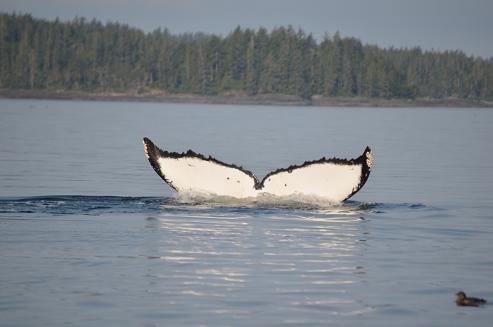
Humpback Whale Fluking

Humpback Whale Tail


Humpback Whale Tail 2

Humpback Whale Tail 2

Humpback Whale Tail 4

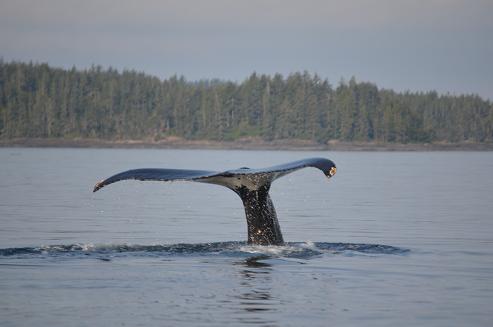
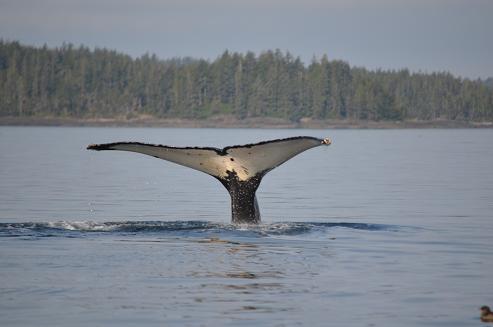
Not much to say except that Angus (guide and owner) got a great sequence of photos. Even thought there are many whales in our viewing area it is still hard to be in the right place at the right time and get a good photo especially when you are the one operating the boat and that is a full time job.


Killer Whales Dorsal Fin – Collapsed

Killer whale

A wild orca often travels far, and quickly, in deep water. The water provides pressure to the fin, keeping the tissues inside healthy and straight, and encouraging the dorsal fin to remain straight. However, it is not impossible for a wild orca’s dorsal fin to collapse or become bent. A study in 1998 of killer whales in New Zealand showed a relatively high rate (23%) of collapsing, collapsed, or even bent or wavy dorsal fins, and noted that this was higher than that observed in populations in British Columbia or Norway. It has been found from a well-studied group of wild killer whales (the ones in our viewing area) off the coast of British Columbia that the total rate of dorsal fin collapse is around 1%.  This is only the second collapsed fin I have seen in ten years.  Researchers have theorized that dorsal fin collapse in wild whales may be due to age, stress or altercations with other killer whales.


Killer Whale Dorsal Fin

orca reflection

A male killer whale’s dorsal fin can grow to as much as 6 feet tall. Despite the fact that the dorsal fin is very straight, it is not supported by bone, but a fibrous connective tissue called collagen. This male is a member of the “A” Clan. The northern resident population numbers approximately 250 whales made up of three clans – A, G, R Clan. Resident (fish eaters) killer whale pods are MATRIARCHAL, meaning that sons and daughters stay with their mother throughout their lives, even after they have offspring of their own. The bonds between siblings usually remain strong even after the mother has died. A matriarch and all of her descendents are referred to as a MATRILINE. A POD is a larger unit that is made up of one or more matrilines that travel together at least half the time and that probably stem from a deceased matriarch. A CLAN is a group of pods that share similar calls or dialects.


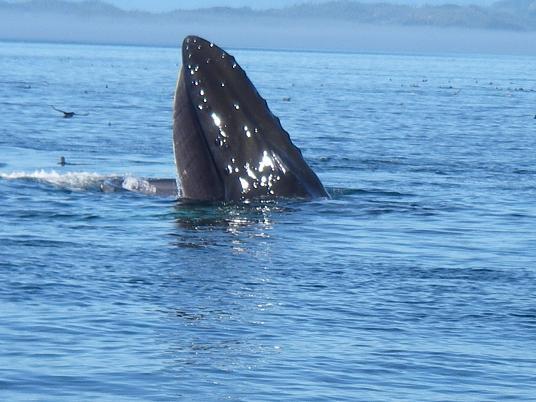
Humpback Whales Lunge Feed

Humpback whale

This is one of the reasons for our day of whale watching from Grizzly Bear Lodge. The numbers of humpback whales that are in our viewing area has increased dramatically over the past five years from four or five a trip to twelve to sixteen. The whales are frequently seen lunge feeding, tail-lobbing and breaching. The picnic lunch break while whale watching is normally the best time for photos because we stop the boat in an area of active whales and drift. The only problem guest have is to decide to eat or take pictures and on most days the realize that it is best to eat because the whales will be there when they finish.


People Watching Tour

Black Bear

This past summer black bears were hard to find along the shore as the berries seemed to last longer than normal so the bears stayed in the bushes. However we still managed some good photos and in this case I am not sure who was more interested the guests or the bear. The first evening in the lodge we do a black bear tour so you get to know your guide, the operation of the boat and work up an appetite for diner. See tomorrow’s post.


Bald Eagle Watching Us

Bald eagle

One of the hardest parts of a good photo of a bald eagle is not finding the eagle but getting a clear photo. Although this photo is interesting it would be better without the branch in the way. This required that I back the boat away from the eagle in hopes that it would not move than travel along the shore and drift back so the branch is behind the eagle. There are enough eagles in the area that if guests want a good picture they will get one.