Tag Archives: Dolphins

Dolphins Playing

watching dolphin pod

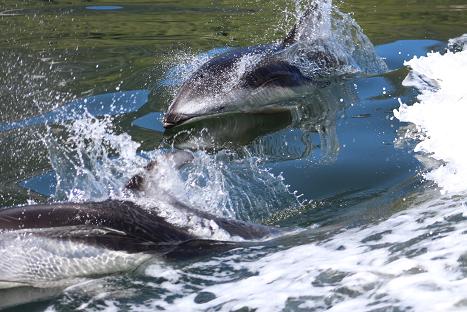
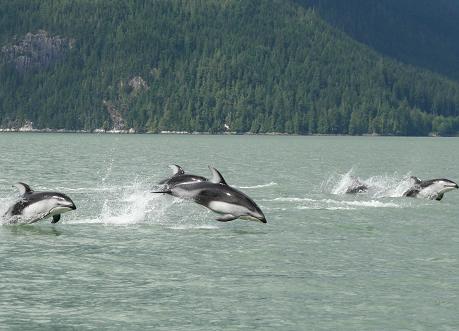
Whenever we are fortunate enough to come upon a large pod of pacific white sided dolphins I am not sure who has the most fun, my guests or the dolphins. The dolphins leap out of the water doing flips, ride the bow wave, follow along side the boat and nose up within a meter of the boat’s prop. While doing all this the guest get great shots of water, air and even some that contain dolphins. More than once I have had guest say that the dolphins make the day.

Dall’s Porpoise are Playfull

dall's porpoise

These small chunky cetaceans have black and white markings that give them the appearance of a mini Killer Whale / Orca. There have been reports by people mistaking Dall’s porpoises for baby Orca, but the lack of white eye patches and a much smaller dorsal fin is definitely a Dall’s.

dall's porpoise

Dall’s Porpoise travel in small groups of two to eight animals rarely in larger groups of around twenty-five. They zip about quickly in random back and forth patterns looking for food. As they speed through the water, they throw a rooster tail type of splash. This is quite distinctive as they shoot along just below the surface of the ocean. They are known to travel at around 30 knots (56 kph or 35 mph). With all this speed it can be a challenge getting good photos. For this reason we often stop and they will make passes by the boat and sometimes we get lucky. They are very playful and are at times known to harass humpback whales see tomorrows post…..


Time to Investigate

dolphins coming

These two photos show some thing that is pretty obvious but if you are much further away it is hard to tell what is making the white water. Pacific white sided dolphins may travel in pods of twenty-five to over one thousand. In either case they seem to like playing with a moving boat. After guest spend time with the dolphins it is hard to make their day get any better but we keep trying.

dolphins playing


Dall’s Porpoise – Phocoenoides dalli

dall’s porpoise wildlife tour

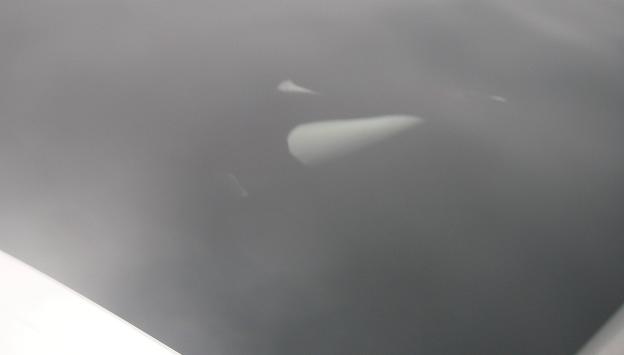
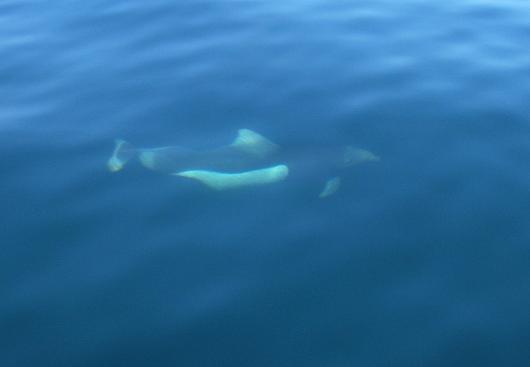
Dall’s porpoises are speed demons reaching speeds up to 55 km/hr. They suddenly appear out of nowhere and disappear the same way. Although they ride in both bow and stern wakes of boats, they seldom stay for very long. Next to impossible to get a photo if you are moving but frequently if the boat stops suddenly while they are playing they will come to investigate and it is possible to get “under water” photos. The white in the corner of the photo is the edge of our boat.

Pacific White-sided Dolphins Playing

Visiting dolphins out tour boatPeder and Ann again capture the activity on one of their days from their visit in July, 2015. For me as a guide and I know from the guest comments this is one of the highlights of a day on the water – a group of Pacific White-sided Dolphins. Such a clear and sharp photo emphasizes the speed of these dolphins as they keep pace with our boat. The Marine Mammal Watching Guidelines say we are to stay one hundred meters from the dolphins but unfortunately or fortunately depending on your point of view the dolphins cannot read.

Marine Mammals Airborne 1 of 3

Lags

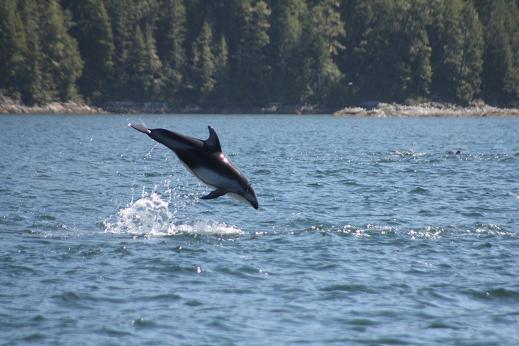
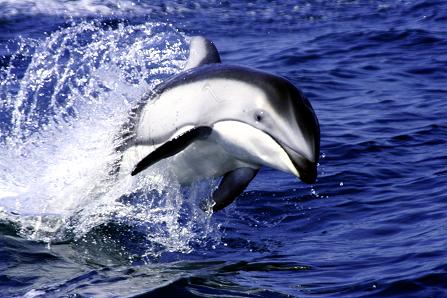
This is a Pacific White Sided Dolphin or “Lag” for short as it is a much easier name to use over a marine radio. These dolphins travel in groups between 20 to 100 but, on occasion, reach numbers of up to approximately 3,000. If you only see a couple, you might want to keep a look out, there are usually more not too far off.  Lags travel quickly reaching speeds up to 25 knots (almost 30 mph or 47 kph). They are very acrobatic and their frequent airborne flips and leaps can reach extreme heights.


Dall’s Porpoise

Dall's PorpoiseDall's Porpoise

Dall’s porpoise are the fastest cetacean in BC, at speeds up to 55 km/hr and like dolphins they will often play around the boat. The white in the corner of the photo is the edge of our boat. Dall’s are found only in the North Pacific Ocean and adjacent seas (Bering Sea, Okhotsk Sea and Sea of Japan). They range from coastal waters to deep offshore waters.  Details of migrations are poorly known, however, Dall’s porpoise are year-round resident though-out much of their range, generally moving north for the summer and south for the winter. Dall’s porpoise feed mainly on small schooling fishes (herring, anchovies, mackerels and sauries) and cephalopods (octopuses, squid, and cuttlefish).


Dolphins playing on tour

s White Sides 2

Pacific white-sided dolphins have a “good” habit of enjoying playing with a boat.  Slowing a boat to 7 or 8 mph seems to provide a reason for this change in behaviour. The dolphins will pace the boat, nose into the prop wash of the motor and even ride the bow wave.  They will often play for fifteen or twenty minutes then abruptly stop and go their way, This is the signal they have had enough and it is time to hunt for food.


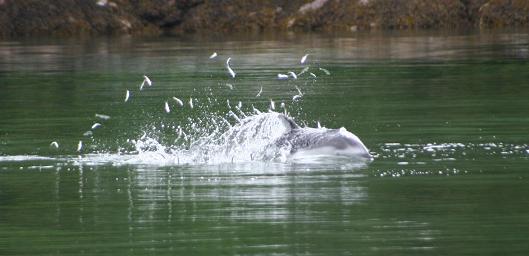
Dolphin Feeding

Dolphins feeding

Compare this photo to the one in the September 12th posting to see they are the same type of dolphins – Pacific Whitesided Dolphins. In the 12th posting they are playing beside the boat but today they are working / feeding. The dolphins often work in pods to corral the herring and then take turns feeding but on this day it was a solo act.


Porpoising 1 of 2

Pacific White Sides Dolphins

Two definitions for the same activity take your pick I know the one I like. In this case a pacific whitsided dolphin is porpoising.

From Oxford Journals “Porpoising is the popular name for the high-speed surface piercing motion of dolphins and other species, in which long, ballistic jumps are alternated with sections of swimming close to the surface. The first analysis of this behavior (Au and Weihs, 1980) showed that above a certain “crossover” speed this behavior is energetically advantageous, as the reduction in drag due to movement in the air becomes greater than the added cost of leaping.”
Or Porpoising Definition – Birding and Wild Birds – About.com (verb) The act of leaping in and out of the water in a short, shallow arc while swimming.