Tag Archives: Humpback Whales
Humpback Whale Lunge Feeding
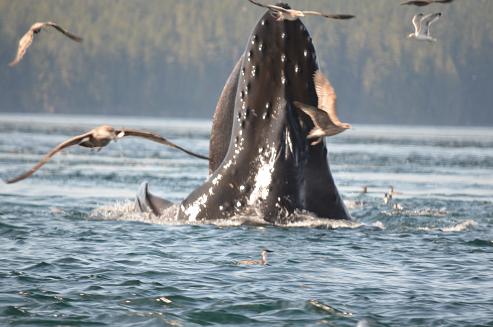
One method of feeding we often see with humpback whales is “Lunge Feeding”. The whale will lunge through a shoal of prey with mouth gaping open often exploding at the surface with both food and water. In this case the photo shows the top of the humpback’s head with its lower jaw hanging open. Humpback whales do not feed in the warmer climates of Hawaii and Mexico where they spend the winter so it makes sense that once they arrive in their feeding grounds, this will occupy most of their time. Humpback whales in our area will feed small, shoaling fish such as herring. They may eat up to 1,400 kg (3,000 lbs.) of food a day.
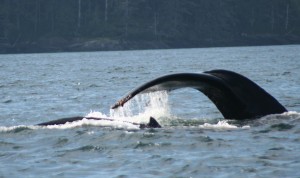
Humpback Whale lobtailing
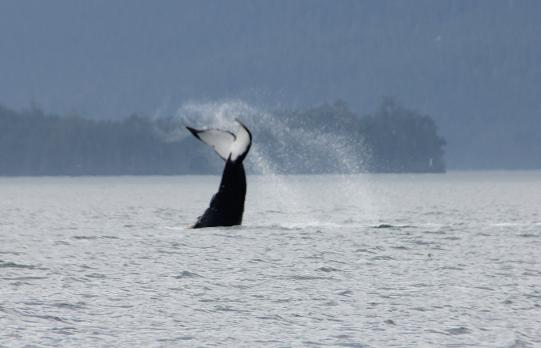
While on a whale watching tour from Grizzly Bear Lodge we came upon a humpback whale tail lobbing or lobtailing. Lobtailing is the act of a whale lifting its fluke (tail) out of the water and then bringing it down onto the surface of the water hard and fast in order to make a loud slap. In this picture it is an upside down lobbing where the top of the tail is hitting the surface so the whale is on its back. If you compare photos this is the same humpback from the Oct 18th posting. In this case a guest counted 38 consecutive slaps that is a lot of energy expelled and no one is sure why.
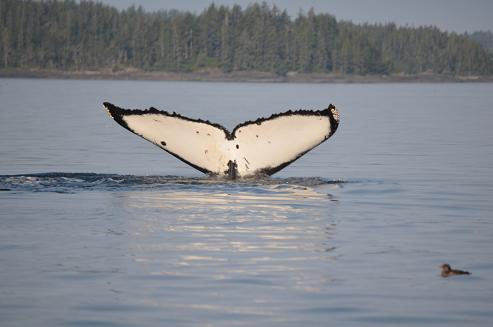
Photo used to ID Humpback Whales
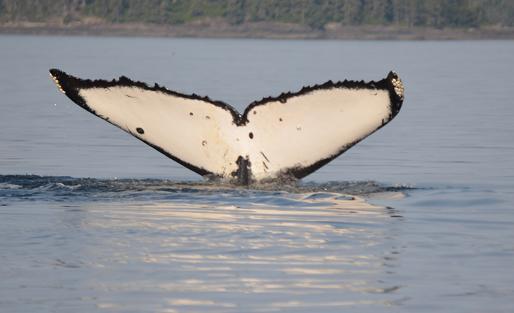
Compared to the posting on October 1st this is the perfect photo to be used to identify a humpback whale. The underside of the fluke (tail) which shows the colour pattern, serrated edges and barnacles on the corners are unique to each whale. “Each individual humpback is given a unique alphanumeric identifier. Each identifier starts with BC to indicate that the animal was seen in British Columbian waters. Following the BC is an X, Y or Z, corresponding to the amount of white on the flukes and a number to identify the individual. BCX## contain approximately 0-20% white, BCY## have approximately 20-80% white and BCZ## have approximately 80-100% white. The catalogue is generally arranged in order of increasing white pigmentation. BCX flukes are further arranged into groups of similar appearance, and thus may not be in order of increasing white pigmentation.” Quote from the “Photographic Catalogue of Humpback Whales in British Columbia”.
Visiting Orca
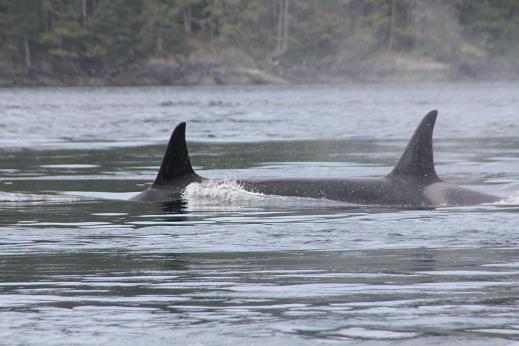
At a first quick glance this might appear to be a “deformed orca” with two dorsal fins, but no it is only a calf and mother. Orcas travel in small groups or pods that are known by the identity of the oldest female in the pod. The pod structure for the orca is a matriarchy. This is a social organizational form in which the mother or oldest female heads the family or in this case the pod. The male orca stays with their mother all their life and breed outside the pod.
Humpback fluking close
 s a guide when I take photos in the boat I try to put things in perspective. For convenience I use a small Pentax OPI waterproof camera. This photo shows a guest taking a picture of a humpback whale fluking in the background. With the camera he was using and the closeness of the whale he has a good photo to take home and show his friends. This brings me to a word of caution I give all the guests in my boat: “Put down the camera and enjoy the experience”. If on your vacation, especially on wildlife tours, if you view everything through the lens of your camera you will miss more than half of the experience.
Whale watching
 Whale watching trips from the lodge will often eat their picnic lunches on the water. Sitting quietly becomes a time for excellent viewing of the surrounding marine life. Humpback whales are very cautious is an area with boats traveling likely because they cannot be sure of their direction of travel or any sudden change that may occur. But we have found that by sitting quietly while other tour boats are returning to exchange their guests we are able to enjoy close up wildlife viewing.
Humpback whale diving
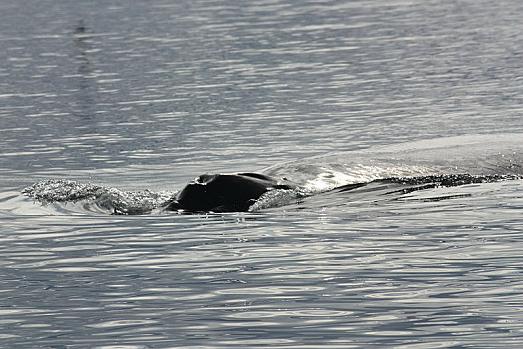
 Great photo of a humpback whale into its dive but would not work for identification. The whale watching companies in the viewing area used by Grizzly Bear Lodge are constantly trying to determine which whales are in the area. Whale identification requires a clear photo of the underside of the tail to view the patterns of white and black as well as all the nicks and scars.
Humpback for lunch
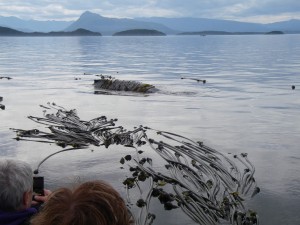

The whale watching tour leaves the lodge between 7:30 and 8:00 to travel the fifty-minute boat ride to Johnstone Strait. Mid-morning we have a bathroom break in Telegraph Cove on BC’s Vancouver Island. The picnic lunch we carry is often eaten drifting on the ocean currents. This day for a change we tied to the bull kelp that grows along the shore. It was also the same day that a humpback whale decided to spend some time in the same kelp bed. It was less than 10 meters (yards) from the boat and spent about thirty minutes rolling and playing in the kelp. We were quite and the whale did not move off until another boat made noise running up Blackfish Sound about a kilometer (mile) away.
Humpback whale and calf
With the ever-increasing number of humpback whales remaining in the whale watching tour area there are also more calves. The number of whales normally viewed on a given tour day has increased from five or six whales six years ago to fourteen to sixteen this past season. The humpback calves are much more active than their mothers often spend time tail lobbing and breaching however it is the adults that provide the best classic whale tail photographs.