Tag Archives: Whale Watching

Eagle Watching While Whale Watching

Eagle in the fog


Bald Eagle in Tree“Bald Eagle watching us from a nearby tree. We saw many Bald Eagles during our time at Grizzly Bear Lodge, but they were so difficult to photograph!!  George maneuvered the boat into the perfect position for us to take this photo.
This photo just sums up the beauty and tranquillity of Knights Inlet – the flat calm water, kelp and a bald eagle on a small island in the early morning mist. Just stunning!!”
I may move the boat but the credit for the photos goes to Lynn.

Breaching Humpback Whale 2 of 2

Breaching Humpback Whale

It is very difficult to get one great picture of a breaching whale but to get two on the same trip is a testimony to the ability of the photographer and the number of breaching whales. It was one of those days with many breaches but most of them while in range to see the breach and splash not always in range for a good picture. Whale watching safaris from Grizzly Bear Lodge normally encounter orca, humpback whales, dolphins, porpoise, sealion, seals, eagles and a variety of marine ducks.


Breaching Humpback Whale 1 of 2

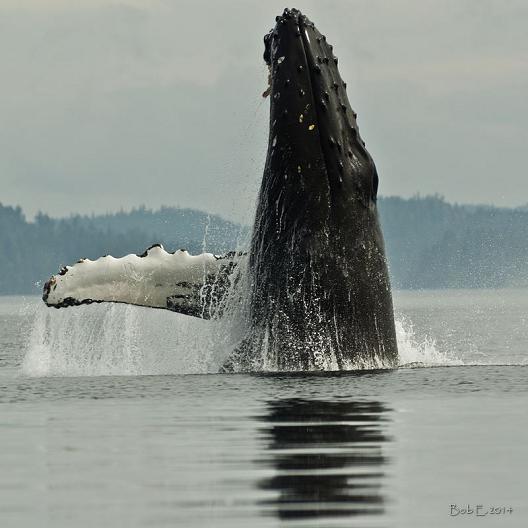
Humpback Breaching

The first of two great photos of breaching humpback whales provided by
Canada’s Bob and Helen Everson. The numbers of humpback whales that stay in our viewing area is increasing every summer. Five years ago there might be four or five whales that stay in the area all summer and now that number has increased to between fifteen and twenty whales. The area being off the East Coast of Vancouver Island near Telegraph Cove which is two-thirds of the way up the island, going north. Second photo tomorrow.


Humpback Whale Lunge Feeding

Humpback whale

The waters between Vancouver Island and mainland British Columbia are alive with herring, which are the staple in the food chain. Diving birds and ducks feed on the herring and forces them into “herring balls” which are a tight mass of swirling herring from the size a basketball to the size of a small boat.  The duck force them to the surface where the seagulls and eagle dive into to feed.  As a guide I try to locate these balls by watching the gulls, then position the boat near the gulls and wait for the humpbacks to come and feed. If all work as planned then we get a photo such as the one above with a humpback whale taking in a mouthful of herring.

Orcas / Killer Whales 3 of 3

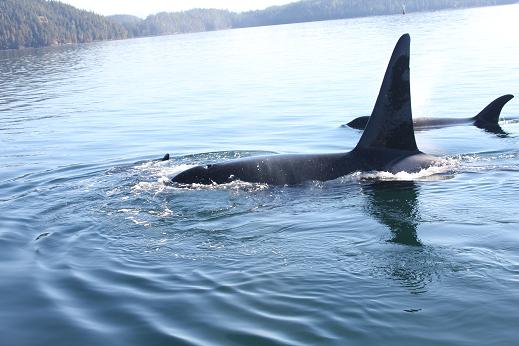
Killer Whale / Orca

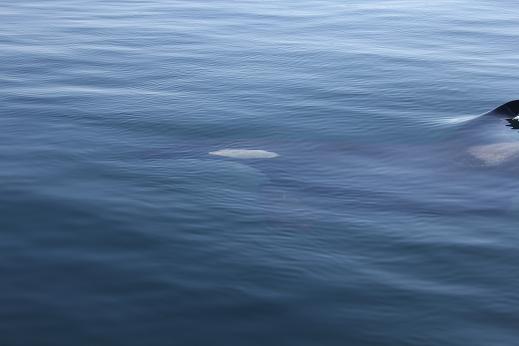
Although we do see some orca in Knight Inlet we spend more time in BC’s coastal waters off Eastern Vancouver Island in an area around Telegraph Cove and Black Fish Sound.  (Black Fish being another name for Orca.) Orca being members of the dolphin family are curious and will often approach boats if they are sitting quietly as shown by the photos in the previous days posting.

Pacific Whitesides Dolphins Play

Pacific Whiteside Dolphins

“(Lagenorhynchus obliquidens) The Pacific white sided dolphin is very beautiful. They have a coloring that ranges from light to dark gray. The underside of them though is white. They also have dark black rings that cover both eyes. The beak is very small and often seems out of proportion with the rest of the body. One characteristic that you will notice is that the dorsal fin has a hook on the end of it. They aren’t very large though compared to other types of dolphins. Full grown they will be about 8 feet long. They will weight approximately 300 pounds.” Taken form the website Dolphins-World
The technical write up is interesting but cannot compare to the excitement of a pod of two or three hundred dolphins playing with our boat. They are on all sides of the boat playing in the bow wave as well as sticking their nose within a meter (yard) of the prop.

Humpback Whales Also Play

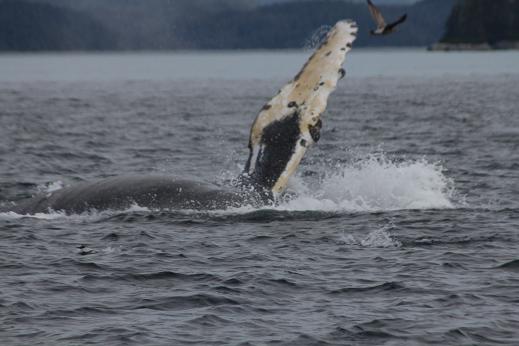
Humpback Whales at play

Over the past five years humpback whales have become more common in the area Grizzly Bear Lodge visits on whale watching days. The area close to Johnstone Straits between Vancouver Island and mainland British Columbia has become the summer home of more than twenty-five whales. The area has an abundant supply of herring and the whales come to feed and stay within our viewing area for a few days before moving in and out of nearby inlets. The whales start appearing in late May and there are whales all summer some days on six or eight but most days more than a dozen whales are lunge feeding and lobtailing in our viewing area. By the size of the pectoral fin it is clear that this is one of the calves that frequent and play in our viewing area.