Tag Archives: Whale Watching

Killer whales passing

Orca and Guests

A day whale watching from Grizzly Bear Lodge does not mean that you will be in “close” proximity to orca or humpback whales all the time.  There is, however an excellent chance that sometime during the trip you will be close enough to get those “bucket list” pictures. A good photo is the result of patience and position. My job as a guide is to get you into the best position and as a guest you just need the patience.


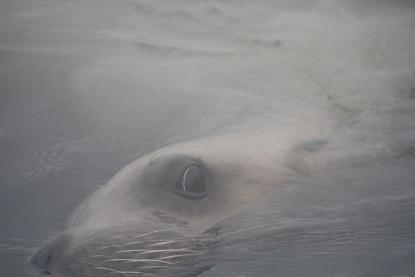
Stelle Sea lion Visiting

Stellar sea lion

This is probably as close as one needs to get to a steller sea lion. The sea lions migrate between California and Alaska. Traveling north in the spring (June) and back south in the fall (September) although for the past several years there have been several dozen sea lions that stay in the area all year. On this day we had stopped to watch a humpback whale feeding in Weynton Pass when this Sealion visited us. And by visited I mean it came right up to the edge of the boat as if to ask: “What are you doing?”


Two for one lunge feeding Humpback Whales

Humpback Whales Lunging

To provide perspective the yellow in the right hand corner is a guest’s head. Over the past five years humpback whales have become more common in Grizzly Bear Lodge’s whale watching area so a normal day in 2014 we would view between ten and twenty different whales. The idea is to wait quietly near a herring ball and wait for the whale’s lunge with mouth open to engulf the herring. In this case we had two coming up through a large school of herring.


Waiting Quietly 2 of 6

Humpback whale lunging

Again sitting quietly in an area known as Bold Head we wait for the humpback whales to appear. We do cheat a little because the first thing we do is find a herring ball, which is located by the seagulls diving in the water. Parked near the herring we wait for the whales to come and feed. The feeding is a lunge as the whales come from beneath the herring with their mouth open to engulf the whole herring ball. More waiting tomorrow!


Waiting Quietly 1 of 6

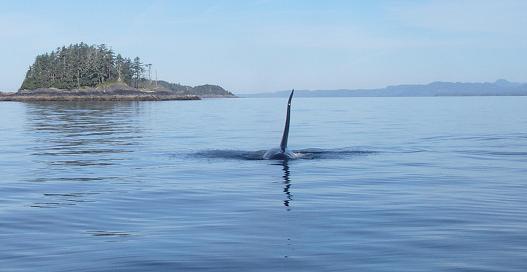
orca close to boat

The orca / killer whales in the Grizzly Bear Lodge’s whale safari area are mostly resident or fish eaters although at times we encounter the transient or mammal eaters.  The northern resident orca are located in waters north of Campbell River on Vancouver Island and while the transient orca are more often found in BC coastal inlets. This is a female orca as indicated by the shorter dorsal fin. Sitting quietly while whale watching is the key to many interesting photos. Humpback whale tomorrow.


Humpback Whale

Humpback lobtailing

“Humpbacks also stick their tail out of the water into the air, swing it around, and then slap it on the water’s surface; this is called lobtailing. It makes a very loud sound. The meaning or purpose of lobtailing is unknown, but may be done as a warning to the rest of the pod. Humpbacks lobtail more when the seas are rough and stormy.” A quote from the Sea Shepherd Conservation Society. Our guest are not always interested in the reason behind mammal’s behaviour but they sure do want the photographs. The numbers of humpback whales that are staying in our viewing area all summer are increasing every year so these photos are becoming common.


Killer Whales 1 of 2

Large male orca

Grizzly Bear Lodge’s whale watching safari trips travel to the waters of Johnstone Strait, between Vancouver Island and mainland British Columbia.  The orca / killer whales arrives in the area by late June or early July and remains until late October.  These resident salmon eating orca travel in pods and are curious, as most dolphins.  They have been known to detour from their normal path of travel to inspect boats and whale watchers passing on all sides of the boat which makes it hard to choose the best chance for a picture. This large male may have come close for another reason. See tomorrow’s post


Visiting Humpback Whales

Humpback Whales visiting

The lodge’s whale watching is takes places on the waters between Vancouver Island and the BC mainland.  An area around Telegraph Cove on the Johnstone Strait.  Humpback whales and calves are becoming a more common sight in our viewing area. They arrive in the waters off the East Coast of Vancouver Island in the spring and feed in the area until late October. In this photo one of our boats was sitting quietly watching another humpback whale when this mother and calf came for a visit.


Killer Whales – aka Orca

Killer whales

The orcas in our whale watching area arrive in late June and stay through mid-October. The most common orca / killer whales in the area are the residents. Residents or fish eating orca live in large family groups called pods, with multiple pods making up a population or community. The pods consist of multiple related matrilines, with each matriline often containing 3 or more generations. Each pod is led by the head female or matriach, as orca are a female dominated species. The matriarch tends to be the oldest female in the extended family. Her experience and knowledge guides the pod, and the matriach teaches younger whales about everything from parenting skills, feeding tactics, and navigation through the vast territories that they cover. Marc & Solange and family from France provided the photo and I know enjoyed their time with the orca.


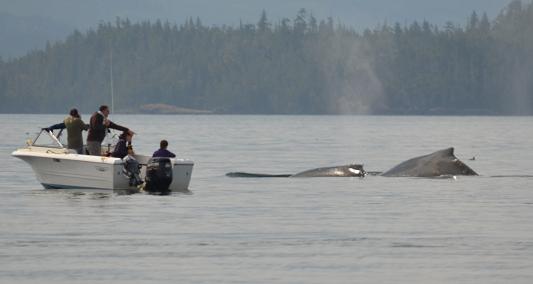
Humpback Whale for Lunch

Visiting Humpback Whale


“This photo was taken as we sat in the boat with George having lunch in the Inside Passage.
I can only describe this as the most perfect setting I have ever had lunch in. Beautiful perfectly calm sea, stunning scenery and total silence, but for the sound of the Humpbacks surfacing & blowing SO close to the boat.
Yet more Humpbacks near the boat!!”

Lynn is right but the key to “great pictures” is patience.  On our whale watching day we often sit and have lunch in the same areas that the humpback whales are feeding.  By being still in one area (motors turned off) we pose no threat or danger and end up with some incredible memories.