Tag Archives: orca watching
Killer Whales Visit
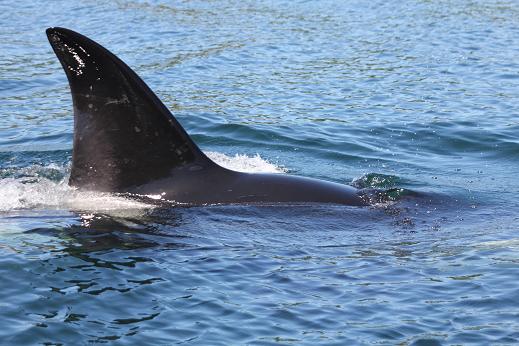
As with most wildlife viewing the best approach is often to sit and wait. On this particular whale watching tour from Grizzly Bear Lodge we arrived at the area of Johnstone Strait to start looking for orca and immediately located a pod of orca traveling along the shore. We stopped our boat, got out the cameras and let the orca come to us. As a guide for the lodge this is the best way to start a days trip and after some time with the orca we went on to watch stellar sealions, humpback whales lunge feeding, harbour seals, eagles and a few dall’s porpoise. All in all a full day.
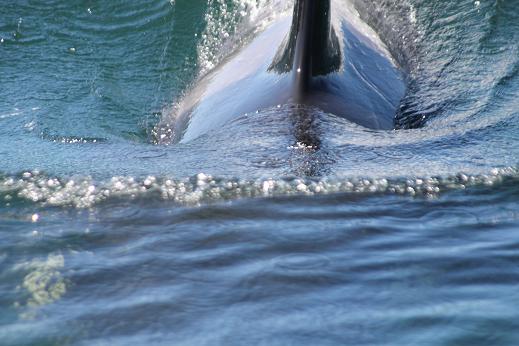
Orca passing behind boat
 The northern resident (fish eating) orca in our whale watching area number more than two hundred and fifty individuals. This community consists of 3 clans (A, G and R) and numerous pods within each clan. The individual pods seem to contain less than a dozen members but will often join together to travel in larger groups. The killer whales viewed behind our boat were part of a larger group that was in front. It is best to avoid being in the middle of the group of orca but it is not possible to control their action as pods split off to travel alone.
Orca breaching
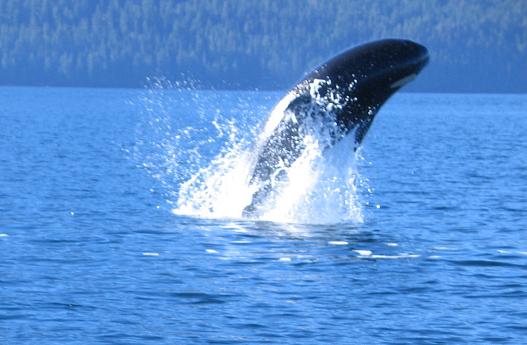 The classic photograph for an orca is breaching. All of the books on marine mammals have numerous pictures of killer whales and most of them are breaching. I would assume that the photographers have spent hundreds of hours on the water and countless pictures of splashed. Guest coming to Grizzly Bear Lodge expect that this will be the case when they go on a whale watching safari to the whale watching area in Johnstone Strait. The truth of the matter is that although we do see breaching orca on a reasonably regular basis it is not easy to get a photo especially a good photo. For some reason orca do not announce their intention to breach and do not repeated breaches so you can be prepared to get that clear focus.
Orca passing under boats
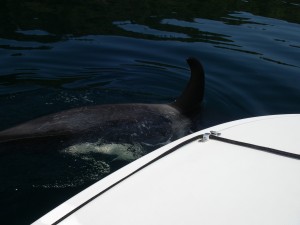
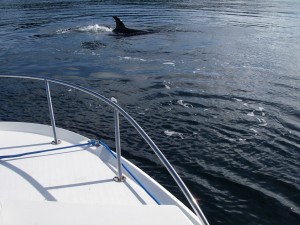
On days when the killer whales are feeding it is not unusual to have them come close to the boat. Sitting quietly in one position if that position happens to be over a school of salmon makes for an interesting viewing. This orca choose our boat as a base and swam around and under the boat several times while catching salmon. Some days are golden in the case black and white.
Orca passing between boats
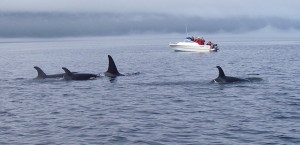
The northern resident orcas appear in the area of Johnstone Strait in late June and remain until mid October. They are the fish eating orca and their appearance coincides with the arrival of the Chinook salmon. The Chinook salmon, Oncorhynchus tshawytscha is the largest species in the pacific salmon genus. Other commonly used names for the species include king salmon, black mouth, Quinnat salmon, spring salmon and Tyee salmon.
Chinook salmon are big fish! They are the largest Pacific salmon species. On average, Chinook salmon are close to a meter (3 feet) long and 8 to 14 kg (20 to 30 pounds). But some Chinook salmon in this area can grow to over 25 kg (55 pounds)! This is the preferred food for the orca although they will other species of salmon…..more tomorrow.
Killer whale on a mission
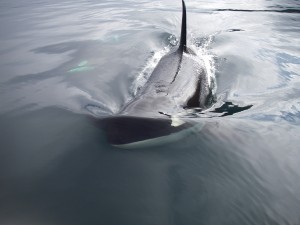
As with most wildlife photography doing nothing is often the best practice. On whale watching safaris from the lodge there is normally allot of activity when a pod of killer whales in located. The guides job is to try predict where the orca are going and to try and be there when they arrive and this can be a challenge when they continually change directions. But when there is a full day on the water at sometime there is a good chance of success and then a photo such as this is the result. Taken just before the two orca dove beneath the boat.
A once in a lifetime photo


Many really interesting wildlife photos are the result of the right place and right time. And many more you do not know that you have until they are enlarged on a computer screen. This photo was taken when several orca passed beneath the boat and I snapped a series of photos with my fingers crossed. The enlargement shows a calf tucked by its mother’s side. As a mother swims quickly through the water, she forms something called a ‘slipstream’ next to her body as the water rushes past her. If the baby is inside this slipstream, he or she will be carried along with mom.
Resident Killer Whales
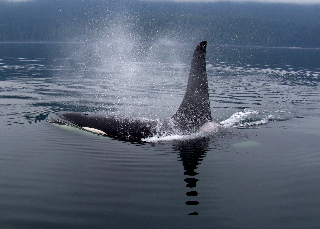
Excellent picture of the orca we see in the Johnston Strait while on a whale watching safari. The resident orcas (fish eaters) return to the area in late June and remain through late October. Their return corresponds to the arrival of the salmon, which attract the many fishers to the area to try their luck on catching a “Tyee”. A tyee is a large salmon over thirty pounds (13.6 k). Thanks again Karen and Martin for the provided this photo.
Killer Whales also fish
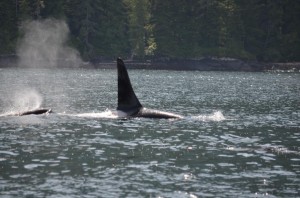
The post from yesterday with the seine boat netting salmon is in direct competition with today’s killer whales fishing. I have found over the years that during the commercial fishing season, which is not much, more that two weeks the orca stay away from the areas containing the fishing boats. Fortunately the commercial fishing area is a small portion of the viewing area for orca and humpback whales. In a way it is helpful in that it eliminates some area from our search grid and helps to locate the humpbacks and killer whales a little faster.