Tag Archives: Whale Watching

Humpback Whale Backward Tail Lobbing

Humpback tail lobbing

Yes that humpback whale is slapping the water with the upper-side of its tail. That means that it is on its back and slapping downward. With the increase number of humpback whales that spend the summer in our viewing area, often viewing ten or twelve whales each trip; we view more interesting behaviour. In the past summer tail lobbing, lunge feeding and breaching are common place. For the first time there has been a whale bubble feeding and this is a rare behaviour. Rare because it is one whale bubble feeding rather than a group. The whale swims in a circle blowing bubbles to keep the herring inside the ring and then turns and lunges up through it’s own bubbles.


My Camera vs guest camera 2 of 2

Humpback lunge

Comparing yesterday’s post and today’s there is not much room for a comment. The only comment is that we often view a dozen of more different humpback whales each day and frequently they are lunge feeding close to our boat, which provides opportunities for “bucket list” photographs.


My Camera vs guest camera 1 of 2

Humpback Whales lunging

My camera is a smaller Pentax Optio waterproof camera that is great for getting the perspective and a close up if the object is close. Also good or grandkids and general scenery. Tomorrow’s post the guest’s photo.


Killer Whales – Blackfish – Orca

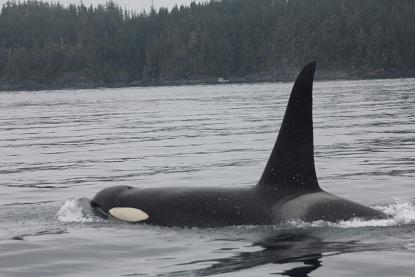
Killer whales

Killer whale is the tourist / media name, Orcinus orca is the scientific name, and Blackfish is the name I grew up knowing. Growing up and fishing in Campbell River on BC’s Vancouver Island orca were frequently in the area. At that time in the 1950’s and for years to come the name used by local was Blackfish. It was not until the mid 1960’s and on the name killer whale came into common use.  After the first orca was captured in 1964 and for the first time, newspapers and magazines including Reader’s Digest, Life, The Times of London, and the Victoria Times gave some positive press about killer whales the name started to become popular. It is not hard to see that a tour or a visit to see a Blackfish did not seem to attract much interest whereas killer whale was media gold.


Humpback Whale Feeding

Humpback Whale under jaw

That is the underside of a humpback whale’s lower jaw as it lunges out of the water with a mouth full (minus one) herring. Getting into position for the picture is easier than getting the picture. As a guide I keep a look out for diving seagulls, which gives me the location of a herring ball. Next you try to get close to the herring ball before a humpback whale beats you to the herring ball. After that it is a matter of waiting for the gulls to lift off the water just before the whale lunges.  My job is complete all the guests needs to do is have perfect timing and an excellent eye mixed with luck.  My photography relies mostly on the luck.


Perfect identification photo

Humpback Whales fluke

“Humpback whales (Megaptera novaeangliae) migrate between high latitude summer feeding grounds and low latitude winter breeding grounds. In the North Pacific, winter breeding grounds are known in waters off Japan, Hawaii and Mexico; summer feeding grounds are found in coastal waters of Alaska, British Columbia and the western mainland United States. Researchers use photographs of the ventral surface of the tail flukes to identify and track movements of individual whales and to estimate abundance. Patterns of pigmentation, scarring and shape of the flukes are unique to each individual.” From Fisheries and Oceans Canada website.

Over the past five years more and more humpback whales are spending the summer in the area near Grizzly Bear Lodge in Knight Inlet so that it is common to see more than a dozen whales on a days whale watching safari.


Killer Whale Watching

Orca identification

The killer whales / orca along the west coast of North America are identified by the shape and size of their dorsal fin and the saddlepatch located by the fin. Other distinguishing marks are also a great help especially the notch located in A72’s fin. I have found over the years that our guests are less interested in “who” they are watching and more interested in “that” are watching killer whales.


Sometimes lucky!

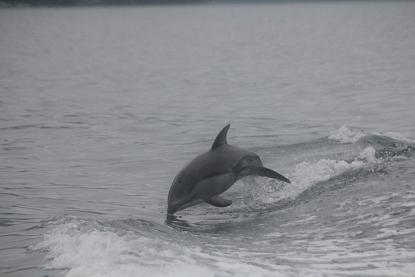
Pacific whiteside dolphins

It is not uncommon to encounter a pod of Pacific Whitesided Dolphins while on a tour from Grizzly Bear Lodge. These dolphins travel and feed in Knight Inlet as well as along the shores of Vancouver Island. This means that the encounter is as likely to happen while on a grizzly bear tour or a visit to trapper Rick’s as it is while whale watching. Less common is to get a photo of a dolphin completely out of the water this is where luck comes in to play. The best approach to getting a good photo of a dolphin is to take as many as possible in the hopes that one will contain a dolphin and not just water or sky. Luck often is better than skill.


Wildlife Watching?

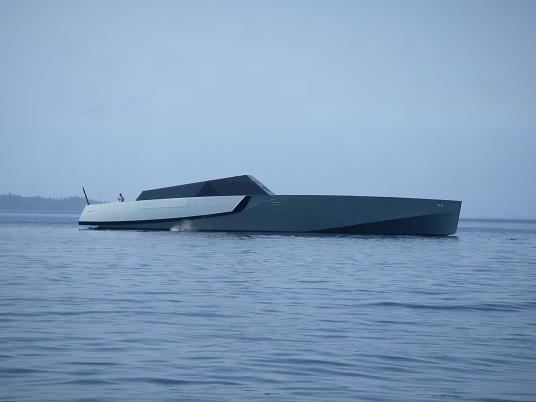
Batboat

Not all watching is wildlife watching.  This summer we were taken by surprise when this vessel showed up in our viewing area.  The guest I had on board became quite interested and took many photos.

“PORT ANGELES — Galeocerdo — which is the genus name of the tiger shark — came into the Port Angeles Boat Haven for a load of fuel on Friday afternoon.

The unique-looking vessel conjures images of the Batmobile or something out of “Star Wars.”

The 118-foot vessel was built of composite materials by Wally Yachts in Italy in 2003.

She is powered by three gas turbine Detroit Diesel engines that generate 16,800 horsepower, which will push the boat up to 60 knots (70 mph).

She also has two auxiliary Cummins diesel engines, each of which delivers 370 horsepower and are used for close-quarter maneuvering and cruising at the more comfortable speed of 9 knots.

I understand that Galeocerdo was most recently in Mexico’s Baja California state cruising in the Sea of Cortez and is on her way north to spend the balance of the summer season cruising in British Columbia. But you can read more about this unusual vessel — with photos of its layout inside — at http://www.superyachttimes.com/sale/details/327.” Taken from the Peninsula Daily News


Humpback Whale Breaching

Humpback Whale Breaching

This was an interesting morning off the end of Craycroft Point that juts out into Johnstone Strait. We were watching some orca feeding in the ripe tide as well as a humpback whale. These were resident or salmon eating orca so no threat to the humpback but it was repeatedly breach as if to scare the orca from the area but it was not working. The highest count I got was nine breaches in a row. This breach was mid-way in a sequence were the whale was coming out of the water and down with a loud slap.  The guest got many excellent photos, which put mine to shame, but then I always use the excuse “I was running the boat.”