Whale Watching

We’re not all about the bears, whales are abundant here too!

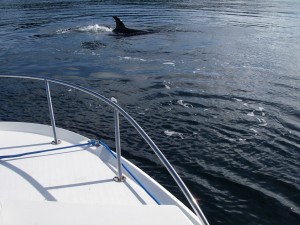
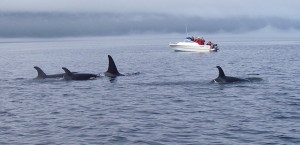
Killer whales and humpback whales are often seen during our wildlife tours. There are resident whales and transient whales that can be seen feeding and playing in our waters.

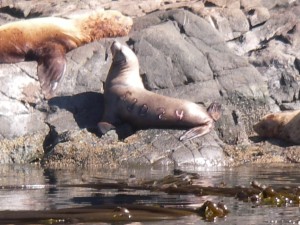
Tracking sealions

The USA Department of Fish and Wildlife (ODFW) has a program to brand Steller sea lions as a means to estimate vital population parameters in the future. The western stock is listed as endangered under the ESA (U.S. Endangered Species Act) and the eastern stock is listed as threatened. The Steller Sea Lion Recovery Team recommended in 2000 that researchers begin branding and marking Steller sea lion pups throughout their range. Most summer we viewing two of three branded sea lions and report them online.



Bathroom break

Click to enlarge then click again

Telegraph Cove is a tourist destination on the north East Coast of Vancouver Island. It is a two and half-hour drive from Campbell River but more important it is often our bathroom stop while whale watching. It has nice clean restroom and also great coffee or hot chocolate. Depending on the location of mornings viewing we normally arrive there around 11:00 or 11:30 for a break and then return to the water and our picnic lunch and continued marine wildlife viewing.


Orca passing under boats

Click to enlarge then click again

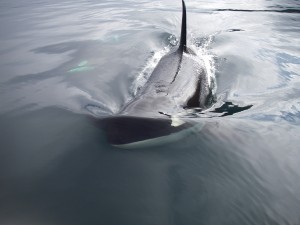
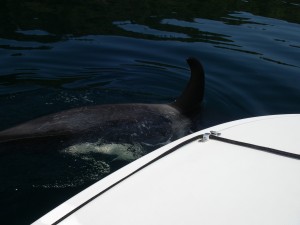
On days when the killer whales are feeding it is not unusual to have them come close to the boat. Sitting quietly in one position if that position happens to be over a school of salmon makes for an interesting viewing. This orca choose our boat as a base and swam around and under the boat several times while catching salmon. Some days are golden in the case black and white.


Orca passing between boats

Click to enlarge then click again

The northern resident orcas appear in the area of Johnstone Strait in late June and remain until mid October. They are the fish eating orca and their appearance coincides with the arrival of the Chinook salmon. The Chinook salmon, Oncorhynchus tshawytscha is the largest species in the pacific salmon genus. Other commonly used names for the species include king salmon, black mouth, Quinnat salmon, spring salmon and Tyee salmon.
Chinook salmon are big fish! They are the largest Pacific salmon species. On average, Chinook salmon are close to a meter (3 feet) long and 8 to 14 kg (20 to 30 pounds). But some Chinook salmon in this area can grow to over 25 kg (55 pounds)!  This is the preferred food for the orca although they will other species of salmon…..more tomorrow.


Killer whale on a mission

Click to enlarge then click again

As with most wildlife photography doing nothing is often the best practice. On whale watching safaris from the lodge there is normally allot of activity when a pod of killer whales in located. The guides job is to try predict where the orca are going and to try and be there when they arrive and this can be a challenge when they continually change directions. But when there is a full day on the water at sometime there is a good chance of success and then a photo such as this is the result. Taken just before the two orca dove beneath the boat.


Guess who came to lunch?

Click to enlarge then click again

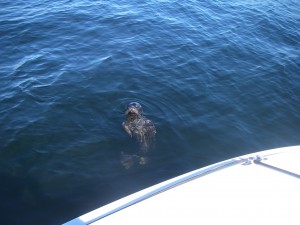
The whale watching day from the lodge requires a fifty-minute boat ride to the area around Johnstone Strait, which is part of the Inside Passage to Alaska. On this day we have a picnic lunch that is normally eaten in the boat as we drift with the whales or other marine life. I am always amazed at the curiosity of these mammals. With the motor turned off and sitting quietly we frequently have visitors. Harbour seals because of their size are a little more timid and less frequent. Steller sealions will approach the boat swimming around and beneath when we have lunch near their “haul out island”. 


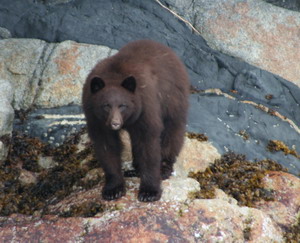
Looks a bit like a grizzly

Click to enlarge then click again

On the boat rides up and down Knight Inlet for the grizzly bear watching day the guides are constantly scanning the shores for black bears. This photo is of one of the few brown black bears observed in the inlet over the years.
Ministry of Environment, Lands and Parks for British Columbia says:
“Black bears are not always black, and this variation is most apparent in British Columbia. Other colour phases that occur in British Columbia include cinnamon, brown, and blonde. A white-coloured morph, called Kermode or Spirit Bear, is reported most frequently on the north-central coast. The blue phase, or “glacier” bear, is sometimes seen in the extreme northwest corner of the province.” Unfortunately this “brown” black bear is rarely seen in our viewing area.


Beautiful day on the water

Click to enlarge then click again

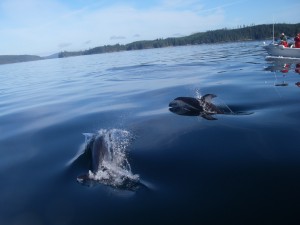
It is only 9:00 and the whale watching trip is off to a good start with a pod of Pacific whitesided dolphins playing with the boats. These dolphins are often in the area and it is a treat when they become playful. A normal day will also include time spend with a pod of northern resident killer whales, Steller sealions basking in the sun and humpback whales feeding on herring. Along the way there will be bald eagles in the trees or feeding, harbour seals, dall porpoises and may be a black bear or two.


A once in a lifetime photo

Click to enlarge then click again

Many really interesting wildlife photos are the result of the right place and right time.  And many more you do not know that you have until they are enlarged on a computer screen. This photo was taken when several orca passed beneath the boat and I snapped a series of photos with my fingers crossed. The enlargement shows a calf tucked by its mother’s side. As a mother swims quickly through the water, she forms something called a ‘slipstream’ next to her body as the water rushes past her. If the baby is inside this slipstream, he or she will be carried along with mom.


June Black Bear Cubs

Click to enlarge then click again

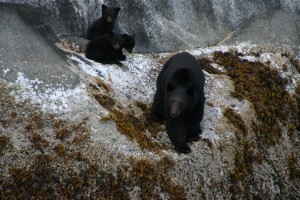
Whenever we are on the water for a day whether it is a grizzly bear tour, whales watching trip or the extra day at the river we are always scanning the shore for wildlife. Frequently the wildlife found is black bears. On this trip in late June it was a mother and cubs that are about six months old. Two things are interesting the first being that there are three cubs. Triplets for a black bear are rare the common number being one and twins occasionally. The second is all the white on the rock where the barnacles have been removed. Bears come to the shore in search of protein and scraping off and eating barnacles is one source.  This appears to be one of their feeding areas.