Tag Archives: killer whale watching

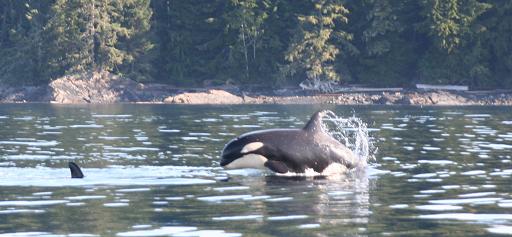
Porpoising 2 of

Killer Whale

Orcas, or killer whales, are the largest of the dolphins so it is only natural that they will often behave like dolphins. There are both resident and transient pod populations of killer whales in our viewing area the most common being the residents. Resident pods tend to prefer fish, while transient pods target marine mammals.


Visiting Killer Whales / Orca

Visiting killer whale

Some orcas do not believe in the 100 meter (yard) distance set out in the Whale Watching Guidelines. But this was a good day because the warden that oversees these guidelines was near us and watched the orca approach and circle our boat. Talking with her after it moved back to it’s passing pod she thought that we must have been sitting over a school of salmon and it came to fish. The reason is interesting but the experience is what the guests will remember. The days whale watching tour from Grizzly Bear Lodge spends most of its time in the Johnstone Strait adjacent to Vancouver Island where we normally observe orca, humpback whales, porpoise, dolphins, harbour seals, Steller sea lions, bald eagles, a variety of sea birds and frequently black bears.


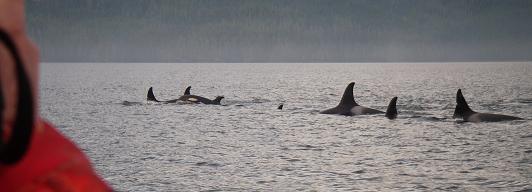
Excitment coming

Killer Whale approachiing

If you have just taken a photo like the one above you know that the next photos will be allot more exciting as the orca / killer whales come closer. The whales watching guidelines specify that we must be 100 meters (yards) from the orca that is to prevent running to close along side the pods or leap frogging to get in front of a traveling pod of orca. However the orcas are not aware of the guidelines and will often turn and approach a boat that is sitting quietly. If you have scanned through the blog postings you will notice many photos of orca close to and even passing under your boat that does not mean it happens every tour but the percentages are high that your will get your “bucket list” photo.


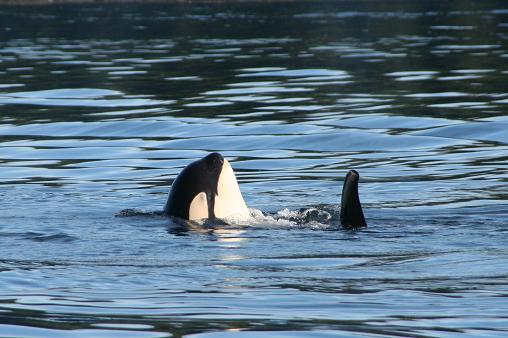
Orca spyhopping

Killer whale spyhopping

In a good spyhop the orca / killer whale has about half of it’s body out of the water. This is more of an orca backstroke where it was passing the boat and rolled over and stuck it’s head out of the water. The description of what is happening is not important because the picture is interesting and unique.


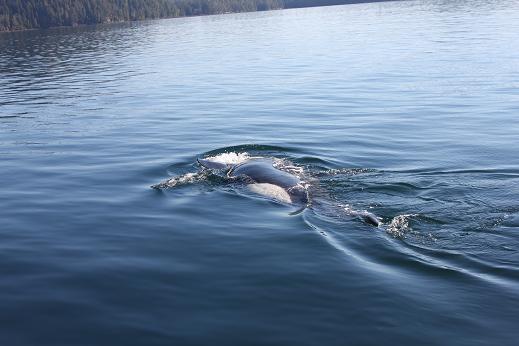
Confusing orca photo

Orca?

These two orca / killer whales passed under our boat and surfaced a few meters (yards) away. Explanation: looking at the photo their appears to be a dorsal fin at the top of the photo but it cannot be from the main orca because that would mean it was coming out of it’s belly. The belly of an orca is white and it is possible to see the tip of the tail at the end of the photo. So it could be one orca diving over the back of another or the dorsal fin could be the tail of another orca and the second one is following too close. Either way it was close.


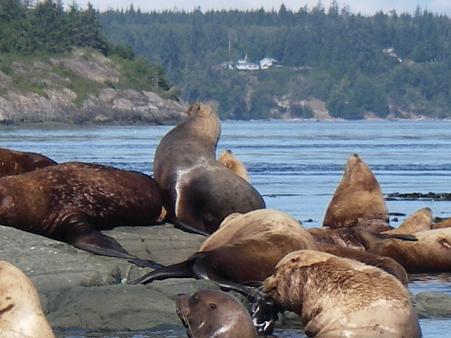
Steller sealions at rest?

Steller sea lions

This was one of those rare times when the sealions were actually resting and not roaring and climbing over each other. But if you look closely you do not see any young sealions only the adults. It is the young that come out of the water and want to move to the top of the rock what cause all the problems and noise. The quiet only lasted five minutes and it turned to chaos and better opportunities for photos of roaring sealions.


Killer Whales pod A30

Killer Whale Pod

If you have time to refer to the posting of June 16th this is again the resident killer whale pod A30 with A72 the last orca with a notch in her dorsal fin.  The guest in the corner of the photo provides a little perspective for the closeness of the orca. On the lodges whale watching safaris we are on the water 7 to 8 hours which allows us time to position ourselves for a number of good pictures of the wildlife we view. The whale watching tours view marine wildlife such as killer whales, humpback whales, dolphins, porpoise, harbour seals, Steller sealions, occasionally minke whales, a wide variety of waterfowl, bald eagles, and frequently black bear as we travel to and from the lodge.


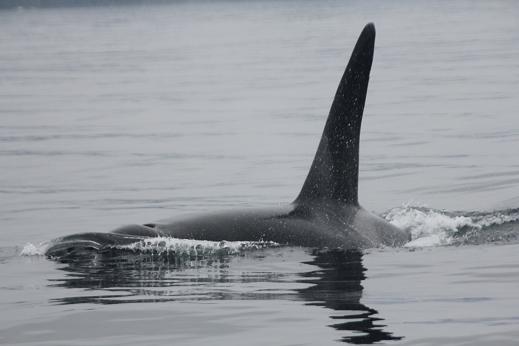
Male Resident Killer Whale

Male killer whale

Male because of the large dorsal fin as the species shows considerable size difference between males and females. Adult males develop larger pectoral flippers, dorsal fins, tail flukes, and girths than females. Resident because the dorsal fin is rounded at the tip and curved and tapering while the transient is shorter and sharper. The other key reason that this is a resident is that it is coming close to the boat while transients are less curious and will not approach a boat.


Killer Whale Dorsal Fin

orca reflection

A male killer whale’s dorsal fin can grow to as much as 6 feet tall. Despite the fact that the dorsal fin is very straight, it is not supported by bone, but a fibrous connective tissue called collagen. This male is a member of the “A” Clan. The northern resident population numbers approximately 250 whales made up of three clans – A, G, R Clan. Resident (fish eaters) killer whale pods are MATRIARCHAL, meaning that sons and daughters stay with their mother throughout their lives, even after they have offspring of their own. The bonds between siblings usually remain strong even after the mother has died. A matriarch and all of her descendents are referred to as a MATRILINE. A POD is a larger unit that is made up of one or more matrilines that travel together at least half the time and that probably stem from a deceased matriarch. A CLAN is a group of pods that share similar calls or dialects.


Herring balls and humpback whales

Humpback Lunge

The seagulls in this photo are the key to good whale watching. Humpback whales in our area feed on herring. Diving ducks attack the herring from below and their defence is to form a tight mass of revolving herring (a herring ball) which moves to the surface. When the herring near the surface the gulls attack from above and that is what your guide wants to see. Once the gulls are spotted it is necessary to move toward the herring ball without making the ball disperse and then wait for a humpback whale to lunge up and eat the herring. On this attempt the humpback was faster than the guide to reach the herring so our view was from the distance but if you check the post’s from April 6th and 7th you can see that is not the norm.