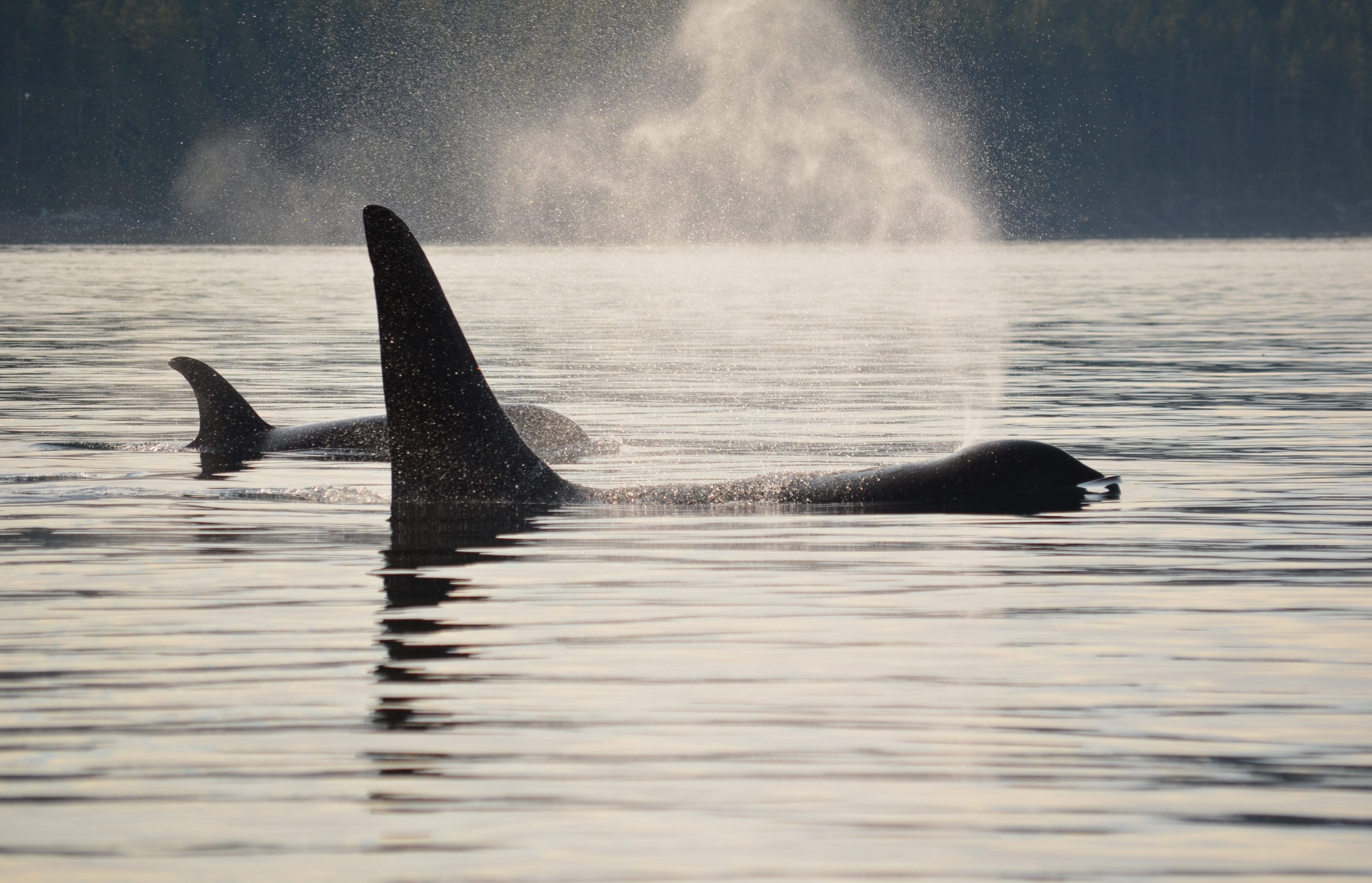
A male killer whale’s dorsal fin can grow to as much as two meters (6 feet) tall. Despite the fact that the dorsal fin is very straight, it is primarily made of cartilage. Orcas travel in deep water and this water provides pressure to the fin, keeping the tissues inside healthy and straight. This photo shows the difference in size between and adult male and female orca’s dorsal fin.
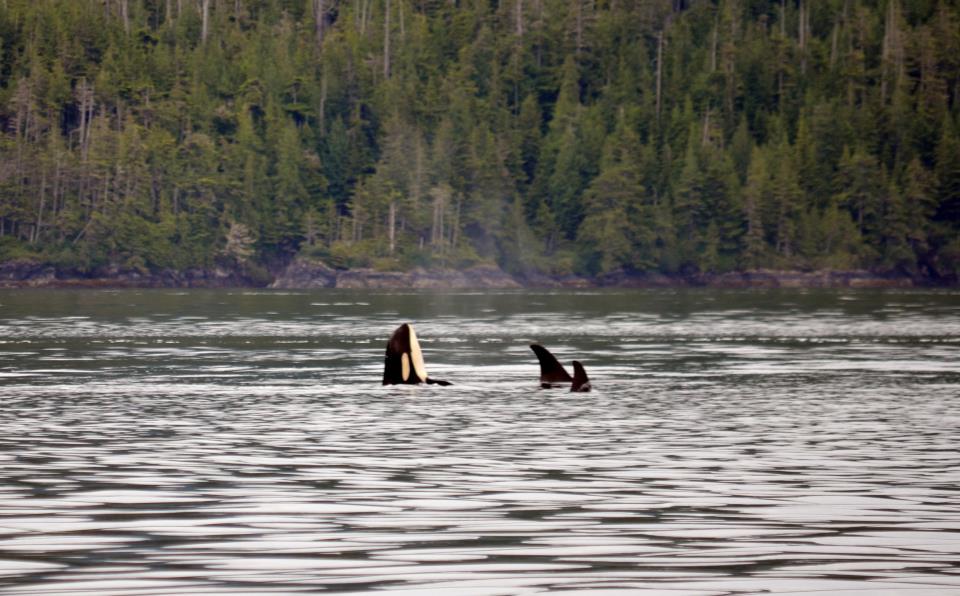
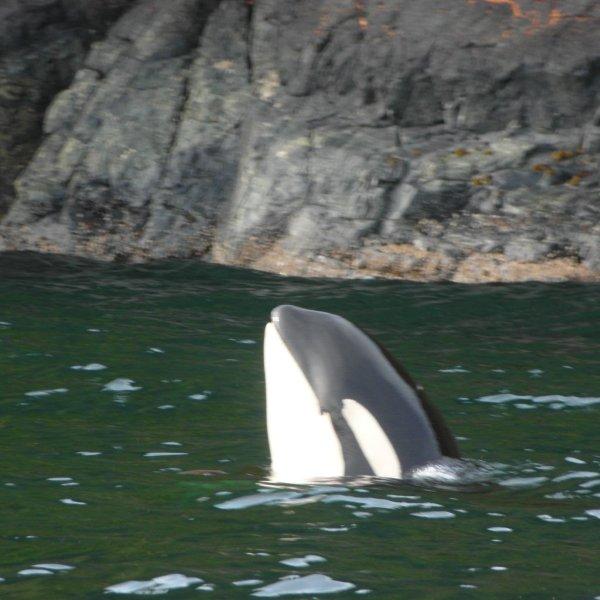
“When spyhopping, the whale rises and holds position partially out of the water, often exposing its entire rostrum and head, and is visually akin to a human treading water. Spyhopping is controlled and slow, and can last for minutes at a time if the whale is sufficiently inquisitive about whatever (or whomever) it is viewing.
Generally, the whale does not appear to swim to maintain its “elevated” position while spyhopping, instead relying on exceptional buoyancy control and positioning with pectoral fins. Typically the whale’s eyes will be slightly above or below the surface of the water, enabling it to see whatever is nearby on the surface.
Spyhopping often occurs during a “mugging” situation, where the focus of a whale’s attention is on a boat rather than on other nearby whales. Spyhopping among orcas may be to view prey species. For this a spyhop may be more useful than a breach, because the view is held steady for a longer period of time.” From Wikipedia
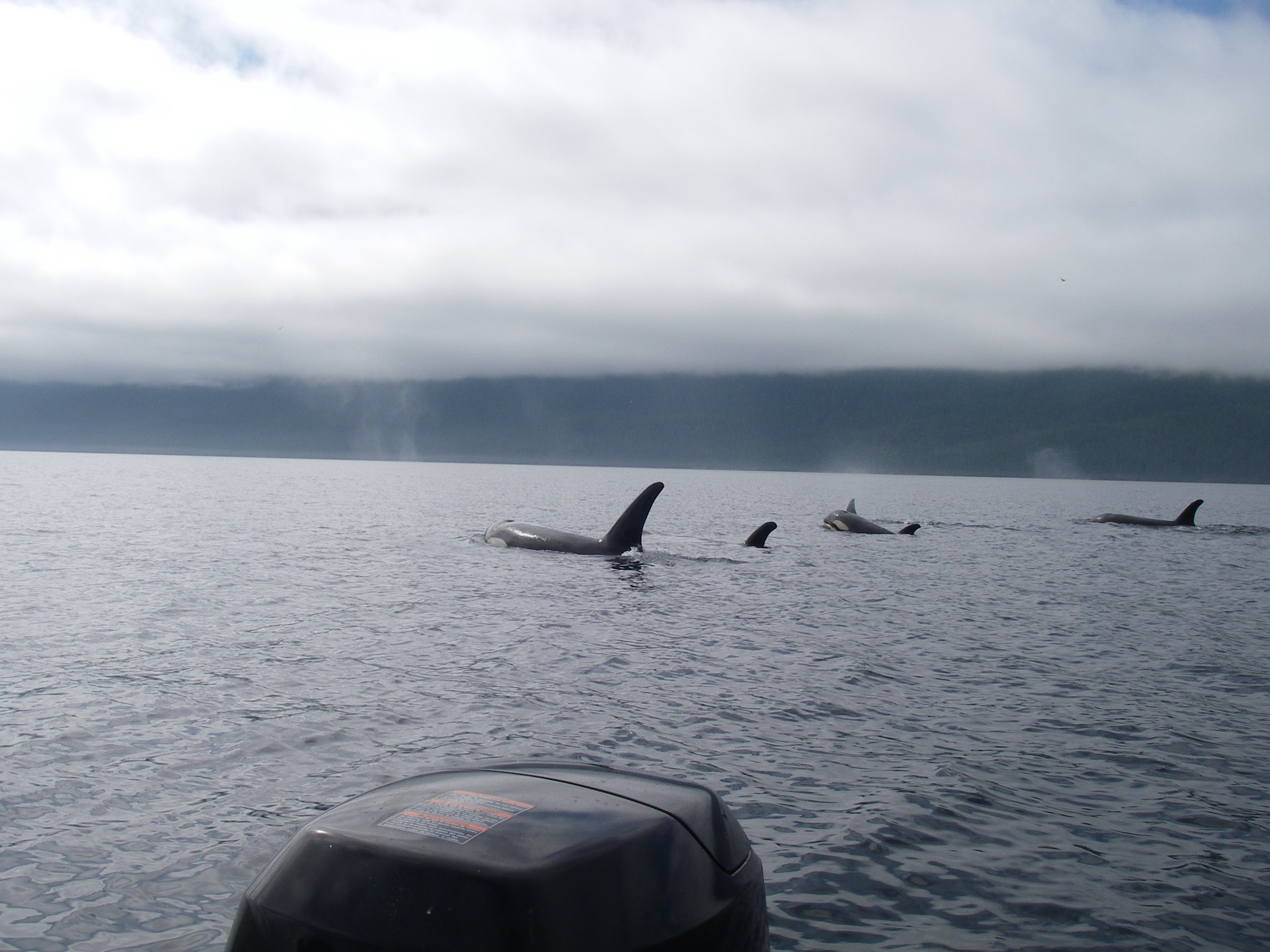
A pod of orca (killer whales) passes close on one of the lodge’s whale watching tours. One big plus of viewing the marine “wildlife” in our viewing area is the absence of many other boats. The southern resident orca near Victoria on Vancouver Island has thirty-one different companies each with several boats observing them on a daily basis. In our area, on a busy day, there may by nine boats in the area and not all watching the whales at the same time. This picture shows two boats in the background but if you take time to check other picture in the blog you will not find many with boats in the background. In fact I get more complaints about the lack of other boats to provide a perspective for photos than I do about the presence of boats.
The Northern resident orca we view on tour from Grizzly Bear Lodge live in large family groups called pods, with multiple pods making up a population or community. The pods consist of related matrilines, with each matriline often containing 3 or more generations. The head female or matriarch leads each pod, as orca is a female dominated species. The matriarch tends to be the oldest female in the extended family. Her experience and knowledge guides the pod, and the matriarch teaches younger whales about everything from parenting skills, feeding tactics, and navigation through the vast territories that they cover. The pods in our area may be as small as three orca or more than fifteen.
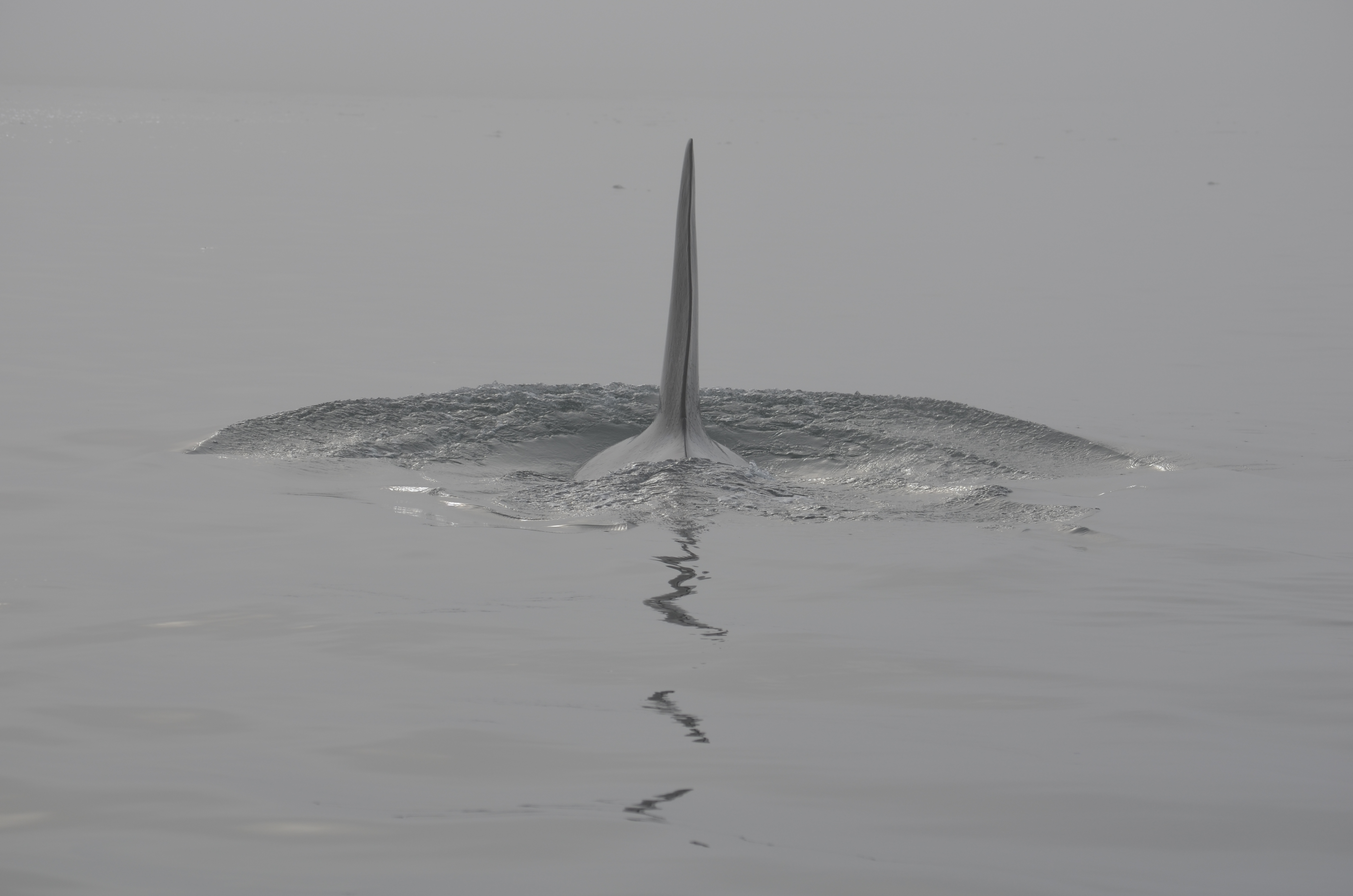
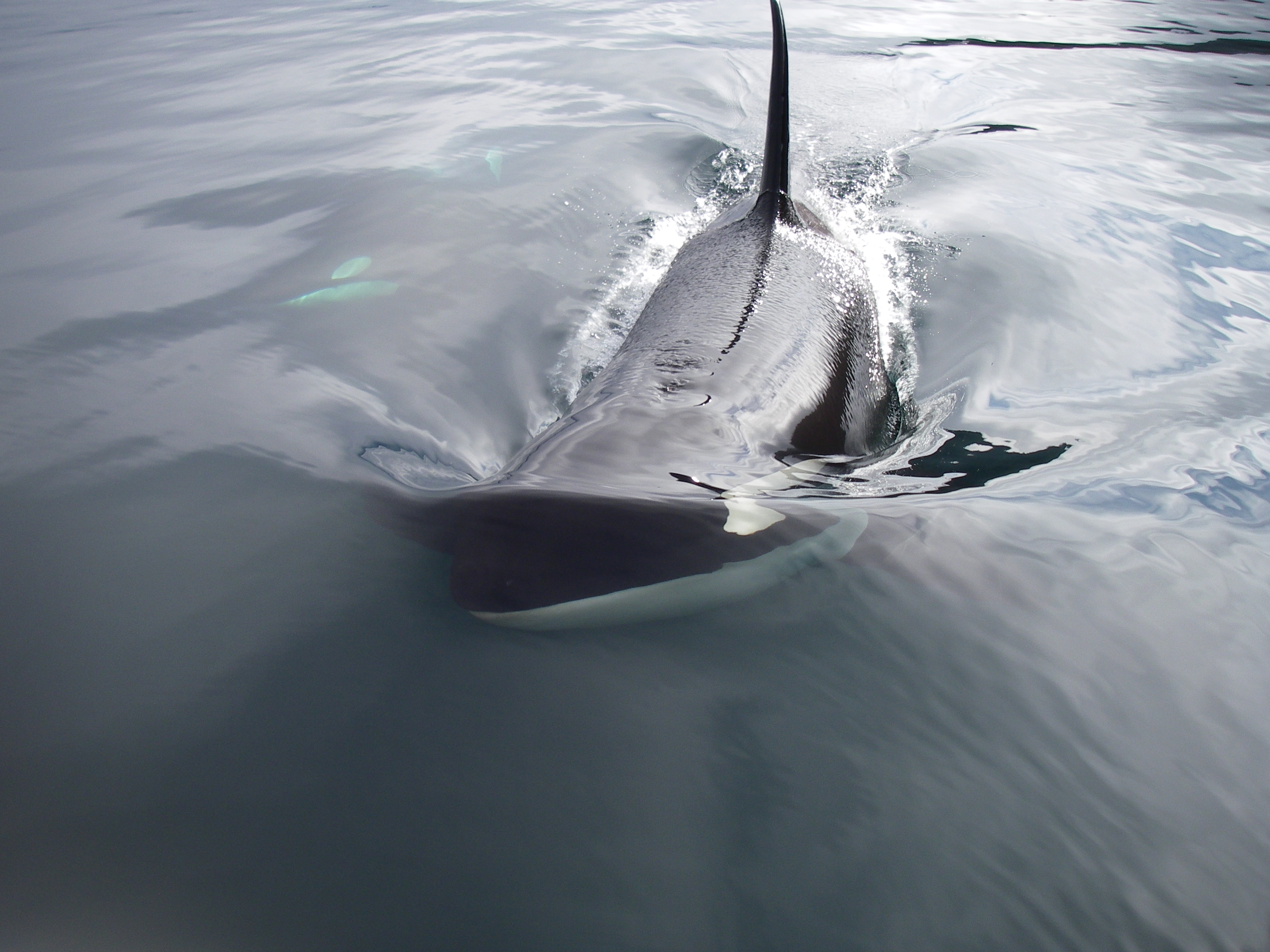
Many mornings in August and September start with a low layer of fog over the area surrounding Grizzly Bear Lodge. This fog is short lived as it normally burns off by noon. The boat used for whale watching is equipped with radar and all the guides have a personal GPS with routes programmed to allow them to navigate in the fog. Whale watching is not a “solo” experience as we are in radio contact with two or three others “whale watchers” and share our search. Unlike Victoria on the southern tip of Vancouver Island a busy day in our area may involve eight boats watching whales in a rather large area while Victoria may have fifty boats in a similar sized area. This photo is of a male resident orca that passed beneath the boat as surfaced in the fog.
This is a classic picture of a male orca (large dorsal fin) and a female orca a.k.a. killer whales or blackfish. Growing up in Campbell River on Vancouver Island I knew orca as blackfish the name killer whales or orca became more common after the start of the Eco tours. The area adjacent to Johnstone where we frequently view the orca is known as Blackfish Sound a name predating the operation of Eco tours.
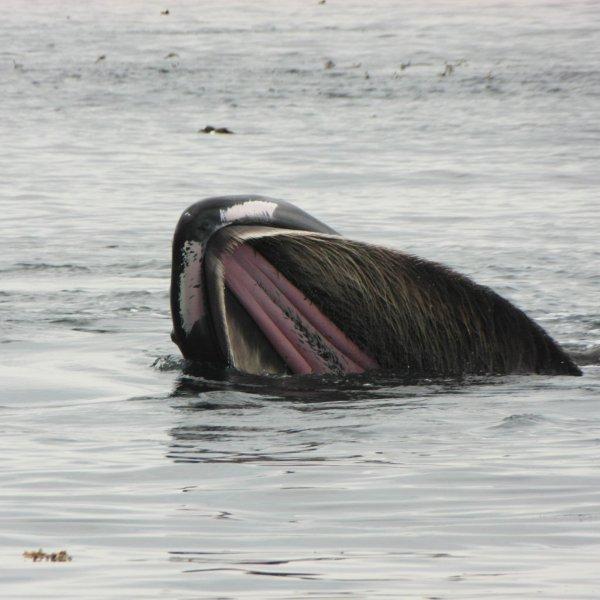
An excellent photo taken by James Wendy of Australia showing the inside of a humpback whale’s mouth. It is interesting to note that this whale came out of the water and held this position for close to thirty seconds while James manages to get several great pictures. “Baleen is a strong, yet flexible material made out of keratin, a protein that is the same material that makes up our hair and fingernails. It is used by whales to filter their prey from the sea water. Some baleen whales, like the humpback whale, feed by gulping large amounts of prey (in our area herring) and water and then using their tongue to force the water out in between the baleen plates.”About.com Marine Life
It is said that an orca’s eyesight is equally good in or out of the water. In fact it is thought they use eyesight when ‘spyhopping’ to spot boats that may present a danger. Orca do not seem to fear boats but once a motor is turned off and no sound is coming from the boat it becomes harder for them to locate. “Orcas possess sophisticated underwater sonar that enables them to perceive their surroundings ten times more effectively than our most advanced equipment.” (http://www.orcafree.org) However a boat’s shallow draft may make it harder to locate and thus the need for an occasional spyhop. Great photo from James Wendy of Australia.
The overcast day may not seem too appealing unless you think about taking pictures from a boat. On bright days it is necessary to have the sun at your back or the reflection off the water will make picture taking difficult if not impossible. Marine mammals often change their direction of travel without notice and do not always cooperate in getting the boat in the right position. On a dull day their cooperation is not necessary. Again the motor in the picture is to provide an indication of the nearness of the orca pod.
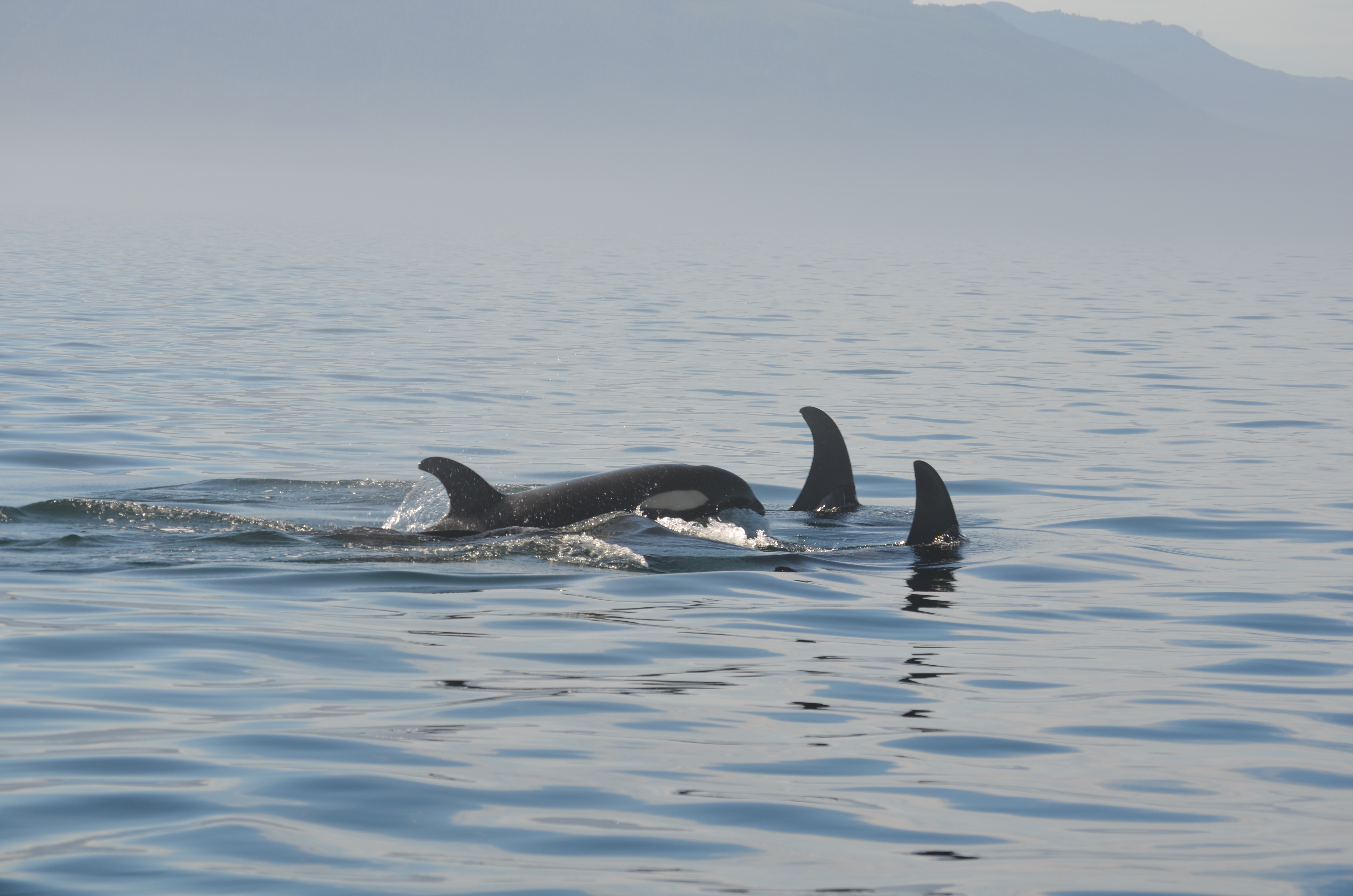
I was fortunate to be in the right place at the right time several years ago. The closeness to the boat is revealed in the fact that my camera is a “Pentax Optio with a 3X Optical Zoom” and I was not using much of the zoom. The “TWO for” aspect of the photo is the second orca under water to the left. Orcas are member of the dolphin family and as such are curious. On many occasions over the years I have seen orca change their direction of travel to come close to a boat and even make circles around the boat to check out the occupants. The “checking out” is obvious as they turn on their side to get a better view and on one occasion a spyhop about seven meter (20 feet) behind the boat. Sometime sitting and waiting is the best option.
Just like that another season has come to an end. We are grateful for all the wonderful staff and the guests this season. It was an excellent season and we are already looking forward to next May.
One of the highlights of the season was all of the new cubs out. It was awesome to see so many new cubs of the year and that is great news for our bear populations moving forward. We had great spring viewing and this continued through summer. On our river trips we started to see salmon arriving in August and enjoyed some great shoulder season viewing. The fish at the viewing platforms were a little late showing up this year, but viewing during late September at the platforms was great and the estuary viewing remained strong throughout the season.
Out in the whale watching world it was another year that saw large numbers of resident Orca who remained in the area right into October. The Humpback viewing was also great with large numbers feeding in Blackfish Sound. It is so amazing to have these magnificent animals back in our waters in such numbers.
Over the winter and spring we will be doing some repairs and maintenance. We rebuilt the front deck last spring, utilising cedar cut on site. We will continue with some siding, rooms improvements and hopefully a floating sauna ready for the start of our season.
2026 is already looking like a very busy season for us. We only have limited high season availability so please book early to ensure we have space for your group.