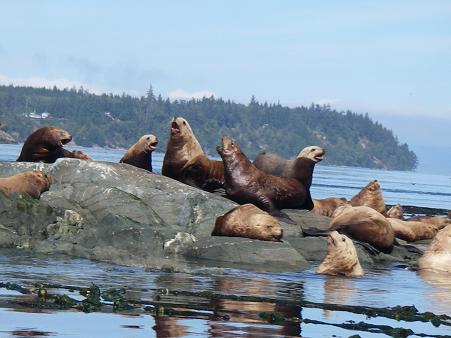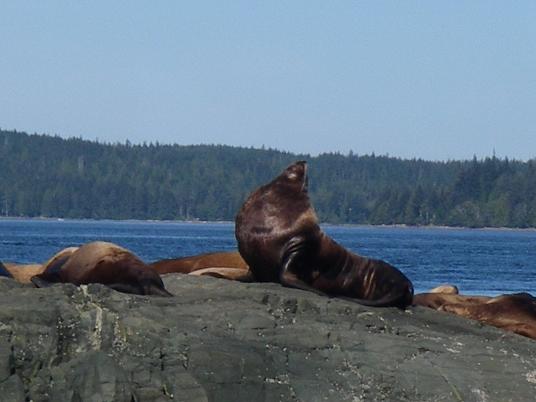
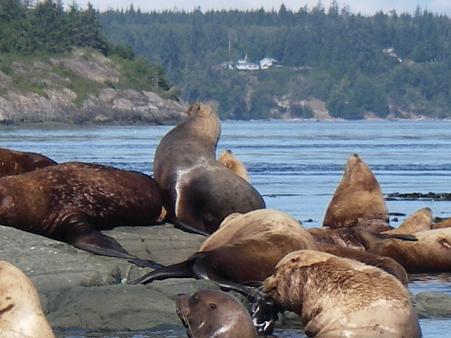
This was one of those rare times when the sealions were actually resting and not roaring and climbing over each other. But if you look closely you do not see any young sealions only the adults. It is the young that come out of the water and want to move to the top of the rock what cause all the problems and noise. The quiet only lasted five minutes and it turned to chaos and better opportunities for photos of roaring sealions.
It seems that Steller sealions get little rest. They may be at one of their haul-out areas but seldom is all quite. As they come and go from the water they climb over each other and just as they get settled again another one moves to start the roaring all over. On occasion we may eat lunch in the area of the sealions but only if we are up wind. The noise is bad enough but the smell is worse.
Steller sea lions are social and gather at various times throughout the year when mating and breeding are not taking place. They use traditional haul out sites (an area used for resting) and rookeries (an area used for breeding and rearing young) on remote and exposed islands. These sites can be rock shelves, ledges, boulders, and gravel or sand beaches. Even in crowds, the big bulls are unmistakable—they are three times larger than females.
Weight: males: up to 2,500 pounds (1,120 kg) females: up to 770 pounds (350 kg) pups: about 35-50 pounds (16-22.5 kg)
Length: males: about 10-11 feet (3-3.4 m) females: about 7.5-9.5 feet (2.5-3.0 m) pups: about 3.3 feet (1 m)
Steller sea lions range throughout the Pacific Rim (from northern California to Northern Honshu in Japan, and to the Bering Strait). About 70 percent of the Steller sea lion population reside in Alaska. They do not migrate like some pinnipeds, but they do move seasonally to different feeding and resting areas. Late May and early June as well as September and October seem to be the time of the year when there are more sea lions in our area. However over the past several years more have remained in the area all year. In the water they do not seem that large but they are curious and often visit us as we watch them on shore (see tomorrows posting).
The Steller sea lion (Eumetopias jubatus) are also known as the northern sea lion and Steller’s sea lion. Males are distinguished from females by broader, higher foreheads, flatter snouts, and darker, slightly tuftier hair around their large necks, giving them a maned appearance. Their Latin name translates roughly as “maned one with the broad forehead”. Steller sea lions are known for their curiosity and playfulness, they frequently visit our boats as we watch them on the rock out croppings along the shore.
A rare photo of steller sea lions at rest when they are actually quiet and resting. On most stops to observe and photograph the sea lions they are acting as their name suggests and roaring like lions. They seem to be in a constant state of turmoil with animals coming out of or diving into the water. Others climb over those trying to “rest” while looking for the perfect location so they can “rest”. Maybe the tranquility of the islands in yesterday’s post does have a side effect in causing at least a little peace for the sea lions.
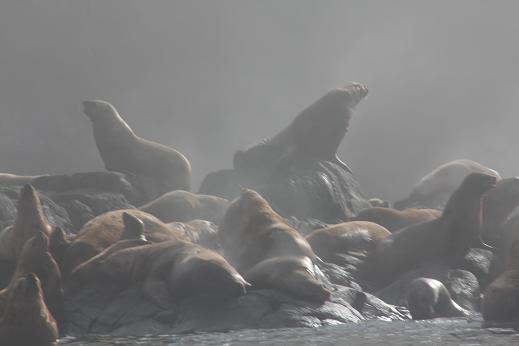
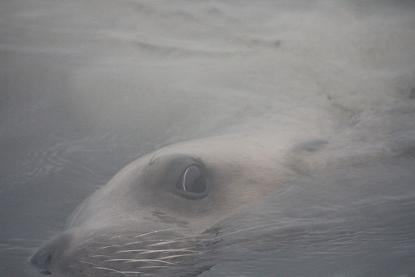
August whale watching can have some interesting mornings as the warm days will produce fog for the following morning. The fog may be patchy and is gone by noon but it does not prevent us from leaving the dock as we have radar and GPS. The fog does produce some unique photos such as this one with stellar sea lions on the rocks near Vancouver Island’s Telegraph Cove. The sea lions are now in the area most of the summer whereas in past years they were only passing through in June and September on their migration between California and Alaska.
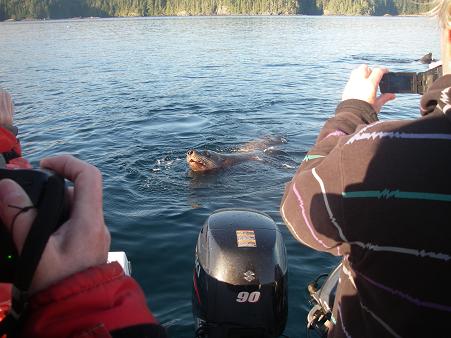
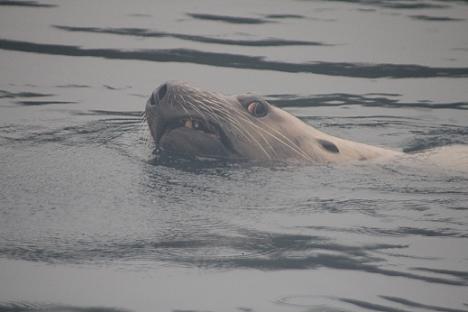
There are stellar sea lion in the lodge’s whale watching viewing area all year but they are more abundant in the spring and fall as they pass through on their migration between Alaska and California. We make a point of stopping to watch the sea lions on their “haul out rocks” and at times they make a point of coming to visit our boat. Sea lions like many marine mammals are curious and will approach your boat if you are sitting quietly. However this is a little closer than normal but then it was a calm day on the water and we were near a school of herring.
This is probably as close as one needs to get to a steller sea lion. The sea lions migrate between California and Alaska. Traveling north in the spring (June) and back south in the fall (September) although for the past several years there have been several dozen sea lions that stay in the area all year. On this day we had stopped to watch a humpback whale feeding in Weynton Pass when this Sealion visited us. And by visited I mean it came right up to the edge of the boat as if to ask: “What are you doing?”
Whale watching safari trips from the Grizzly Bear Lodge include more than humpback whales and orca. The water-ways between Vancouver Island and the BC mainland abound in marine based wildlife: eagles, large variety of ducks and water fowl, white-sided dolphins, dall’s porpoise, harbour porpoise, harbour seals and of course stellar sea lions. A safari trip without viewing a majority of these is not considered a good day. These steller sea lions migrate between California and Alaska in the spring and fall and in the past few years some have made the area their year round residence.
Just like that another season has come to an end. We are grateful for all the wonderful staff and the guests this season. It was an excellent season and we are already looking forward to next May.
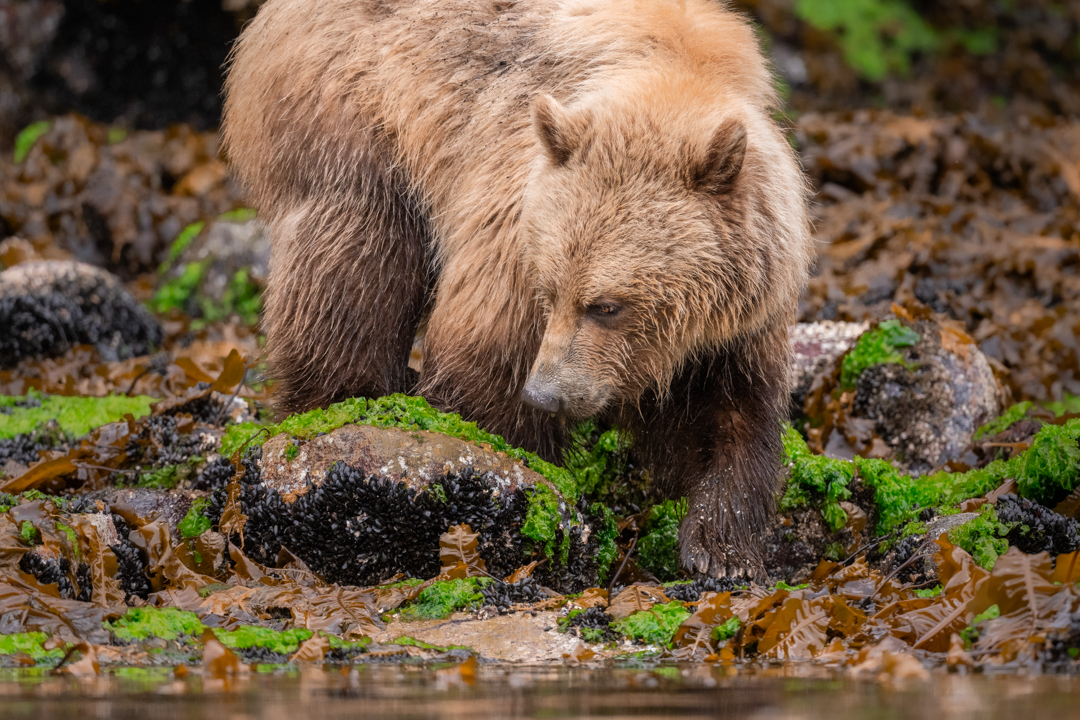
One of the highlights of the season was all of the new cubs out. It was awesome to see so many new cubs of the year and that is great news for our bear populations moving forward. We had great spring viewing and this continued through summer. On our river trips we started to see salmon arriving in August and enjoyed some great shoulder season viewing. The fish at the viewing platforms were a little late showing up this year, but viewing during late September at the platforms was great and the estuary viewing remained strong throughout the season.
Out in the whale watching world it was another year that saw large numbers of resident Orca who remained in the area right into October. The Humpback viewing was also great with large numbers feeding in Blackfish Sound. It is so amazing to have these magnificent animals back in our waters in such numbers.
Over the winter and spring we will be doing some repairs and maintenance. We rebuilt the front deck last spring, utilising cedar cut on site. We will continue with some siding, rooms improvements and hopefully a floating sauna ready for the start of our season.
2026 is already looking like a very busy season for us. We only have limited high season availability so please book early to ensure we have space for your group.