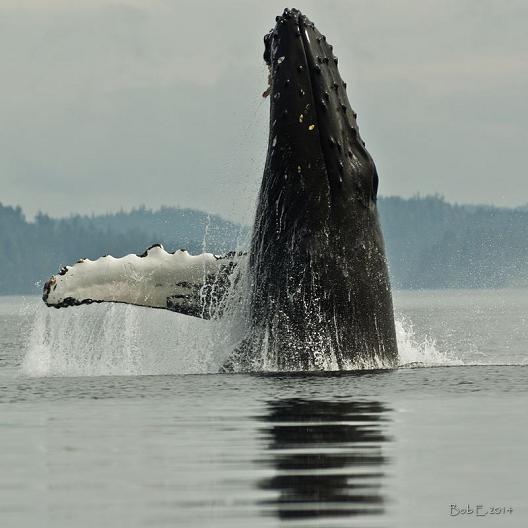
The first of two great photos of breaching humpback whales provided by
Canada’s Bob and Helen Everson. The numbers of humpback whales that stay in our viewing area is increasing every summer. Five years ago there might be four or five whales that stay in the area all summer and now that number has increased to between fifteen and twenty whales. The area being off the East Coast of Vancouver Island near Telegraph Cove which is two-thirds of the way up the island, going north. Second photo tomorrow.
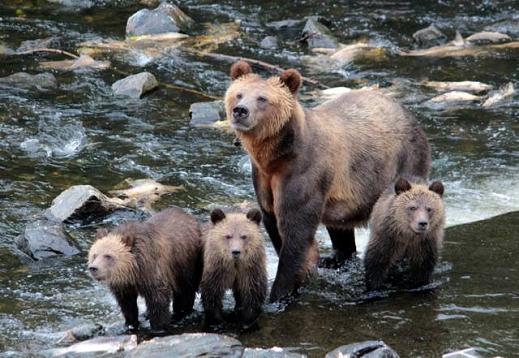
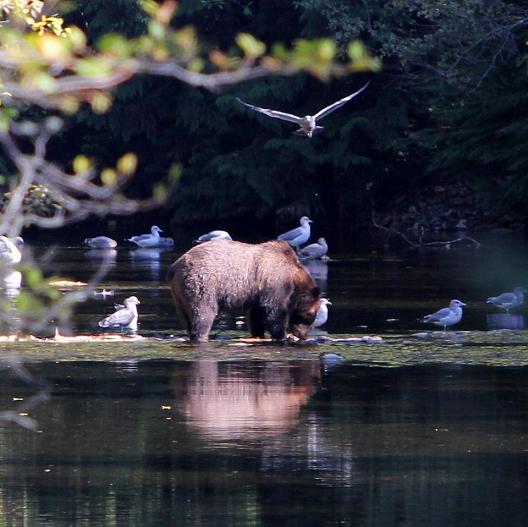
Comparing this photo with the posting of December 5th it is obvious that they are the same bears but the background is different. In the background of this photo are more than a dozen dead salmon. This summer was an extremely dry with no rain for several months. The lack of rain meant that the Glendale River was lower than normal and Tom Brown lake that feeds the river was much warmer than normal the result was a very low oxygen level in the water and many dead salmon. The dead salmon count was several thousand but many of the late arriving salmon stayed in the bay at the mouth of the river so when the rains came in October so did more salmon.
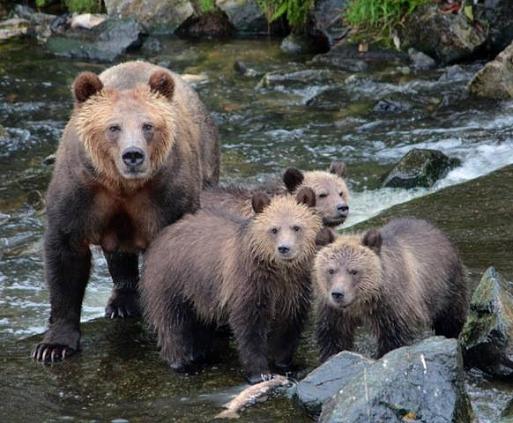
If the number of multiple births in a grizzly bear population is an indication of the health of it’s population then the bears of Knight Inlet are healthy. Twins are common, triplets frequent and even the occasional quadruplets can be seen the viewing area of Grizzly Bear Lodge. This photo from Paul and Sheila Williams from the UK was taken from the viewing stands on the Glendale River. The stands are used by the Lodge after August 24 and through to mid-October.
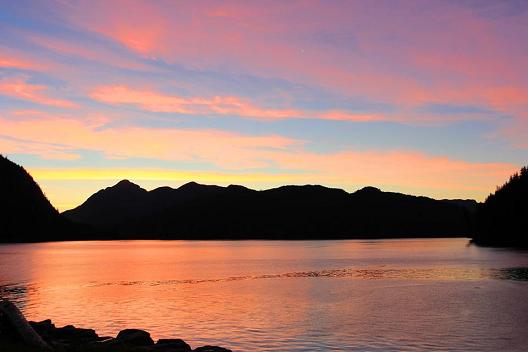
Grizzly Bear Lodge is located on Minstrel Island approximately 25 kilometers from the mouth of Knight Inlet on the West Coast of British Columbia between the BC Coast and Vancouver Island. This is important because the location has its own microclimate, which involves a cloud cover, which moves in most evenings and burns off by noon the next day. This all makes the sunrise shown in this photo by Craig and Pat Brown from USA rather rare.
Play fighting between grizzly bears is a daily occurrence. The first and second year cubs are trying to assert their dominance and cubs will fight with their mother to improve their skills and strength. This behaviour makes for great photos and interesting viewing. The fighting will turn to feeding in seconds nut once the stomachs are full it becomes necessary for the cubs to burn off calories not realizing they should be saving them for hibernation.
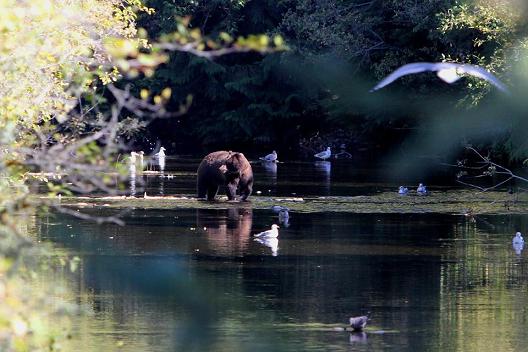
The spring and early summer grizzly bear tours from Grizzly Bear Lodge take place on Knight Inlet’s Glendale River and in the river estuary. After an hour and fifteen minute boat ride up the inlet we transfer to a sixteen foot skiff which permits us to travel in the shallow water of the estuary and up the river at lower tides. As this photo shows the first sighting of a grizzly is normally from a distance and as the tide rises we are able to move closer. The next two posting of the pictures provided by Craig and Pat Brown from USA will show the improved viewing as the tide rises.
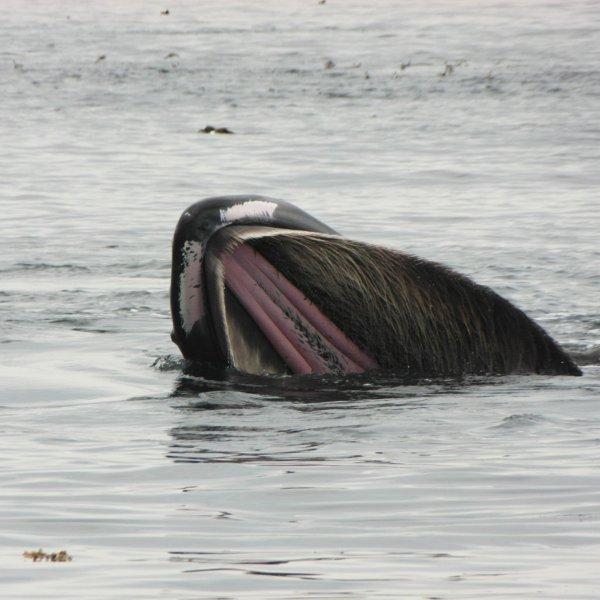
On the whale watching tour from Grizzly Bear Lodge we are fortunate to view between eight and sixteen different humpback whales each trip. These whales spend their summer in our area feeding on the herring, which provides our guests with ample opportunities to watch them lunge feeding. In a lunge the humpbacks come up beneath a herring ball with mouths open as shown in James Kastelein’s photo. The baleen shown is a row of a large number of keratin plates attached to the upper jaw. These plates have a composition similar to those in human hair or fingernails. They are triangular in section with the largest, inward-facing side bearing fine hairs, which form a filtering mat. The humpback whale has about 330 pairs of dark gray baleen plates with coarse gray bristles hanging from the jaws. They are about 0.6 m (25 inches) long and 34 cm (13.5 inches) wide.
A Wikipedia quote “When spyhopping, the whale rises and holds position partially out of the water, often exposing its entire rostrum and head, and is visually akin to a human treading water. Spyhopping is controlled and slow, and can last for minutes at a time if the whale is sufficiently inquisitive about whatever (or whomever) it is viewing. Generally, the whale does not appear to swim to maintain its “elevated” position while spyhopping, instead relying on exceptional buoyancy control and positioning with pectoral fins. Typically the whale’s eyes will be slightly above or below the surface of the water, enabling it to see whatever is nearby on the surface. Spyhopping often occurs during a “mugging” situation, where the focus of a whale’s attention is on a boat rather than on other nearby whales. Spyhopping among orcas may be to view prey species. For this a spyhop may be more useful than a breach, because the view is held steady for a longer period of time.” And thanks to James and Wendy Kastelein for the great photo.
A mother brings her second year cubs to the edge of the river by the viewing stands while another grizzly bears stands in the background. They all have the same concern and that is a larger male grizzly further down river. Fortunately at this time the larger male did not proceed up river which gave the others a chance to come and feed on the many salmon. Most guests want to see the big male grizzlies and they are a magnificent sight but they tend to keep other bears out of the viewing area.
Just like that another season has come to an end. We are grateful for all the wonderful staff and the guests this season. It was an excellent season and we are already looking forward to next May.
One of the highlights of the season was all of the new cubs out. It was awesome to see so many new cubs of the year and that is great news for our bear populations moving forward. We had great spring viewing and this continued through summer. On our river trips we started to see salmon arriving in August and enjoyed some great shoulder season viewing. The fish at the viewing platforms were a little late showing up this year, but viewing during late September at the platforms was great and the estuary viewing remained strong throughout the season.
Out in the whale watching world it was another year that saw large numbers of resident Orca who remained in the area right into October. The Humpback viewing was also great with large numbers feeding in Blackfish Sound. It is so amazing to have these magnificent animals back in our waters in such numbers.
Over the winter and spring we will be doing some repairs and maintenance. We rebuilt the front deck last spring, utilising cedar cut on site. We will continue with some siding, rooms improvements and hopefully a floating sauna ready for the start of our season.
2026 is already looking like a very busy season for us. We only have limited high season availability so please book early to ensure we have space for your group.