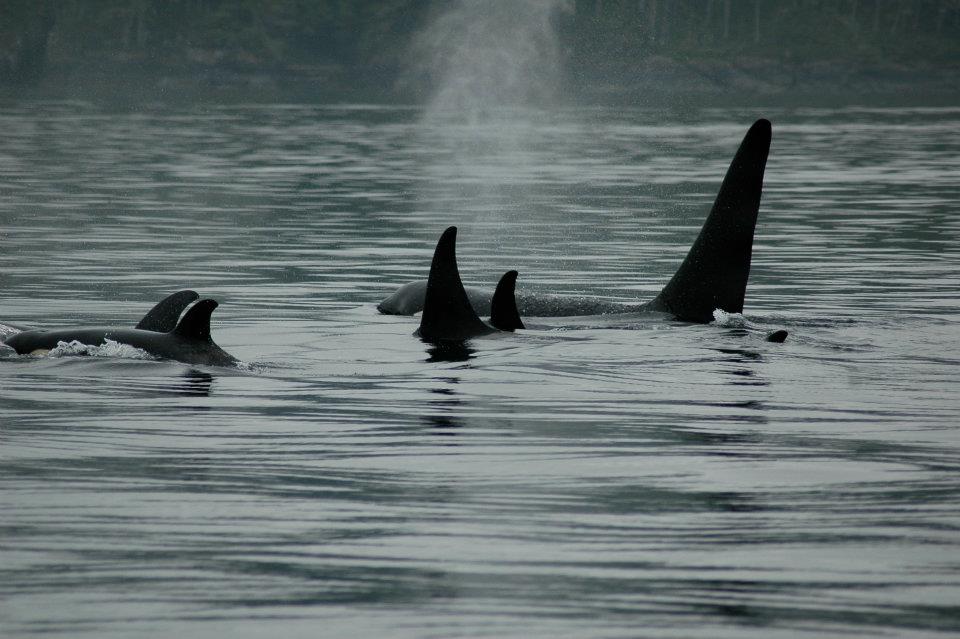
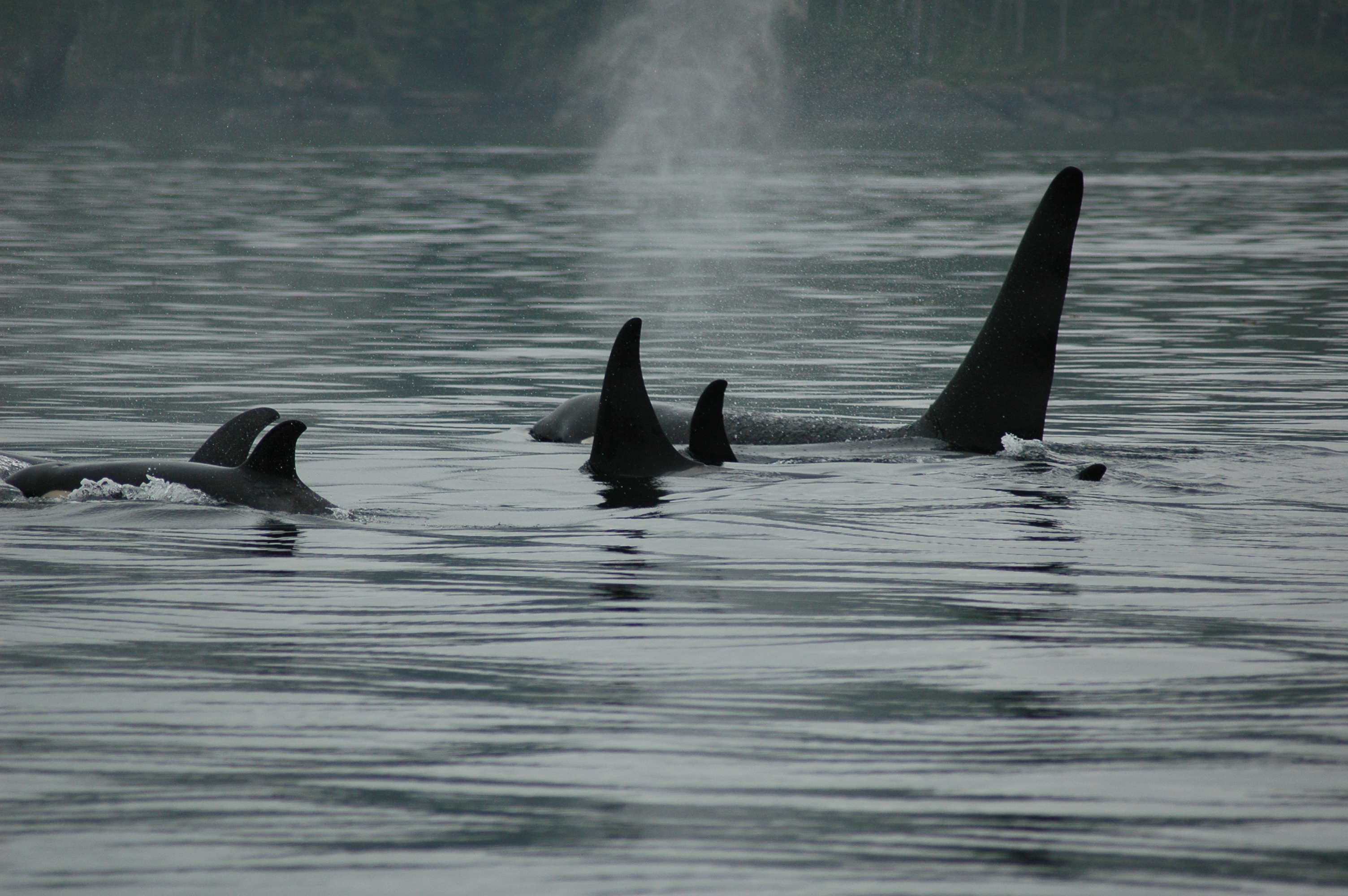
While parked within photo range of a herring ball it is important to remember that humpback whales have and excellent sense of their environment. They will surface close to the boat but they are aware that you are in the area. The other important point is not to be moving while you are waiting or the whales will not know your position. In this case the whale was close enough that it was impossible to focus the camera and those with long lenses were lost. The June 5th posting is a much better distance.
Every day on the whale watching safari trips that leave Grizzly Bear Lodge is different. On the day of this picture we were sitting several hundred meters (yards) off shore as a pod of orca were passing. The whale watching guidelines specify that you are to be two hundred meters from the shore if whales are in shore of your boat or one hundred meters in open water. The regulations are in force by an organization known as Strait Watch and on this day they were less than seventy-five meters behind our boat. One of the whales in the pod turned from the shore and surfaced beside our boat, swam around the boat and then under the boat and resurfaced on the other side. Strait Watch came over after the orca had moved on and were interested in our pictures, they thought that the orca was fishing under the boat and became curious as dolphins are by nature interested in their surroundings. The reason is not as important as the great pictures.
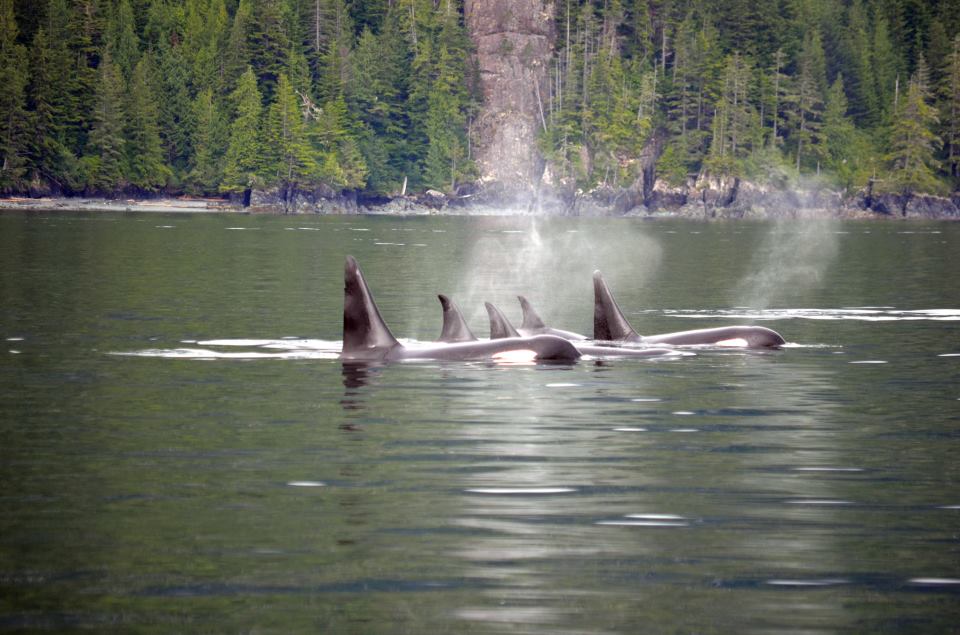
A pleasant morning with the orca on the lodge’s whale watching safari to Johnstone Strait. This area along the shore of Vancouver Island is the summer home to the Northern Resident killer whales. They follow the salmon into the area arriving, most years, in early June and staying until mid-October. The northern residents contain approximately 250 orca in 16 pods. It is a quite area for viewing the orca in that on most mornings there are only five or six boats in the area watching the killer whales so they tend to behave in a natural way. They are not herded about by twenty or thirty boats, as are the Southern Residents near Victoria BC.
A Wikipedia quote “When spyhopping, the whale rises and holds position partially out of the water, often exposing its entire rostrum and head, and is visually akin to a human treading water. Spyhopping is controlled and slow, and can last for minutes at a time if the whale is sufficiently inquisitive about whatever (or whomever) it is viewing. Generally, the whale does not appear to swim to maintain its “elevated” position while spyhopping, instead relying on exceptional buoyancy control and positioning with pectoral fins. Typically the whale’s eyes will be slightly above or below the surface of the water, enabling it to see whatever is nearby on the surface. Spyhopping often occurs during a “mugging” situation, where the focus of a whale’s attention is on a boat rather than on other nearby whales. Spyhopping among orcas may be to view prey species. For this a spyhop may be more useful than a breach, because the view is held steady for a longer period of time.” And thanks to James and Wendy Kastelein for the great photo.
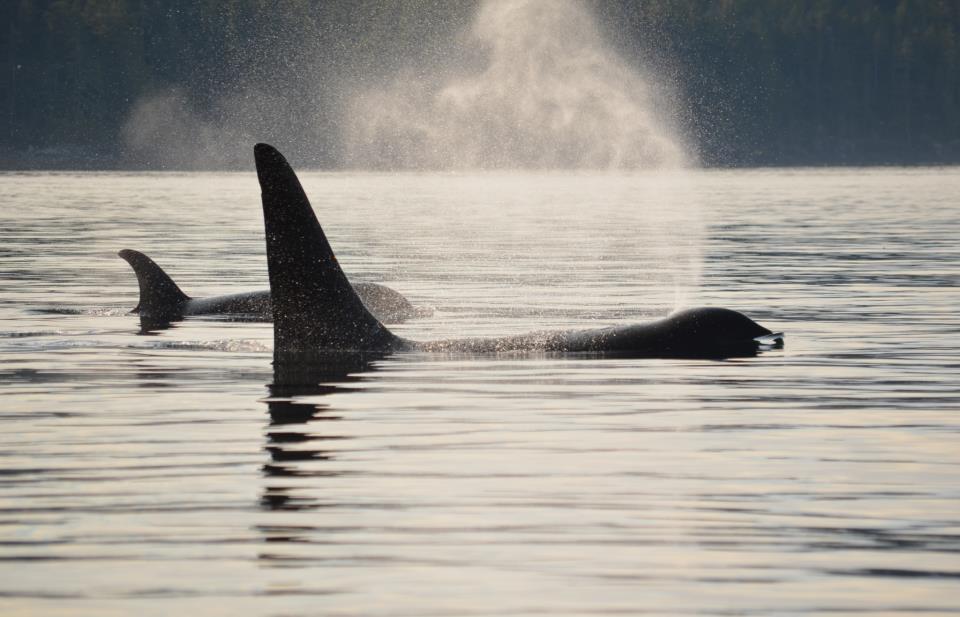
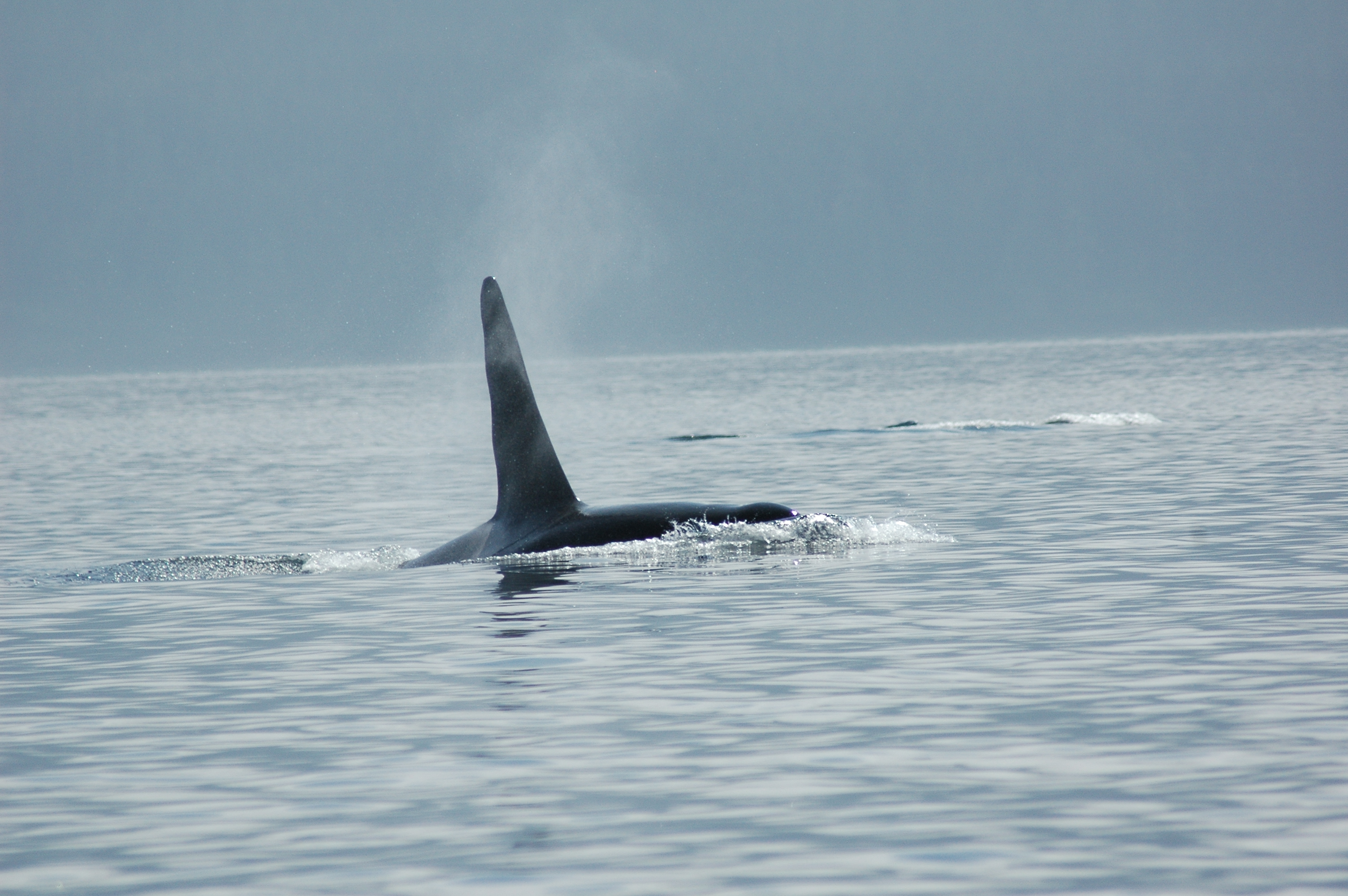
Alfred Bittner provides a great photo that I call “Follow the leader”. Take a close look and there is a tip of a dorsal fin just in front of this large male killer whale. Also an excellent photo as this is how an orca is identified using a picture of the right side of the orca showing its dorsal fin and the saddle patch. All the resident orcas on the BC coast are in two groups either the Northern or Southern Residents. The website: http://wildwhales.org/killer-whale/ provides the following: “The southern resident community consists of one clan (J clan) and 3 pods (J, K and L pods) and number only around 86 animals. They are most commonly seen in the waters around Victoria and the San Juan Islands in the summer, although they may range north to Desolation Sound and as far south as California in the winter months. Southern resident killer whales are critically endangered, due to their small population size, reliance on endangered or threatened salmon runs for prey, high toxin loads and sensitivity to boat disturbance.
The northern resident community consists of 3 clans (A, G and R) and numerous pods within each clan. It numbers around 250 animals. Northern residents are most commonly seen in the waters around the northern end of Vancouver Island, and in sheltered inlets along B.C.’s Central and North Coasts. They also range northward into Southeast Alaska in the winter months. Northern resident killer whales are also threatened by the same factors as southern residents.”
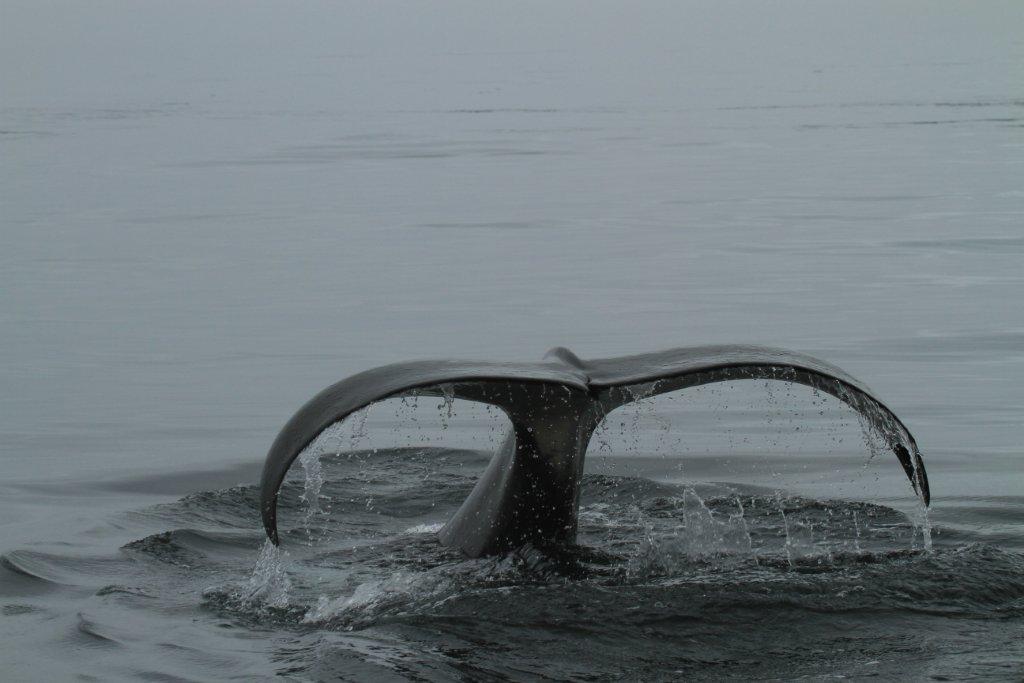
April and Rob White of Australia provide this unique series of photos from their visit to Grizzly Bear Lodge. It is a set of six photos of, which of choose three to make it interesting. This is the best set that I have viewed in my ten years as a guide for the lodge. It is known that humpback whales are identified by the markings on the underside of their tail. The key to this sequence is the first photo and the tip of the dorsal fin, which is visible in the water in front of the tail. This fin is about two meter (six feet) tall and belongs to an orca or killer whale. This orca passed beneath our boat and surfaced about five meters away and then dove and Rob manage to obtain a very unique set of photos.
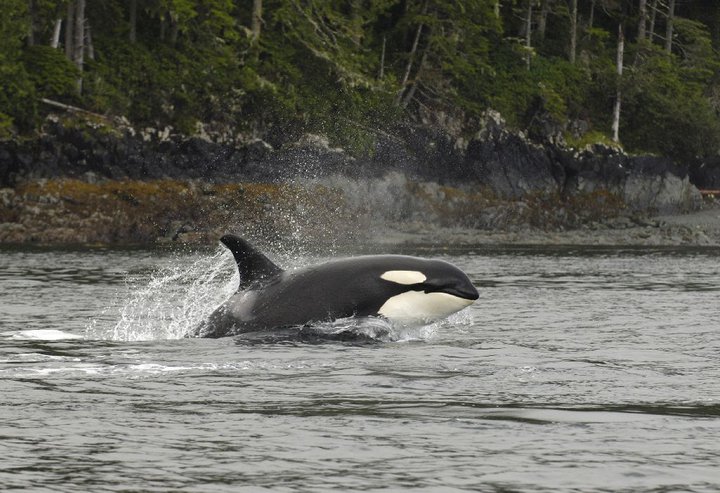
As this photo taken, on a whale watching tour shows orca has a very distinctive coloring. While these markings are beautiful, they do have a very important purpose. The quote from “The Orca Ocean” website is a good explanation. “The first thing the orca’s markings do is to help break up their shape in the water. This is known as Disruptive Coloring. Close up the orca is quite visible in the water. However, when the orca gets further away, the white spots help to make the orca look like a collection of smaller animals, thus fooling their prey. Another bit in fooling their prey the eye patch. Animals that are being attack will instinctively go for the eyes. Sharks protect their eyes from seals and sea lions with membranes that come up and cover the eye. Orcas, however, have the large eye patch that the prey will focus on and therefore leave the actual eye unharmed. The other purposes the coloring on a killer whale is what is known as Counter Shading. Counter shading is a form of camouflage. What it does is simple: When an orca is swimming above their prey and the prey looks up the orca’s white patches will blend in with the light shinning down from the surface. Aforesaid, the black patches that remain fool the prey in to believing the orca is a collection of smaller animals. The counter shading also works when the orca is swimming below the prey. The animal will look down and see only hints of white and a black back that blends with the dark waters.”
Killer whales live in tight-knit families or pods, which are matriarchal family groups. Animals born into a pod stay in the pod their entire lives. Each matriline often contains three or more generations. The head female or matriarch leads the pod, as orcas are a female dominated species. The matriarch tends to be the oldest female in the extended family. Her experience and knowledge guides the pod, and the matriarch teaches younger dolphins about everything from parenting skills, feeding tactics, and navigation through the vast territories that they cover.
Orcas have long life expectancies, 60 to 80 years for females and 40-60 years for the males. Females have the ability to reproduce as early as 14 years of age, but it is more common to see a female first calf at around 17 to 18 years old. Males reach sexual maturity between the ages of 17 and 20, but DNA research has revealed that older males are more successful. An orca gestation period averages 16 to 18 months.
Whether it is a single large male killer whale or a family pod the feeling is always the same, excitement. A whale watching safari from Grizzly Bear Lodge offers this excitement which may come from viewing orca, humpback whales lunge feeding, Steller sealions, harbour seals, dall porpoise, pacific white-sided dolphins or bald eagles. The variety of marine life in the area of Johnstone Strait between Vancouver Island and mainland British Columbia is astounding and mostly due to the abundance of herring. Herring are the food of the humpback whales, dolphins, porpoise and salmon. The salmon then become the food for the orca, seals and eagles.
After leaving the sea lions and entering Blackfish Sound the orca we saw earlier in the day appeared this time in the sunshine. Blackfish Sound is an appropriate name for this area as that is the name used by the locals and the only name I knew growing up for what are now called killer whales and orca. Names the result of advertising for tourism. The name is not really important what is important is the majestic appearance of these mammals and the thrill obtained with the first sighting on a tour.
Just like that another season has come to an end. We are grateful for all the wonderful staff and the guests this season. It was an excellent season and we are already looking forward to next May.
One of the highlights of the season was all of the new cubs out. It was awesome to see so many new cubs of the year and that is great news for our bear populations moving forward. We had great spring viewing and this continued through summer. On our river trips we started to see salmon arriving in August and enjoyed some great shoulder season viewing. The fish at the viewing platforms were a little late showing up this year, but viewing during late September at the platforms was great and the estuary viewing remained strong throughout the season.
Out in the whale watching world it was another year that saw large numbers of resident Orca who remained in the area right into October. The Humpback viewing was also great with large numbers feeding in Blackfish Sound. It is so amazing to have these magnificent animals back in our waters in such numbers.
Over the winter and spring we will be doing some repairs and maintenance. We rebuilt the front deck last spring, utilising cedar cut on site. We will continue with some siding, rooms improvements and hopefully a floating sauna ready for the start of our season.
2026 is already looking like a very busy season for us. We only have limited high season availability so please book early to ensure we have space for your group.