Tag Archives: Whale Watching

Killer Whale Dorsal Fin

killer whale dorsal fin
Click to enlarge then click again

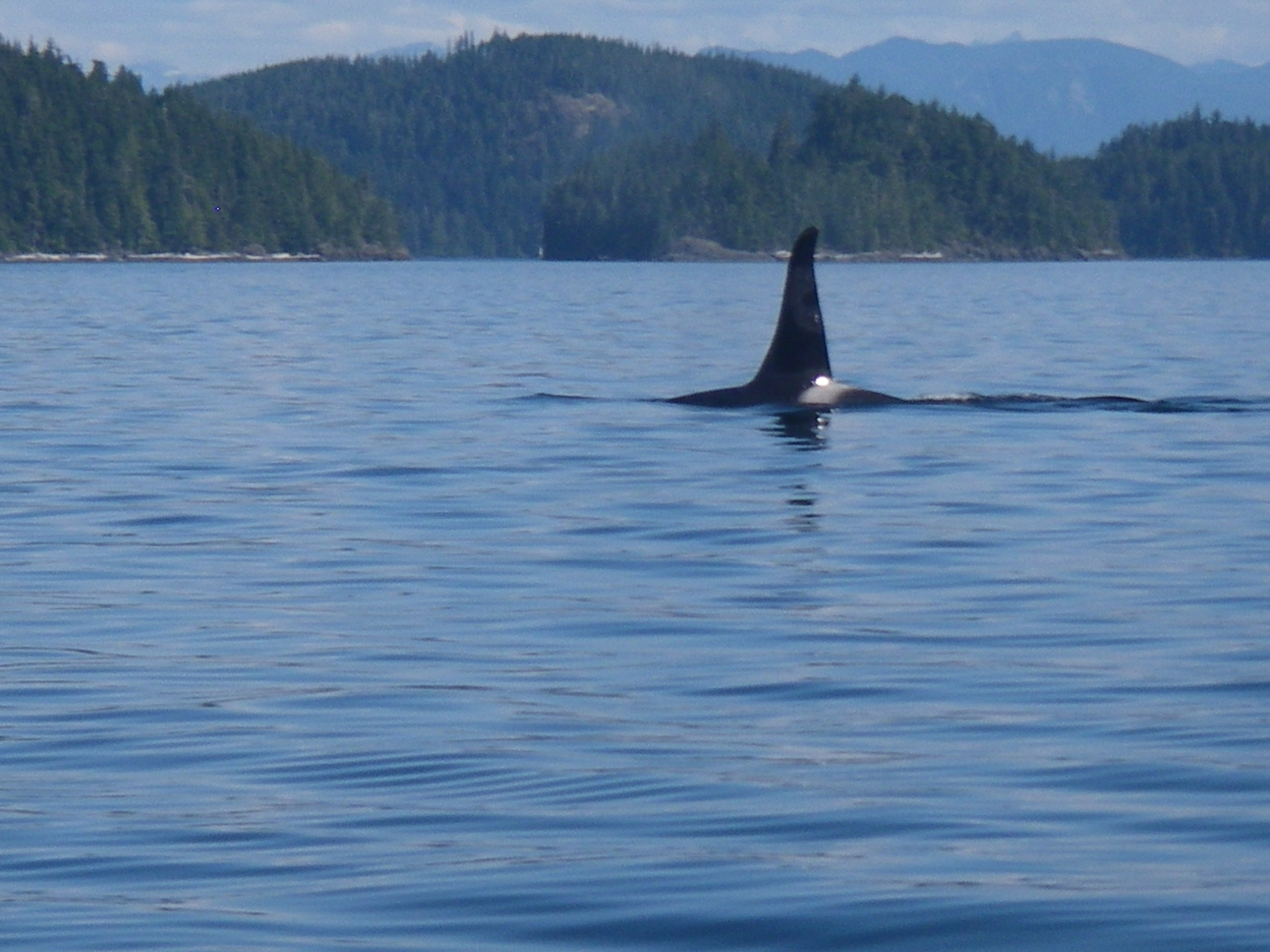
Orca, killer whales or blackfish are all the same and the residents return by late June most years. Our whale watching safaris are in the area of Johnstone Strait between Vancouver Island and the British Columbia mainland. This photo of a male orca shows a mature dorsal fin.  Following are some interesting fact about dorsal fins taken from www.seaworld.org/infobooks/killerwhale.
1.  Like the flukes, the dorsal fin is made of dense, fibrous connective tissue, with no bones.
2.  The dorsal fin acts as a keel.  The dorsal fin probably helps stabilize a killer whale as it swims at high speeds but is not essential to a whale’s stability.
3.  The dorsal fins of male killer whales are the tallest of any cetacean in the world, growing up to 1.8 m (6 ft.).  Female dorsal fins are smaller at about 0.9 to 1.2 m (3-4 ft.) and may be slightly curved back.
4.  For male killer whales, dorsal fin growth is thought to be a secondary sexual characteristic as peak growth of the fin coincides approximately with the onset of sexual maturity.
5.  Because of the huge diversity of killer whale dorsal fins and the adjacent saddle patch, researchers take pictures of these fins to identify individuals and their pods, much like fingerprints are taken to identify humans.
Andreas & Steffi Tacke, Germany – 4

tel slapping whale
Click to enlarge then click again

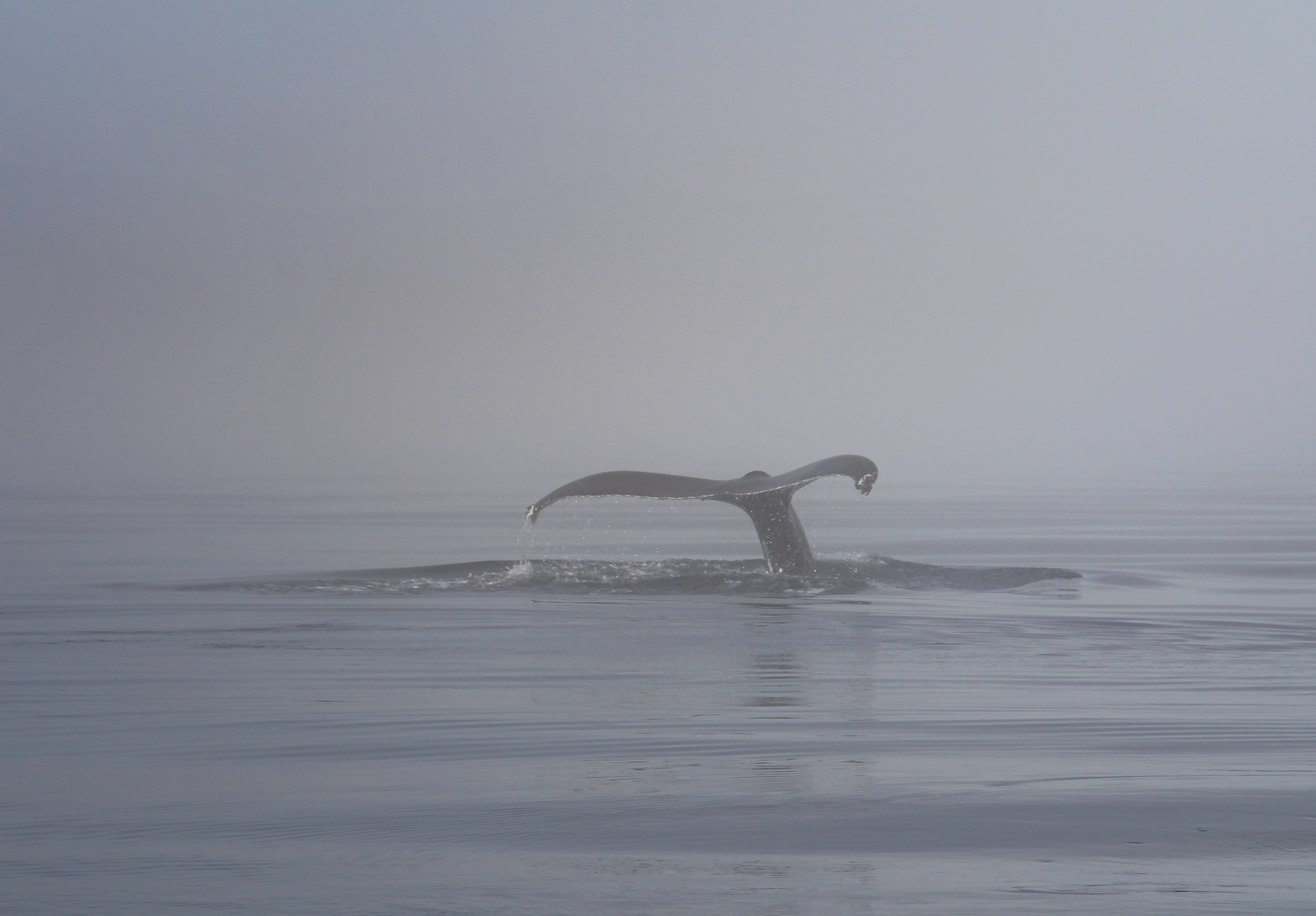
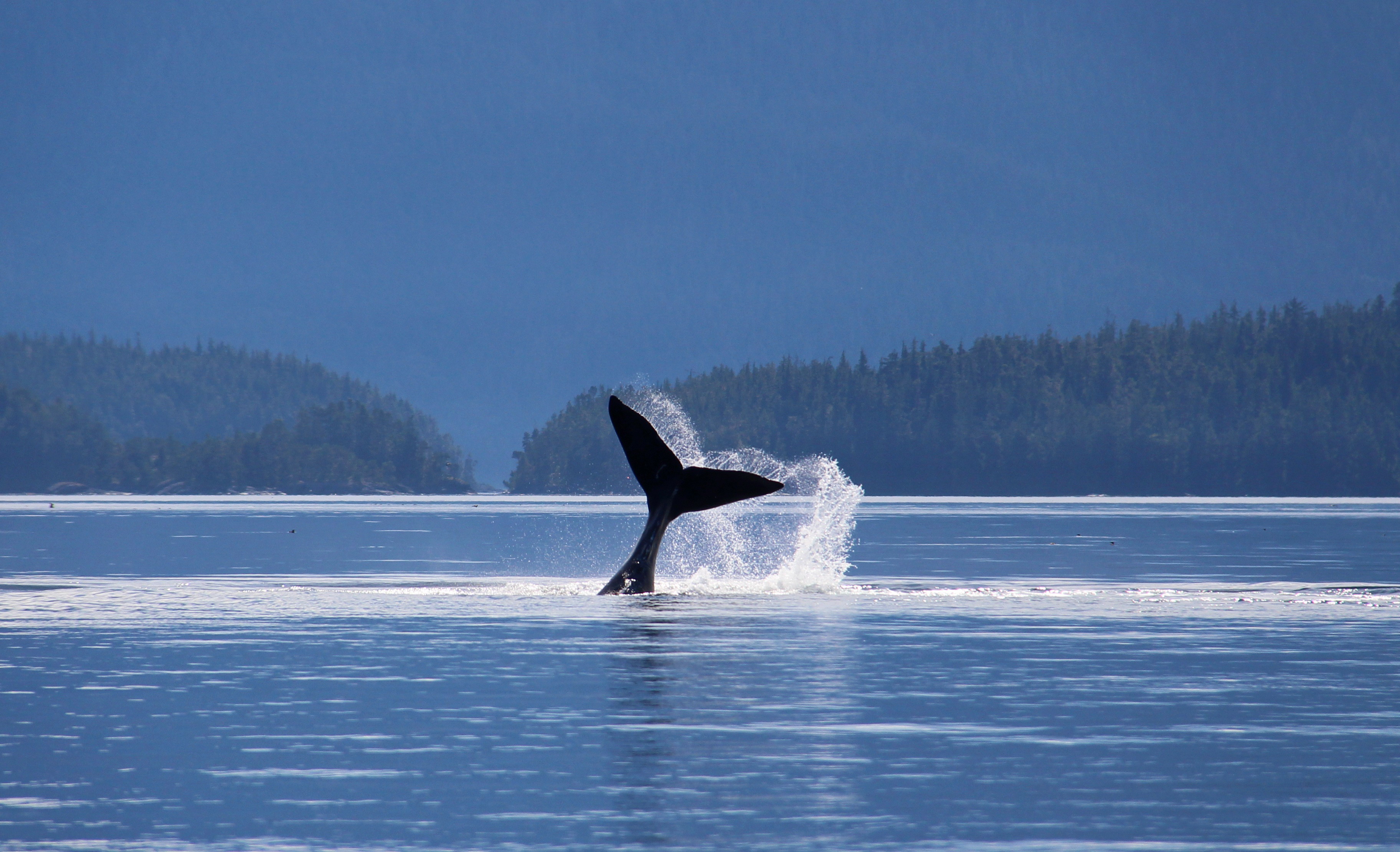
This photo taken an hour earlier than yesterday’s post shows a humpback whale fluking or lobtailing. Lobtailing is the act of a whale lifting its fluke out of the water and then bringing it down onto the surface of the water hard and fast in order to make a loud slap. Large whales tend to lobtail by positioning themselves vertically downwards into the water and then slapping the surface by bending the tail stock.  They are likely to slap several times in a single session. The sound of a lobtail can be heard underwater several hundred metres from the site of a slap. This has led to speculation amongst scientists that lobtailing is, like breaching, a form of non-vocal communication. Also some suggest that lobtailing in humpback whales is a means of foraging. The hypothesis is that the loud noise causes herring to become frightened, thus tightening their school together, making it easier for the humpback to feed on them.

Andreas & Steffi Tacke, Germany – 3

tail lobbing whale
Click to enlarge then click again

Whale watching safaris from the lodge this summer saw allot of activity from the humpback whales. Most days there were more than a dozen whales in the area of Bold Head on Blackfish Sound which is adjacent to Johnstone Strait and Vancouver Island on BC’s coast. There were two families of mother and calf in the area and the calves were very active. In this photo the calf was quite close and spent time throwing it’s back half of its body sideways out of the water. It would come up with it’s upper body part way out of the water and then throw it’s back half up and to the side.  This was a repeat performance going on for the better part of five minutes with a rest and then trying again.  From my searching scientists aren’t sure if this breaching behaviour serves some purpose, such as cleaning pests from the whale’s skin, or whether whales simply do it for fun.

Andreas & Steffi Tacke, Germany – 1

foggy whale watching
Click to enlarge then click again

Fog is always a challenge for a guide.  The first being able to locate the whales which is the easiest to overcome because the humpback whales are normally in the area of Bold Head (the northern end of Swanson Island not far from Vancouver Island) about a fifty minute boat ride from our lodge. GPS have made that part much easier. The harder part once the whales are located in the fog is to find them.  They can be easily heard but when there are many whales blowing or breathing it is hard to choose the correct direction and once the whale is in site even hared to be behind for a good photo. In this case it all work out but my motto has always been: “Luck is better than skill any day.”

Alica Goldston Taylor

perefect humpback lunge
Click to enlarge then click again

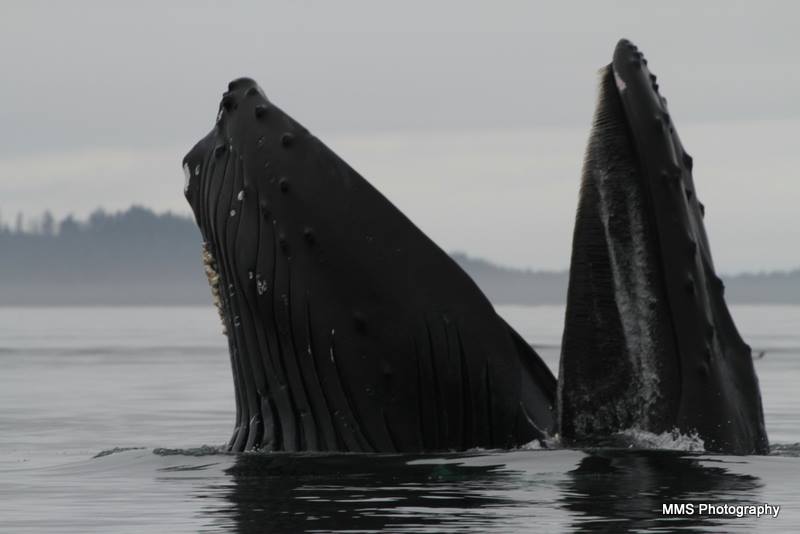
An incredible photo of a Humpback whale lunge feeding up through a ball of herring. As the photo shows these whales have throat groves that run from chin to navel. The grooves allow the throat to expand and take in large volumes of water and food into the mouth. As the mouth closes the whale presses down with its tongue forcing all water out through baleen plates. The photo shows that the baleen plates hang in row from each side of the upper jaw. Baleen is made of a similar protein to the human fingernail; they are very strong and flexible.

Orca dorsal fin height

pair of killer whales
Click to enlarge then click again

The whale watching safaris from Grizzly Bear Lodge has a good chance of finding resident orca or killer whales.  The resident orca is the fish eaters while the transient orca are the male eaters and are less common in the summer.  This photo demonstrates the difference in size of the dorsal fins between a male and female orca. The males fin can be up to two meters (six feet) while the females are often less than half the height.

Steller sea lion haul-out

sealions on rocks
Click to enlarge then click again

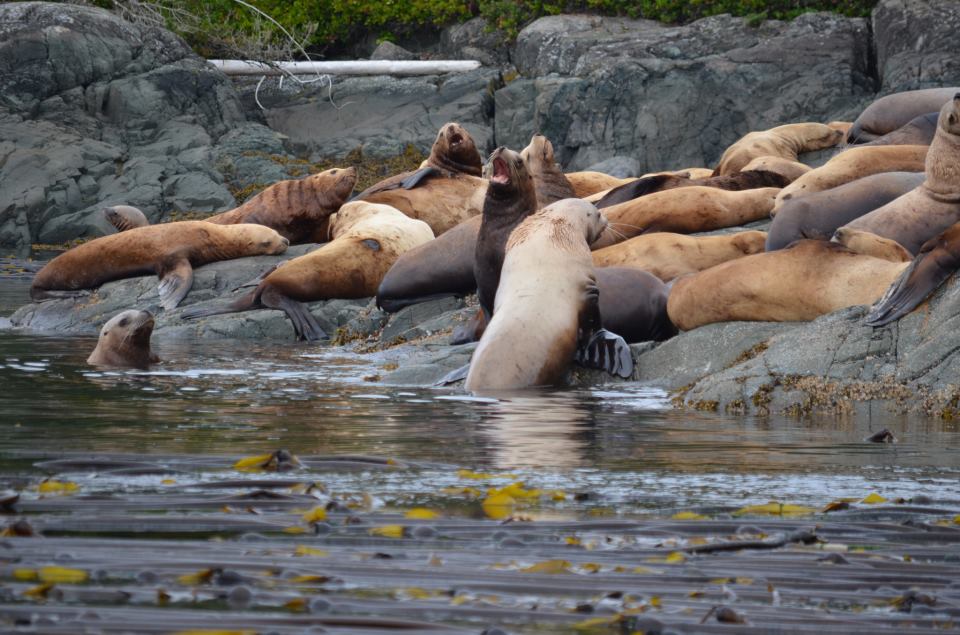
Steller sea lions use land habitat as haul-out sites for periods of rest, molting, and as rookeries for mating and pupping during the breeding season. In this case it is a resting area as they migrate along the coast spending part of their spring and fall in the area where we watch whales. Steller sea lions have been known to migrate large distances (>400 nm) but it is presumed their routes remain coastal. They are solitary hunters but are often seen small groups, but may gather in large “rafts” at the surface near rookeries and haul outs. The haul-pouts are a noisy area as they are capable of powerful vocalizations that are accompanied by a vertical head bobbing motion by males.

Orca listening to hydrophone

orca comong
Click to enlarge then click again

Although the weather does not look the best it was one of the most interesting experiences of my summer. It was a foggy morning and thus a challenge to find the orca but the whale watching companies work together and being the faster boat on the water we were able to find the orca first. As they came out of the fog we had a hydrophone in the water listening to their calls to help locate them.  Two orcas came very close to the boat and stayed on the surface as the calls came over the speaker. These two remained in position for several minutes and did not go back down until the calls stopped. Orcas are members of the dolphin family and at times their curiosity is amazing. Note: as normal the fog lifted by noon and we were able to enjoy an afternoon with humpback whales.

Humpback Lunge feed

open mouth humpback
Click to enlarge then click again

Humpback lunging

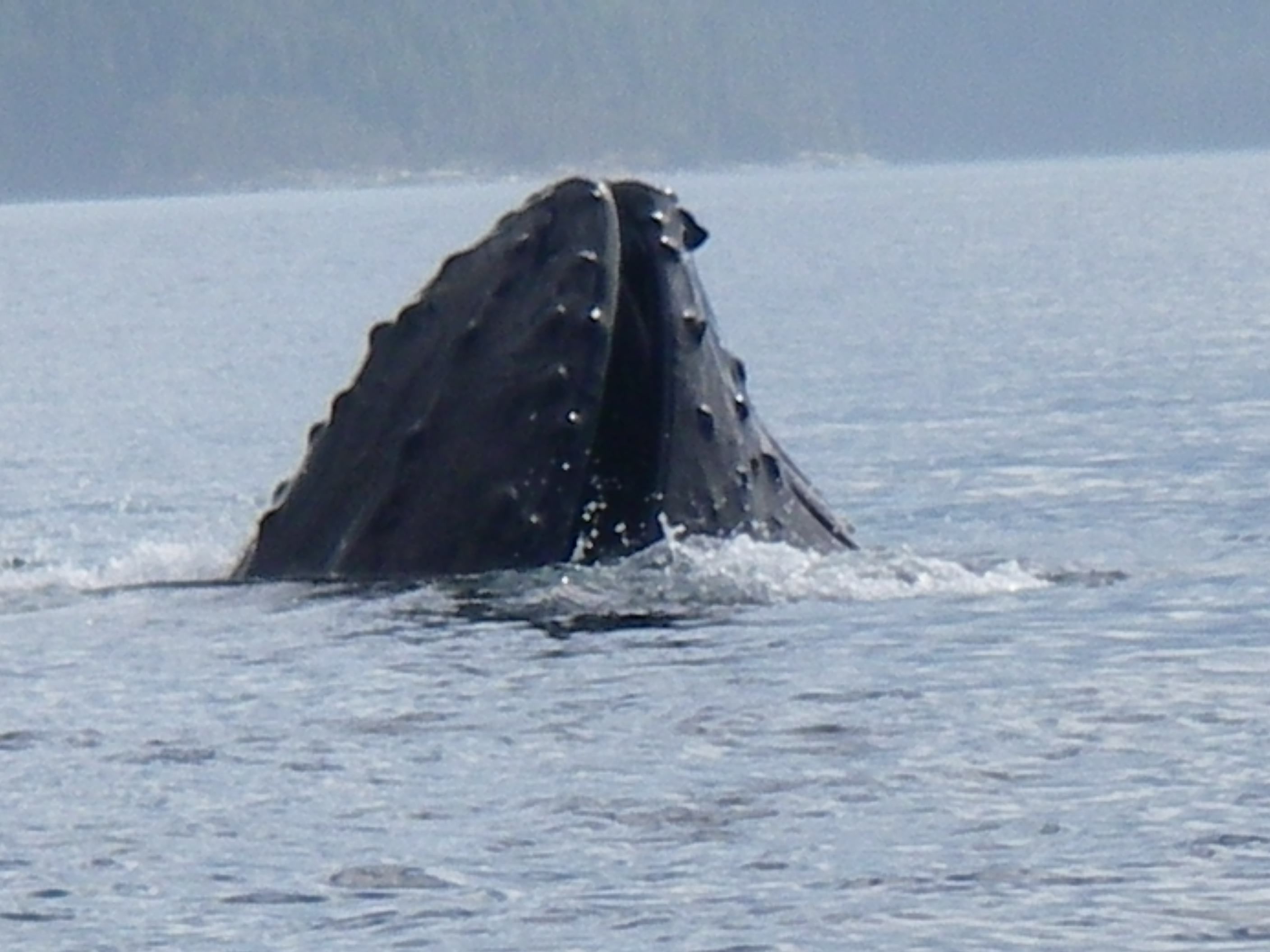
Whale watching tours from Grizzly Bear Lodge were fortunate to view many humpback whales this summer. Most trips encounter ten or twelve different whales and some days up to twenty whales. Most days we were able to watch them lunge feed on the schools of herring.  These two photos show a whale coming straight up with mouth open, pausing for a few seconds before closing it’s mouth which was full of herring. Notice the back of the boat in the first photo that was a guided fishing charter out of Telegraph Cove on Vancouver Island.

Pacific White-sided Dolphins

dolphins on tour
Click to enlarge then click again

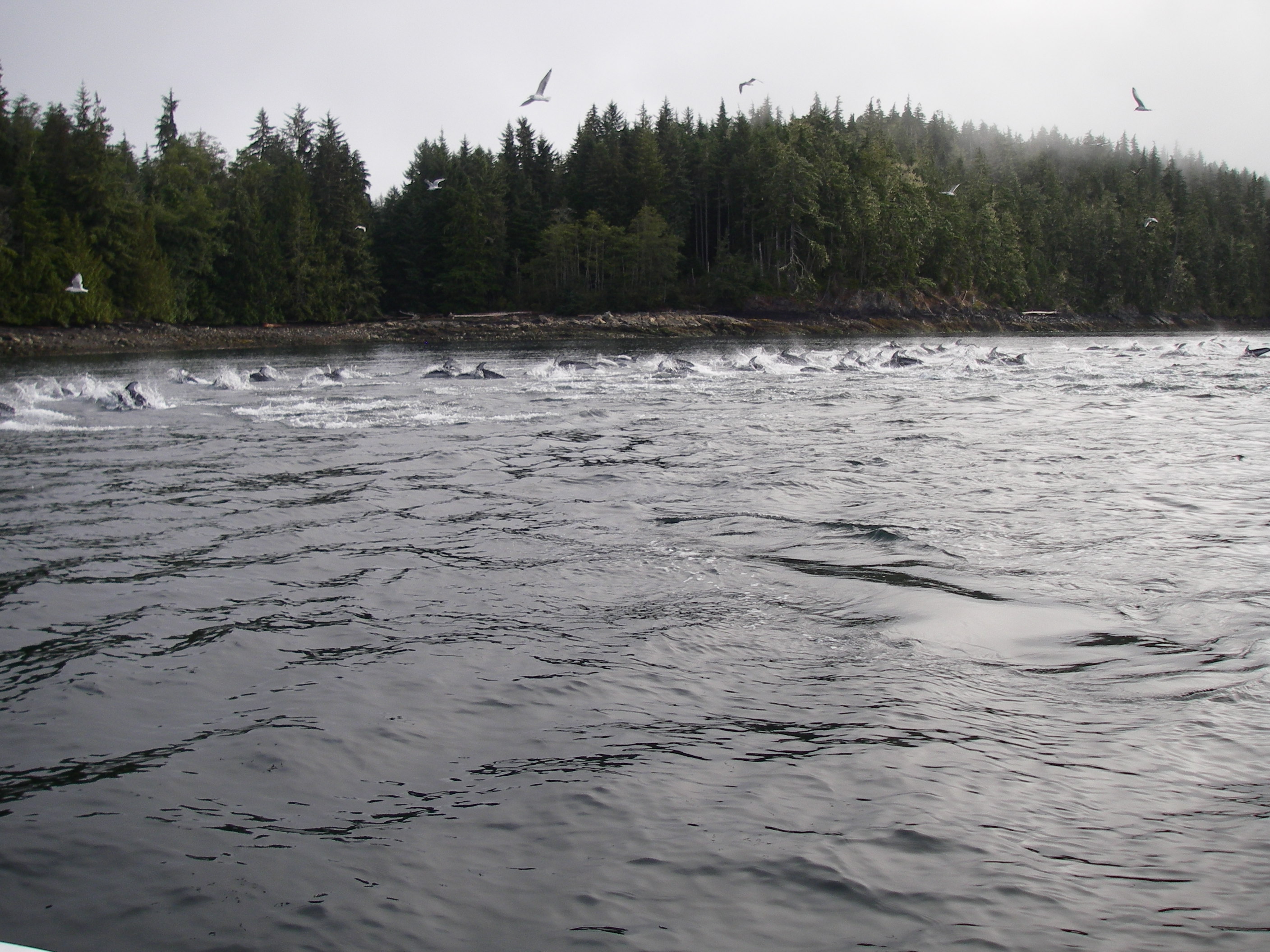
“In British Columbia, Pacific white-sided dolphins move inshore/offshore throughout the year. Pacific white-sided dolphins are opportunistic predators feeding on over 60 species of fish and 20 species of cephalopods (octopuses, squid, and cuttlefish etc.). In BC, they feed on at least 13 different prey species, including salmon, herring, Pollock, shrimp, sablefish, smelt, and squid.  They forage cooperatively, though large groups may separate into smaller sub-groups for foraging purposes.  These feeding groups have been observed corralling and herding fish in a coordinated fashion.” Quote from Wild Whales b.c. cetacean sightings network website.  
This photo is of dolphins forging activity that we followed as they worked through a large bay (Parsons Bay) adjacent to Johnstone Strait.  There were at least three hundred dolphins that would churn the water in an area then stop and eat before rushing through another area. We observed them for about forty-five minutes.